
What is the rhyme?
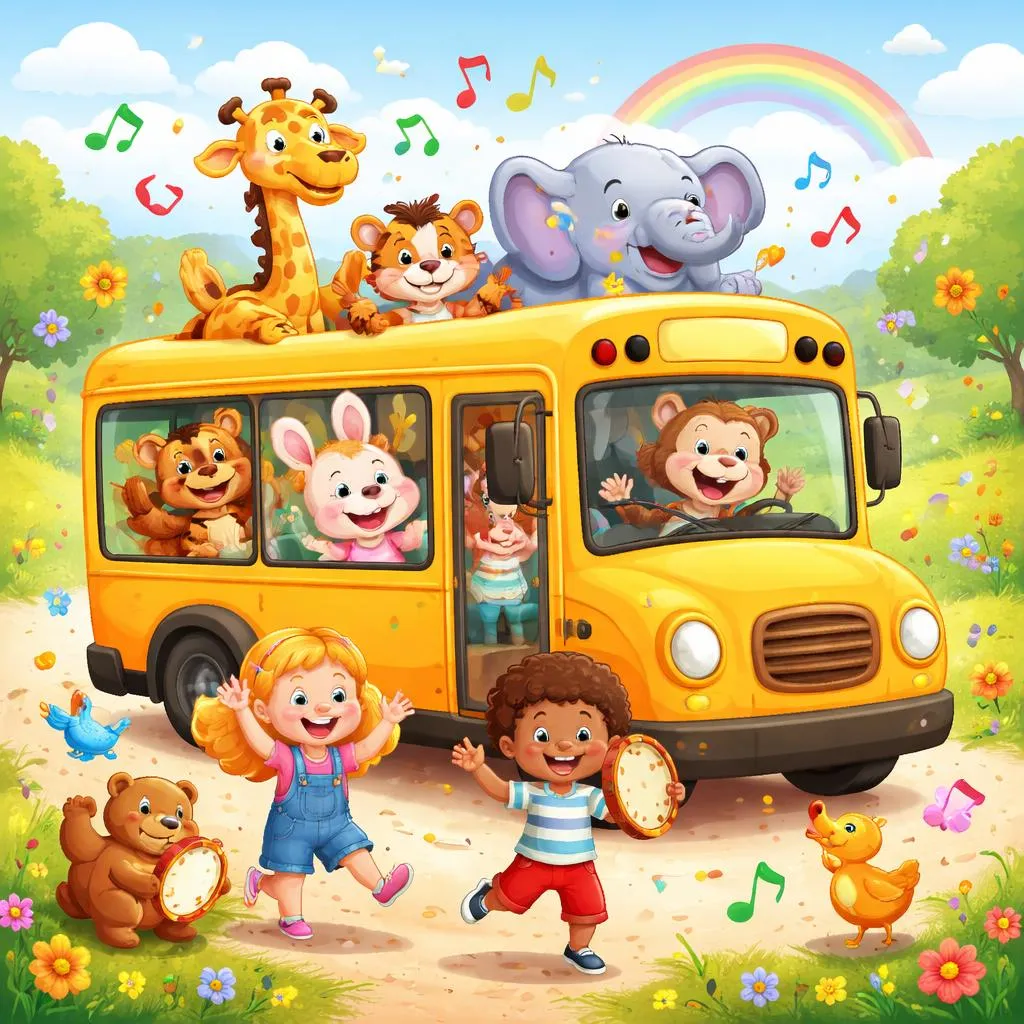
“Wheels on the Bus with Animals” is a creative variation of the classic song “The Wheels on the Bus.” This version adds animal characters into the familiar bus journey.
Teachers often use this adapted rhyme to connect animal vocabulary with movement, sound effects, and simple sentence patterns.
The structure remains repetitive and rhythmic. This makes it ideal for early English learners who benefit from predictable patterns.
The animal version also supports imagination. It turns a simple bus ride into a playful story world.
The lyrics of nursery rhymes
The traditional structure follows the repetitive pattern:
“The wheels on the bus go round and round.”
In the animal version, animals join the ride. For example:
“The dog on the bus says woof woof woof.” “The cat on the bus says meow meow meow.” “The cow on the bus says moo moo moo.”
Each verse follows the same rhythm. Only the animal and sound change.
This predictable format helps learners anticipate language. It also supports memory and pronunciation practice.
Teachers often encourage singing with gestures. Gestures reinforce meaning and keep attention high.
Vocabulary learning
This rhyme introduces key vocabulary in three main areas.
Animals
Common animals appear in the song. Dog, cat, cow, duck, sheep, bird, and horse are typical examples.
Each animal connects to a sound. This strengthens word–sound association.
Transportation
The word “bus” becomes a core topic. Learners also hear “wheels,” “doors,” “windows,” and “driver.”
These words connect to daily life experiences. Many learners have seen or ridden a bus.
Action verbs
Verbs appear through sound patterns and movement. Go, say, open, close, and drive appear naturally in classroom discussion.
Teachers can expand with gestures like “go round,” “open,” and “shut.”
Phonics points
This rhyme supports early phonics development in multiple ways.
Initial sounds
Animal names introduce clear consonant sounds. Dog /d/, Cat /k/, Cow /k/, Duck /d/, Sheep /ʃ/, Bird /b/.
Teachers can isolate the first sound and model pronunciation slowly.
Onomatopoeia
Animal sounds provide natural phonetic practice. “Woof,” “meow,” “moo,” “quack,” and “baa” are simple and fun.
These sounds help learners explore English phonics through playful repetition.
Rhythm and stress
The song uses a strong beat. Stress patterns in “Wheels on the BUS go ROUND and ROUND” become clear.
Clapping or tapping reinforces stress awareness.
Grammar patterns
The rhyme provides simple grammar patterns that are easy to model.
Pattern 1: “The + noun + on the bus”
“The dog on the bus.” “The cat on the bus.”
This pattern teaches prepositions and noun phrases.
Pattern 2: “says + sound”
“The dog says woof.” “The cow says moo.”
This introduces reporting verbs in a natural way.
Pattern 3: Present simple tense
“The wheels go round and round.” “The doors open and shut.”
The present simple shows habitual actions. Teachers can explain that songs often use this tense to describe repeated actions.
Learning activities
Teachers can use this rhyme in structured classroom activities.
Singing with actions
Model gestures for wheels, doors, and animals. Encourage whole-body movement.
Movement increases retention and motivation.
Animal role-play
Assign each learner an animal role. Sing verses and let learners make the correct sound.
This encourages speaking without pressure.
Picture sequencing
Show pictures of animals on a bus. Ask learners to place them in order as the song progresses.
This builds listening comprehension.
Sentence building
Write frames on the board: “The ___ on the bus says ___.”
Learners fill in animal names and sounds.
Printable materials
Teachers can prepare printable learning materials to reinforce the rhyme.
Flashcards
Create animal flashcards with pictures and words. Include sound words on separate cards.
Mini song book
Print simple lyrics with pictures. Learners can color and read along.
Worksheet
Include matching exercises. Match animal pictures with sounds and words.
Cut-and-paste bus craft
Provide a bus template. Learners cut out animals and place them inside the bus.
Hands-on materials deepen understanding and engagement.
Educational games
Games transform repetition into meaningful practice.
Animal Sound Guessing Game
Play animal sounds and ask learners to identify the animal. This reinforces listening and vocabulary recall.
Musical Chairs Bus Game
Arrange chairs like a bus. When the music stops, call an animal. Learners make the animal sound while sitting.
Phonics Bingo
Create bingo cards with animal names and pictures. Call out sounds or initial letters.
Story Extension Game
Ask learners to add a new animal verse. For example: “The monkey on the bus says ooh ooh ooh.”
This supports creativity and sentence construction.
“Wheels on the Bus with Animals” integrates music, phonics, vocabulary, and grammar in a playful format. Teachers can adapt the rhyme for different proficiency levels. It suits group singing, storytelling, and literacy activities. With repetition and guided practice, learners internalize language patterns naturally and confidently.