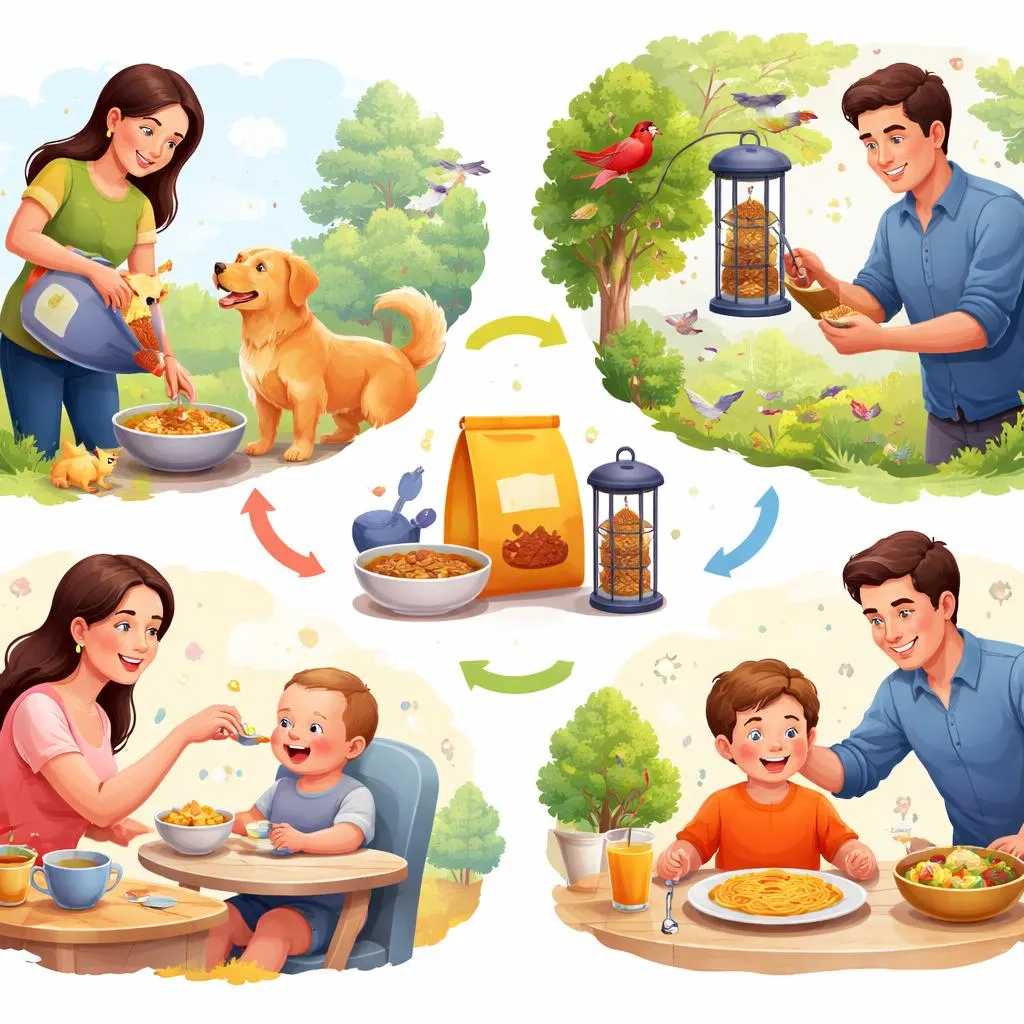

Hello, word wizard! Look at these sentences: "I feed the fish." "The fish is fed." They talk about the same idea: giving food. But they use different words. Why? It sounds a bit tricky, right? Don't worry! The words feed, feeder, feeding, and fed are a team. They are "Word Transformers". They share one core idea. But each form has a special power. Your mission is to learn their secret codes. Let's see a quick example at home.
At home, you might say: "I will feed the dog now." That's an action you will do. But you could also say: "The dog's feeder is full." That's a thing, a bowl. Or, "The dog is fed every day." That describes a routine. Which one is right? They all can be! You just need to pick the perfect "Transformer" for the job. Let's start our adventure!
Adventure! Cracking the Code of Word Forms
Welcome to the word lab! Our four "Feed Transformers" are here. Let's give them fun names. Meet Feed, the main action hero. It's the basic verb. Meet Feeder, the noun. It's a person or a thing that does the feeding. Meet Feeding, the -ing form. It shows ongoing action. Meet Fed, the past and participle form. It talks about what is finished. Let's find their differences.
Dimension One: The Time Path – When is the Action?
Words live on a timeline. Some are about now. Others are about before. Let's walk the path.
Feed: The "Now or Always" Action. This is the simple action. It happens in the present. It can be a habit. It is a general truth. Look at the "school" and "playground" time path.
School example: "We feed our class hamster every morning." This is a regular routine. It happens often.
Playground example: "Please do not feed the ducks." This is a rule for now and always. It is a general action.
Feeding: The "Right Now" Action. This word shows the action is happening at this moment. It is in progress. It's like a live video of the action.
Home example: "Mom is feeding the baby right now." The action is ongoing. It is happening as we speak.
Animal example: "Look! The bird is feeding its chicks." The action is live. We can see it now.
Fed: The "Already Done" Action. This form points to the past. The action is complete. It is finished. Sometimes, it describes a resulting state.
Home example: "I already fed the cat." The action is over. It happened earlier.
School example: "The plants were fed yesterday." The action happened in the past. A specific time is mentioned.
Dimension Two: The Role Reveal – What's Your Job in the Sentence?
Every word has a role on the "sentence stage". Is it the main action? Is it a person or thing? Or is it a description?
Feed: The Action Actor (Verb). Its main job is to show the action of giving food. It tells us what someone or something does.
Animal example: "The mother lion will feed her cubs." The word "feed" is the main action.
Playground example: "Can you feed the pretend dinosaur?" The word "feed" is the action you are asked to do.
Feeder: The Name-Tag Noun. This word is a thing or a person. It names the object or person that provides food. It is not an action.
Home example: "The bird feeder is outside my window." It is a thing, a container for bird food.
Animal example: "The hummingbird is a nectar feeder." It describes the bird's role. It is a thing that feeds on nectar.
Feeding: The Double-Role Actor. This word can have two roles. First, it can be the action in progress (verb). It often works with "is" or "was". Second, it can act like a noun. We call this a gerund.
As a verb (action): "She is feeding the rabbits." (With "is", shows ongoing action) As a noun (thing): "Feeding the pets is my job." Here, "Feeding" is the activity. It is the name of the chore.
Fed: The State or Finished Action Actor. This word also has roles. It can be the simple past tense verb. It can also be a word that describes a state, like an adjective.
As a past action (verb): "He fed the dog an hour ago." This tells a finished past event. As a state (adjective-like): "The dog seems fed and happy." Here, it describes the dog's condition now. It often follows "is", "was", "seems".
Dimension Three: The Team-Up – Who Are Its Best Friends?
Some words work alone. Others need a partner. Knowing their favorite "gear" helps us use them right.
Feed (Verb): It often takes a partner called an object. You feed someone or something. "I feed the dog." "Feed" teams with "will", "can", "do".
Feeder (Noun): It likes articles like "a", "the", or "my". "A bird feeder", "the class feeder", "my pet's feeder".
Feeding (-ing form): It almost always needs a helper verb when it's showing action. "Am/is/are feeding", "was/were feeding". As a noun, it can start a sentence. "Feeding time is fun!"
Fed (Past/Participle): It has two main teams. For simple past, it often stands alone: "I fed them." For the "state" meaning, it loves "is", "was", "has been", "seems". "The baby is fed." "The cat has been fed."
Our Discovery Map: The Word Transformer Guide
What did we find? Our map is clear. Do you want to talk about the action of giving food, either now or usually? Use the verb feed. Do you want to name the person or object that gives food? Use the noun feeder. Do you want to show the action is happening right now? Use feeding with "is" or "are". Or, do you want to use the action as the name of an activity? You can also use feeding as a noun. Do you want to talk about an action that is finished in the past? Use fed. Do you want to describe the state of having eaten? Use fed with "is" or "was". Remember their teams: feed takes an object, feeder needs "a" or "the", feeding loves "is", and fed for states loves "is" or "has been".
Challenge! Become a Word Form Master
-
Best Form Choice: Read the scene. Pick the best word. (Animal Scene) You are at a pond. A sign warns people. The action of giving bread to birds is bad for them. a) Do not be a duck feeder. b) Do not feed the ducks. Which one tells people to stop the action of giving food? (Answer: b)
-
Two-Form Sentence Showdown: (Home/Cooking Scene) Imagine helping in the kitchen. You are making dinner for your family. First, describe the action you are doing at this moment. Use the -ing form with a helper. Example: "I am feeding the vegetables into the food processor." Now, talk about a finished task from earlier. Use the past form. Example: "I already fed the sourdough starter this morning."
-
Sharp Eyes! Find the Glitch: Look at this sentence. One word form is in the wrong job. Can you fix it? (School Scene) "Our teacher says the feeding of the frog is my job last week." What's wrong? "Feeding" as a noun is okay. But "is" is present tense. The job was "last week", in the past. We need the past form. Fixed sentence: "Our teacher said the feeding of the frog was my job last week." Or, "Our teacher said feeding the frog was my job last week."
Your Takeaway and Mission! Make Your Sentences Shine
Great work, word wizard! You did it. You learned the secret powers of the Feed team. You can now choose the perfect word. Your sentences will be clear and strong.
What you can learn from this article:
You now see that feed, feeder, feeding, and fed are connected. But they are different. You learned to use "feed" for the general action. You use "feeder" to name a thing or a role. You use "is feeding" for an action happening now. You use "fed" to talk about the past. You also use "is fed" to describe a state. You found their best friends like "a", "is", and objects.
Live Practice Application:
Try this today! Look at mealtime or pet care. Describe what's happening. Say, "I am feeding the dog now." Later, say, "The dog is fed." See the difference? Watch a bird at a feeder. Tell someone, "That's a bird feeder. The bird is feeding." When you write a story, think: Is it a habit (use feed)? Is it happening now (use is feeding)? Is it over (use fed)? Pick the right word. It makes your story perfect. You are now a master of word choice. Well done