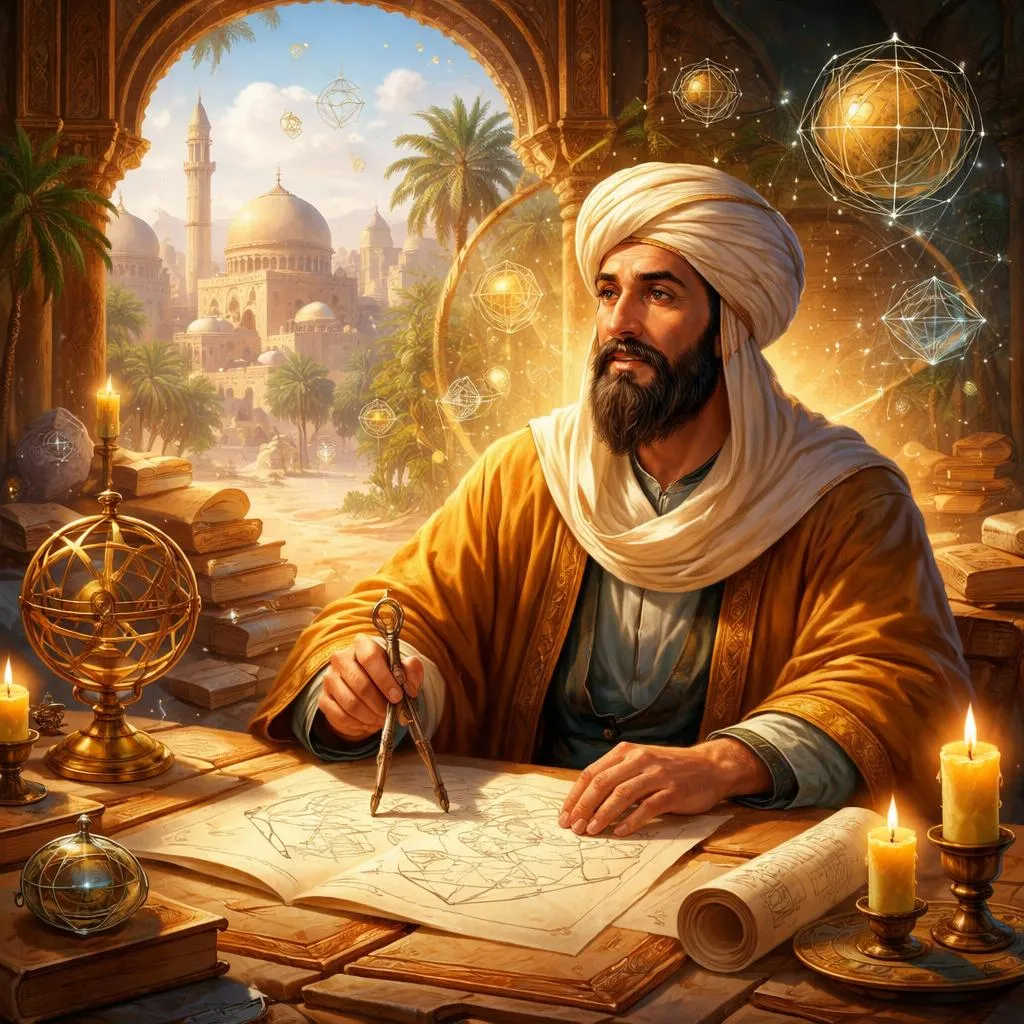

Who Is This Celebrity?
Al-Khwarizmi was a brilliant mathematician from ancient Persia. He lived over 1,200 years ago in Baghdad, Iraq. People call him the father of algebra. He also gave his name to the word "algorithm." His books taught Europe how to do modern mathematics. He created the number system we use every day. Without him, math would look completely different. His story shows how one person can change the world forever.
Early Life and Childhood
Al-Khwarizmi was born around 780 CE in Khwarazm, a region in modern-day Uzbekistan. His full name was Muhammad ibn Musa al-Khwarizmi. His family lived in a desert area near the Caspian Sea. Young Muhammad grew up surrounded by traders and travelers. He watched merchants calculate prices and distances. He loved solving puzzles and number games. He also enjoyed watching stars in the clear desert sky. His parents encouraged his curiosity about numbers and patterns. He dreamed of understanding the hidden rules of the universe. He believed that math held the answers.
Education and Learning Journey
Al-Khwarizmi traveled to Baghdad as a young man. Baghdad was the world's greatest center of learning. The caliph, or ruler, had built the House of Wisdom. This was a giant library and university. Scholars from India, Greece, Persia, and China came to study together. Al-Khwarizmi joined this community of thinkers. He learned Indian mathematics, Greek geometry, and Persian astronomy. He also studied geography, history, and translation. He read every book he could find. He translated important works from Sanskrit and Greek into Arabic. He spent years absorbing knowledge from different cultures. Then he began creating his own ideas.
How Did They Become Successful?
Al-Khwarizmi became successful by organizing messy ideas into clear systems. The caliph noticed his talent and hired him as a court scholar. He gave Al-Khwarizmi access to the best resources. The scholar traveled to India and Afghanistan to study local mathematics. He saw how Indian scholars used a number system with nine digits and a zero. This system was easier than Roman numerals. He wrote a book explaining this system to the Arab world. The book spread across Europe and changed everything. Merchants, bankers, and scientists adopted these new numbers. People called them "Arabic numerals." Al-Khwarizmi had introduced the numbers we use today.
Big Ideas and Achievements
Al-Khwarizmi's biggest achievement was inventing algebra. He wrote a book called "The Compendious Book on Calculation by Completion and Balancing." The Arabic word "al-jabr" meant completion. This word became our word "algebra." In this book, he showed how to solve equations step by step. He explained that any mathematical problem has a solution if you follow the rules. He also developed the concept of the algorithm. An algorithm is a set of steps for solving a problem. Computer programmers use algorithms every single day. He also created accurate tables for tracking the sun, moon, and planets. He helped map the known world. His geography book corrected mistakes from ancient Greek scholars.
Challenges and Difficult Times
Al-Khwarizmi faced the challenge of bringing different cultures together. Scholars from different traditions did not trust each other's ideas. Greek scholars looked down on Indian mathematics. Indian scholars thought their system was best. Al-Khwarizmi ignored these arguments. He took the best ideas from every culture. He combined Greek geometry with Indian numbers. He added Persian and Arab insights. This created something new and better. He also faced the challenge of explaining complex ideas simply. He wrote for merchants who needed practical math, not just philosophers. He used real-world examples like inheritance, trade, and land measurement. His clear writing made math accessible to ordinary people.
Fun Facts About the Celebrity
Al-Khwarizmi loved solving puzzles about inheritance. Islamic inheritance laws were very complex. He used math to figure out exactly how much each person should get. He also enjoyed measuring the size of the Earth. He calculated that the Earth's circumference was about 40,000 kilometers. His estimate was incredibly accurate for his time. He never ate lunch, only breakfast and dinner. He said eating at noon made his mind sleepy. He also loved playing a game similar to chess. He designed math problems based on chess moves. He kept a large collection of maps in his study. He added corrections to each map based on his own travels. He also wrote poetry about numbers and equations.
Why Is This Celebrity Important Today?
Al-Khwarizmi's influence appears everywhere in modern life. Every time you solve for x in algebra class, you use his methods. Every time a computer follows a set of instructions, it uses an algorithm. His name gave us that word. Every time you see the number zero, thank his book. Every time you look at a clock or a calendar, his astronomical tables helped make it accurate. His work built a bridge between ancient and modern mathematics. He showed that different cultures can learn from each other. The algorithms he invented now guide self-driving cars and search engines. His algebra helps architects build bridges and rockets reach space.
What Can Kids Learn from This Story?
You can learn that math is a universal language. Al-Khwarizmi combined ideas from India, Greece, and Persia. You can also learn to explain things clearly. He wrote for everyone, not just experts. You can learn that simple steps solve complex problems. That is the heart of algebra and algorithms. You can learn to look for patterns in nature. He found mathematical rules in stars and rivers. You can also learn that your name can become part of history. His name became the word "algorithm." What will your name become?
Quick Quiz or Practice Time
Let's see what you remember about Al-Khwarizmi.
Question 1: What two English words come from Al-Khwarizmi's name and work?
Answer: Algebra (from al-jabr) and algorithm (from his name Al-Khwarizmi).
Question 2: What number system did Al-Khwarizmi introduce to Europe?
Answer: Arabic numerals, including the number zero.
Question 3: What was the name of the great library and university in Baghdad?
Answer: The House of Wisdom.
Question 4: What did Al-Khwarizmi use math to calculate about the Earth?
Answer: Its circumference (about 40,000 kilometers).
Question 5: What did Al-Khwarizmi never eat because it made his mind sleepy?
Answer: Lunch.
Activity: Write down a simple algorithm for making a peanut butter sandwich. List each step in order. This is just like the steps Al-Khwarizmi wrote for solving math problems. Share your algorithm with a family member.
Al-Khwarizmi lived over 1,200 years ago in a desert empire. He had no computers, no calculators, no internet. He had only paper, a pen, and his brilliant mind. He looked at the stars and saw patterns. He looked at numbers and saw rules. He looked at different cultures and saw connections. Then he wrote everything down. He wrote so clearly that people still read his books today. He wrote so usefully that his methods never went away. Algebra class might feel hard sometimes. But remember Al-Khwarizmi. He created algebra so people could solve real problems. He wanted math to help farmers divide land. He wanted math to help merchants calculate profit. He wanted math to help astronomers predict the seasons. He never meant for math to be scary. He meant for math to be a tool. A beautiful, logical, powerful tool. Now that tool is in your hands. Use it well. Solve problems. Find patterns. Ask questions. And remember the man from the desert who gave us the language of math. His name was Al-Khwarizmi. Now go solve for x.