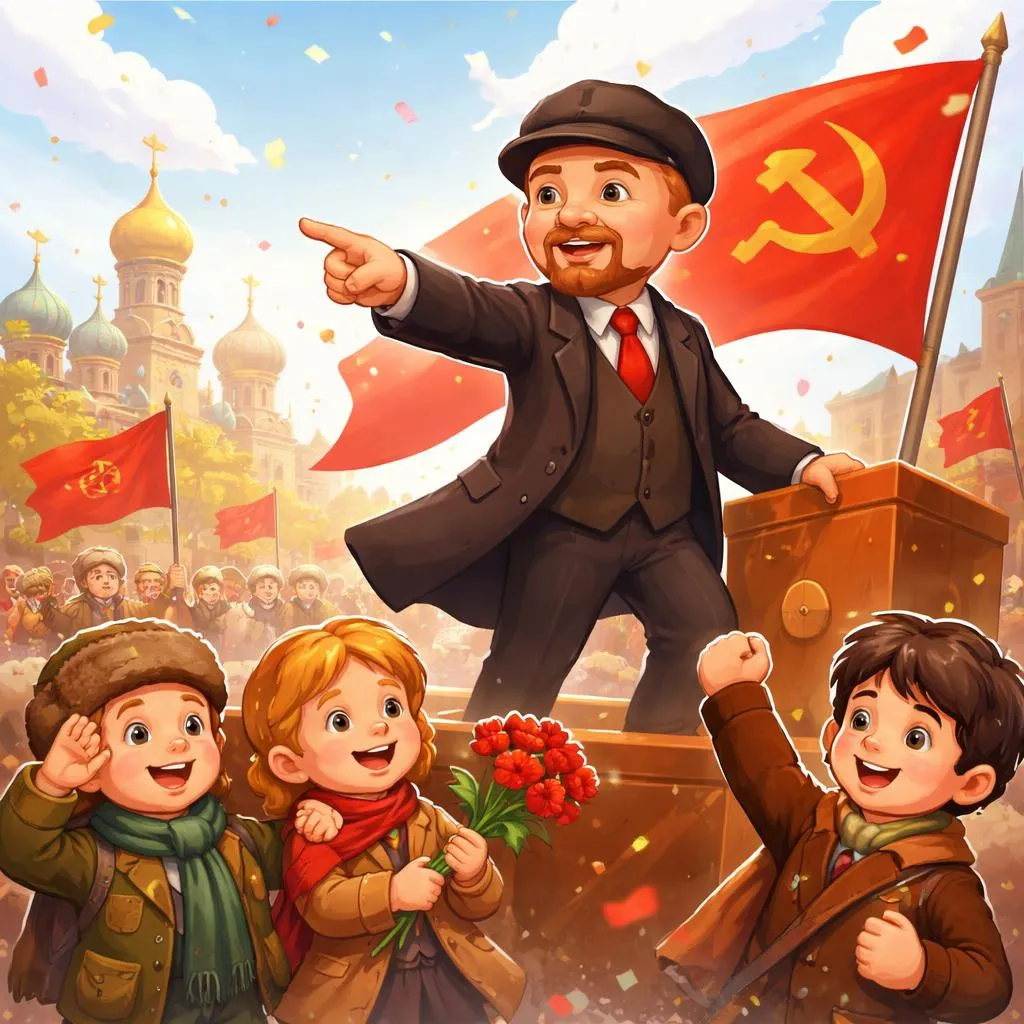

Who Is This Celebrity?
Vladimir Lenin was a revolutionary and political leader. He led the Bolshevik Revolution that overthrew the Russian government. He created the world's first communist state.
This celebrity story follows a man who believed that workers should own everything. Lenin spent years in exile and prison. He never stopped planning the revolution.
Kids who wonder how big changes happen will find his story fascinating. Lenin showed that a small group of dedicated people can change a huge country. He turned an empire into the Soviet Union.
Some people call him a hero. Others call him a villain. Everyone agrees he changed history. His ideas influenced billions of people around the world.
Early Life and Childhood
Vladimir Lenin was born in 1870. He was born in Simbirsk, a city on the Volga River in Russia. His birth name was Vladimir Ulyanov.
His father was a school inspector. His mother was a doctor's daughter. Lenin grew up in a comfortable, educated family.
Young Vladimir was a very good student. He finished first in his class. He loved to read and learn. His teachers thought he would become a professor.
He also loved chess. He played for hours. He studied chess strategy like other children studied games.
Lenin's older brother Alexander was his hero. Alexander was also a brilliant student. He studied biology at university.
But Alexander had a secret. He joined a group that wanted to kill the Russian tsar. The police arrested him.
In 1887, the government executed Alexander. Lenin was only 17 years old. He watched his beloved brother die.
This event changed Lenin forever. He decided that the tsar's government was evil. He vowed to destroy it.
Lenin grew a beard to look older. He became serious and focused. The playful boy was gone. A revolutionary was born.
Education and Learning Journey
Lenin entered Kazan University to study law. He was an excellent student. But he also joined protest groups.
The government expelled him after only three months. They sent him to live on his family's country estate.
Lenin did not stop learning. He read constantly. He studied the works of Karl Marx, a German philosopher. Marx wrote about communism.
Lenin spent hours each day reading and taking notes. He wrote in the margins of his books. He argued with the authors in his mind.
Eventually, the government allowed him to finish his law degree. He studied on his own and passed the exams. He became a lawyer.
But Lenin did not want to practice law. He wanted to lead a revolution.
He moved to St. Petersburg, the capital of Russia. He joined revolutionary groups. He wrote pamphlets and gave speeches.
The police arrested him again. They sent him to Siberia for three years. Siberia is a cold, remote part of Russia.
Lenin did not waste his time in exile. He read more books. He wrote his first major work. He also got married to a fellow revolutionary named Nadezhda Krupskaya.
After Siberia, Lenin left Russia. He lived in Switzerland, Germany, and England. From abroad, he planned the revolution.
How Did They Become Successful?
Lenin became successful through patience and organization. He waited many years for the right moment. He built a small, disciplined party.
He called his party the Bolsheviks. This meant "majority" in Russian. Lenin believed that a small group of professional revolutionaries should lead the workers.
In 1917, the right moment arrived. Russia was fighting World War I. The soldiers were dying. The people were starving.
The Russian people overthrew the tsar. They set up a temporary government. Lenin returned to Russia from exile.
The Germans helped him travel in a sealed train. They wanted Lenin to cause trouble in Russia. Lenin was happy to oblige.
He arrived in St. Petersburg in April 1917. He gave a speech that shocked everyone. He demanded immediate revolution.
Lenin's slogan became "Peace, Land, and Bread." Soldiers wanted peace. Peasants wanted land. Workers wanted bread.
In November 1917, Lenin's Bolsheviks seized power. They took over the telephone exchange, the banks, and the train stations. The temporary government collapsed.
Lenin became the leader of Russia. He signed a peace treaty with Germany to end the war. He gave land to the peasants. He put workers in charge of factories.
A bloody civil war followed. The Bolsheviks fought against their enemies for three years. Millions of people died. Lenin's side won.
Big Ideas and Achievements
Lenin achieved many things that changed the world. His biggest idea was simple. The workers must overthrow the rich and run the country themselves.
He created the world's first communist government. The Soviet Union lasted for 69 years after his death.
Lenin wrote many books and articles. His most famous work is called "What Is to Be Done?" He argued that revolutionaries must be disciplined and professional.
He also created a new economic policy. This allowed some private business. The policy helped Russia recover from the civil war.
Lenin moved the capital back to Moscow. St. Petersburg had been the capital of the tsars. Lenin wanted a new capital for a new country.
He changed the Russian calendar. Russia had used the old Julian calendar. Lenin switched to the modern Gregorian calendar.
He also made the Soviet Union the first country to legalize abortion. He gave women the right to divorce. He made religion illegal in public schools.
Lenin created the secret police. This group hunted down his enemies. Many people disappeared or were executed.
By the time Lenin died, the Soviet Union controlled a huge part of the world. His ideas spread to China, Cuba, Vietnam, and many other countries.
Challenges and Difficult Times
Lenin faced many challenges. His brother's execution scarred him forever. He spent years in prison and exile.
The police watched him constantly. They opened his mail. They followed him in the street. He lived in constant fear of arrest.
During the revolution, someone shot Lenin. Two bullets entered his body. One bullet stayed near his spine. Doctors could not remove it.
Lenin survived. But his health never fully recovered. He had strokes that paralyzed parts of his body.
His wife Nadezhda cared for him. She read to him when he could not see. She wrote for him when he could not move his hands.
Lenin also faced betrayal. Some of his closest friends disagreed with him. He broke with them bitterly. He called them traitors.
The civil war was terrible. Lenin's enemies killed his supporters. His supporters killed his enemies. Lenin authorized the violence.
Near the end of his life, Lenin saw problems with his system. Workers were not running factories as he had hoped. Bureaucrats were taking control.
He wrote a final testament criticizing his own party. He asked for changes. His followers ignored him after he died.
Lenin died in 1924 at age 53. His health had failed completely. Millions of people mourned him.
Fun Facts About the Celebrity
Vladimir Lenin has many fun facts that kids enjoy. He wore wigs and disguises to avoid the police. He once dressed as a firefighter.
Lenin loved cats. He always had a cat in his office. The cat would sit on his desk while he wrote.
He had a very high forehead. People joked that his brain needed all that space. He was known for his intelligence.
Lenin collected miniature elephants. He had dozens of them made from different materials. No one knows why he loved elephants.
He wrote in very tiny handwriting. He could fit many words on one page. He wanted to save paper.
Lenin hated loud noises. He could not concentrate with music or talking. He worked in complete silence.
After he died, his body was preserved in a special tomb in Moscow. People can still visit Lenin's body today. It looks almost the same as the day he died.
Why Is This Celebrity Important Today?
Vladimir Lenin remains very important today. The country he created, the Soviet Union, is gone. But its influence remains.
China, Vietnam, Cuba, and North Korea still follow Lenin's ideas. More than one billion people live under communist governments.
Lenin's writings are still studied. University students read "What Is to Be Done?" in political science classes.
His ideas about revolution inspired movements around the world. Guerrilla fighters in Latin America, Africa, and Asia read Lenin.
Lenin also showed how a small, disciplined group can seize power. Terrorist groups and revolutionary movements study his methods.
The tomb in Moscow still attracts visitors. People come from around the world to see Lenin's body.
Statues of Lenin still stand in many countries. Some people have torn them down. Others protect them.
Lenin's legacy is complicated. Some see him as a liberator who freed workers. Others see him as a tyrant who started a reign of terror. History is still debating his life.
What Can Kids Learn from This Story?
Kids can learn many lessons from Vladimir Lenin. The first lesson is about dedication. Lenin spent his whole life fighting for his beliefs. He never gave up.
The second lesson is about education. Lenin read constantly. He studied his enemies' ideas. He learned everything he could.
The third lesson is about patience. Lenin waited many years for the revolution. He did not act too early. He waited for the right moment.
The fourth lesson is about organization. Lenin built a small, disciplined party. He believed that organization beats numbers.
The fifth lesson is about sacrifice. Lenin gave up a comfortable life. He went to prison and exile. He sacrificed everything for his cause.
The final lesson is a warning. Lenin's revolution led to violence and dictatorship. Changing the world is dangerous. Be careful what you wish for.
Quick Quiz or Practice Time
Let us see what you remember about Vladimir Lenin. Ask a parent to help with these questions.
Question 1: What happened to Lenin's older brother when Lenin was 17?
Question 2: What German philosopher's ideas influenced Lenin?
Question 3: What were Lenin's three slogans in 1917?
Question 4: What happened to Lenin when someone shot him?
Question 5: Where is Lenin's body preserved today?
Activity Time: Draw Vladimir Lenin standing at a podium giving a speech. Draw workers and soldiers listening. Add his famous beard.
Another Activity: Write down one thing you would change about your school or neighborhood. Then write down a step-by-step plan to make that change happen. Remember Lenin believed in planning.
Talk about a belief you hold strongly. Write down what you would sacrifice for that belief. Think about whether that sacrifice is worth it.
Vladimir Lenin was a complicated man. He grew up in a comfortable home. His brother's execution turned him into a revolutionary. He spent years in prison and exile. He planned and waited. Then he seized power and changed Russia forever. His ideas spread across the world. Billions of people lived under governments he inspired. Some thank him. Some curse him. History still argues about his legacy. His story tells every child that ideas have power. Read. Learn. Plan. Fight for what you believe. But remember that changing the world is serious business. Be sure your cause is just. Be ready for the consequences. That is Lenin's lesson.