
Who Is This Celebrity?
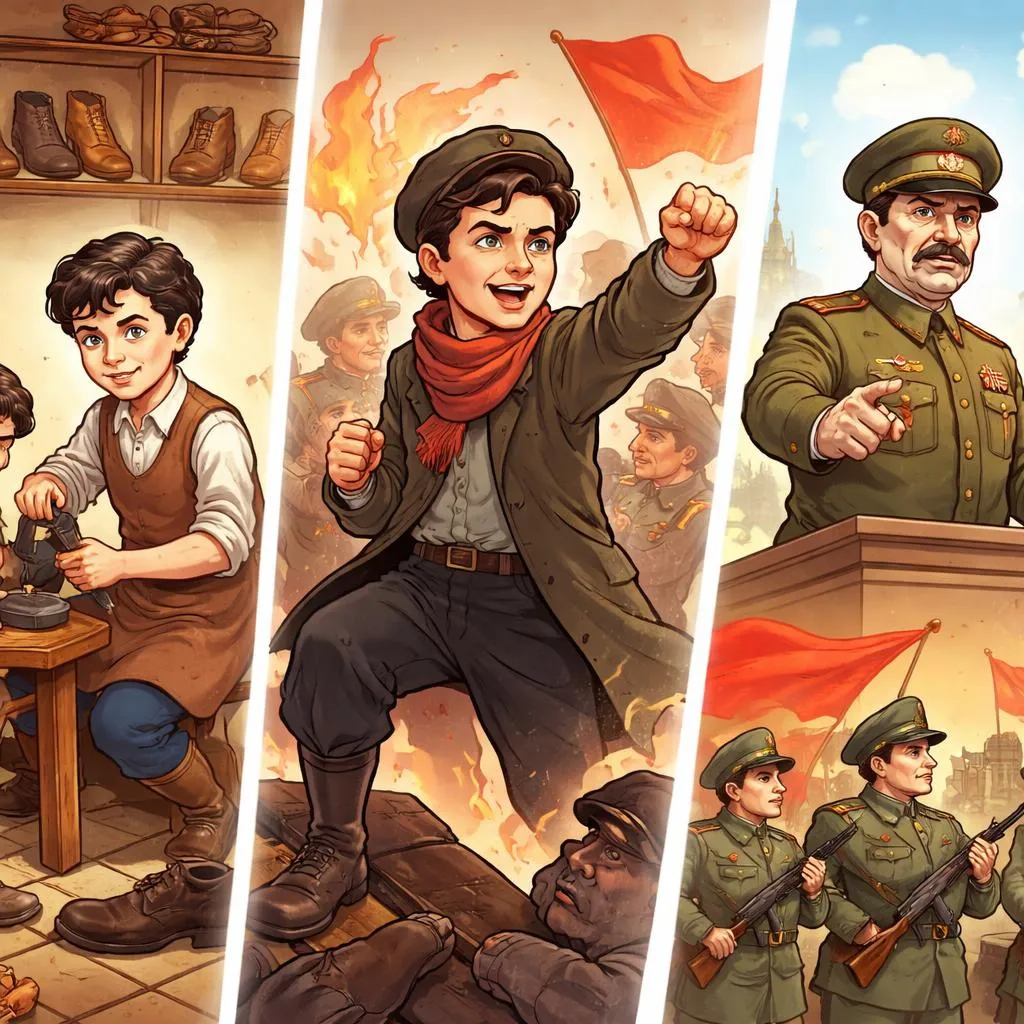
Joseph Stalin was the dictator of the Soviet Union for 25 years. He led his country through World War II and turned it into a superpower. He also caused the deaths of millions of his own people.
This celebrity story follows a man who rose from poverty to absolute power. Stalin started as the son of a shoemaker. He ended as one of the most feared men in history.
Kids who study history need to know about Stalin. His story teaches hard lessons about power and cruelty. He showed how a leader can use fear to control millions.
Some people praise Stalin for defeating the Nazis. Others condemn him as a monster. His legacy remains deeply controversial around the world.
Early Life and Childhood
Joseph Stalin was born in 1878. He was born in Gori, a small town in Georgia. Georgia was then part of the Russian Empire. His birth name was Ioseb Jughashvili.
His father was a shoemaker who drank too much. His mother was a devout religious woman. The family lived in a small, poor house.
Young Ioseb had a difficult childhood. His father beat him regularly. His parents fought constantly. The family had almost no money.
He also had health problems. When he was a child, he got smallpox. The disease left scars on his face. He also had a birth defect that made his left arm shorter.
Ioseb was a bright student. He won a scholarship to a church school. His mother wanted him to become a priest.
At school, he sang in the choir. He studied religious texts. He seemed like a good, quiet boy.
But inside, Ioseb was changing. He read books about revolution. He began to hate the tsar and the rich.
He adopted the name Stalin, which means "man of steel" in Russian. He wanted to sound strong and hard.
Education and Learning Journey
Stalin attended a religious seminary in Tbilisi. He was supposed to become a priest. Instead, he became a revolutionary.
He read forbidden books. He attended secret meetings. He organized protests among other students.
The seminary expelled him in 1899. He had failed to become a priest. He had become a revolutionary instead.
Stalin joined a group called the Bolsheviks. This group wanted to overthrow the government. Lenin led the Bolsheviks from abroad.
Stalin did not go to university. He did not have a formal higher education. Other Bolshevik leaders looked down on him as uneducated.
But Stalin was clever. He organized robberies to get money for the party. He helped plan a bank robbery that netted thousands of rubles.
The police arrested Stalin many times. They sent him to Siberia several times. He escaped each time and returned to revolutionary work.
He learned to be patient and careful. He built a network of loyal supporters. He remembered who helped him and who betrayed him.
Stalin did not write important books like Lenin. He did not give great speeches like other revolutionaries. He worked in the background.
In 1917, Lenin returned to Russia. Stalin helped him seize power. Lenin gave Stalin important jobs after the revolution.
Lenin noticed Stalin's ruthlessness. Shortly before Lenin died, he wrote that Stalin should be removed. But Lenin died before he could act.
How Did They Become Successful?
Stalin became successful through cunning and cruelty. After Lenin died in 1924, a power struggle began. Several men wanted to lead the Soviet Union.
Stalin seemed like a weak candidate. He was not a great speaker. He was not a great writer. Other leaders underestimated him.
Stalin used his position carefully. He put his supporters in key jobs. He befriended enemies and then destroyed them.
One by one, Stalin eliminated his rivals. He had them expelled from the party. He had them arrested. He had them executed.
By 1929, Stalin was the absolute dictator of the Soviet Union. No one could challenge him. He ruled by fear.
Stalin introduced a plan to modernize the country quickly. He called it the Five-Year Plan. He wanted factories, steel, and machines.
He also forced peasants to give up their land. He created collective farms where everyone worked together. Peasants who resisted were killed or sent to prisons.
Millions of people starved to death during this time. The farms could not produce enough food. Stalin blamed the peasants and refused to help.
Stalin also created a vast network of prisons called the Gulag. Millions of people were sent there for minor crimes or no crime at all.
Conditions in the Gulag were terrible. People froze, starved, and died from disease. Many were worked to death.
Big Ideas and Achievements
Stalin achieved many things that changed the Soviet Union. His biggest idea was simple. Industry comes first. People come second.
He turned the Soviet Union into a military superpower. When World War II began, the Soviet Union had thousands of tanks and planes.
Stalin also moved many factories to the east, away from the advancing German army. This saved Soviet industry.
Under Stalin's leadership, the Soviet Union defeated Nazi Germany. The war cost 27 million Soviet lives. But they won.
Stalin took control of Eastern Europe after the war. Countries like Poland, Hungary, and East Germany became communist dictatorships.
He also developed the Soviet atomic bomb. The Soviets tested their first bomb in 1949. The Cold War with America had begun.
Stalin built huge monuments, canals, and buildings. He renamed cities after himself. The city of Stalingrad (now Volgograd) bore his name.
He also changed history books. He had his rivals erased from photographs. He made himself the hero of every story.
By the time Stalin died, the Soviet Union was one of the two most powerful countries on Earth. America was the other.
Challenges and Difficult Times
Stalin faced many challenges. He grew up poor with an abusive father. He had health problems that left him scarred and disabled.
The police arrested him many times. He spent years in prison and exile in Siberia. The cold and hunger damaged his health.
During World War II, Stalin almost lost everything. The German army came within 200 miles of Moscow. Stalin considered fleeing.
He stayed. He gave a famous speech on Red Square. Soldiers marched straight from the parade to the front lines.
Stalin's son Yakov was captured by the Germans. Hitler offered to trade Yakov for a German general. Stalin refused. Yakov died in the camp.
Stalin trusted no one. He knew that even his closest friends might betray him. He lived in constant fear.
In his final years, Stalin became paranoid. He accused doctors of trying to kill him. He planned a new purge of his enemies.
Stalin died in 1953. He had a stroke after a dinner with his closest advisors. They were too afraid to call a doctor for hours.
His daughter Svetlana later said that her father died alone and in pain. No one who loved him was there.
Fun Facts About the Celebrity
Joseph Stalin has many strange facts. He loved Western movies. He watched American cowboy films in his private theater.
Stalin smoked a pipe constantly. He also smoked cigarettes. He died partly from lung problems caused by smoking.
He wrote poetry as a young man. His poems were published in Georgian newspapers. He stopped writing poetry when he became a revolutionary.
Stalin kept a collection of stuffed birds. He liked to look at them while he worked. This hobby surprised people who knew him.
He spoke Russian with a heavy Georgian accent. Other Soviet leaders sometimes mocked him behind his back for this.
Stalin had terrible teeth. They were black and rotting. He refused to see a dentist. He said a leader should not show weakness.
He was only 5 feet 4 inches tall. He was much shorter than most world leaders. Photographs were often staged to make him look taller.
Why Is This Celebrity Important Today?
Joseph Stalin remains important for dark reasons. He showed how much damage one leader can cause. Historians estimate that he caused the deaths of 6 to 9 million of his own people.
His methods of secret police, prison camps, and terror have been copied by other dictators. North Korea, for example, uses Stalin's playbook.
Stalin also showed that industrial progress can come at a terrible cost. The Soviet Union became a superpower. But millions of people died for that progress.
Many people in Russia still admire Stalin. They see him as the man who defeated Hitler and made their country strong. His approval ratings have risen in recent years.
Other Russians see Stalin as a monster. They remember the famine, the purges, and the camps. They want to forget him completely.
Stalin's legacy divides people today. Statues of him have been torn down in some countries. They have been put back up in others.
His methods of propaganda and control are still studied. Political scientists and historians analyze how he held power for so long.
The town of Stalingrad was renamed Volgograd after his death. But some people want to change it back. The debate continues.
What Can Kids Learn from This Story?
Kids can learn many lessons from Joseph Stalin. The first lesson is about the danger of absolute power. When one person has all the power, bad things happen.
The second lesson is about the importance of questioning leaders. Stalin's people were too afraid to speak up. Do not be afraid to ask questions.
The third lesson is about the value of human life. Stalin treated people like numbers. Every person matters.
The fourth lesson is about how fear destroys trust. Stalin's people spied on each other. Trust is precious. Do not break it.
The fifth lesson is about the difference between strength and cruelty. Stalin was strong. He was also cruel. True strength includes kindness.
The final lesson is that history is complicated. Stalin defeated the Nazis and made his country powerful. He also murdered millions. Both things are true. Hold both in your mind.
Quick Quiz or Practice Time
Let us see what you remember about Joseph Stalin. Ask a parent to help with these questions.
Question 1: What does the name "Stalin" mean in Russian?
Question 2: What happened to Stalin's son Yakov during World War II?
Question 3: What was the name of Stalin's network of prison camps?
Question 4: How tall was Joseph Stalin?
Question 5: Who defeated Stalin's army in World War II?
Activity Time: Draw Joseph Stalin with his pipe and mustache. Draw factories and smoke in the background. Add a gray, serious sky.
Another Activity: Research a country that was part of the Soviet Union. Find out what life was like there under Stalin. Share what you learn with a family member.
Talk about the difference between strength and cruelty. Write down an example of a strong leader who was also kind. Write down an example of a strong leader who was cruel.
Joseph Stalin was a poor shoemaker's son who became one of the most powerful men in history. He defeated Hitler and made his country a superpower. He also murdered millions of his own people. His story is not inspiring. It is a warning. It tells every child that power without kindness is poison. Do not admire leaders who rule through fear. Do not trust leaders who treat people like numbers. Ask questions. Speak up. Value every human life. That is how you avoid creating another Stalin. Remember him so you never repeat him.