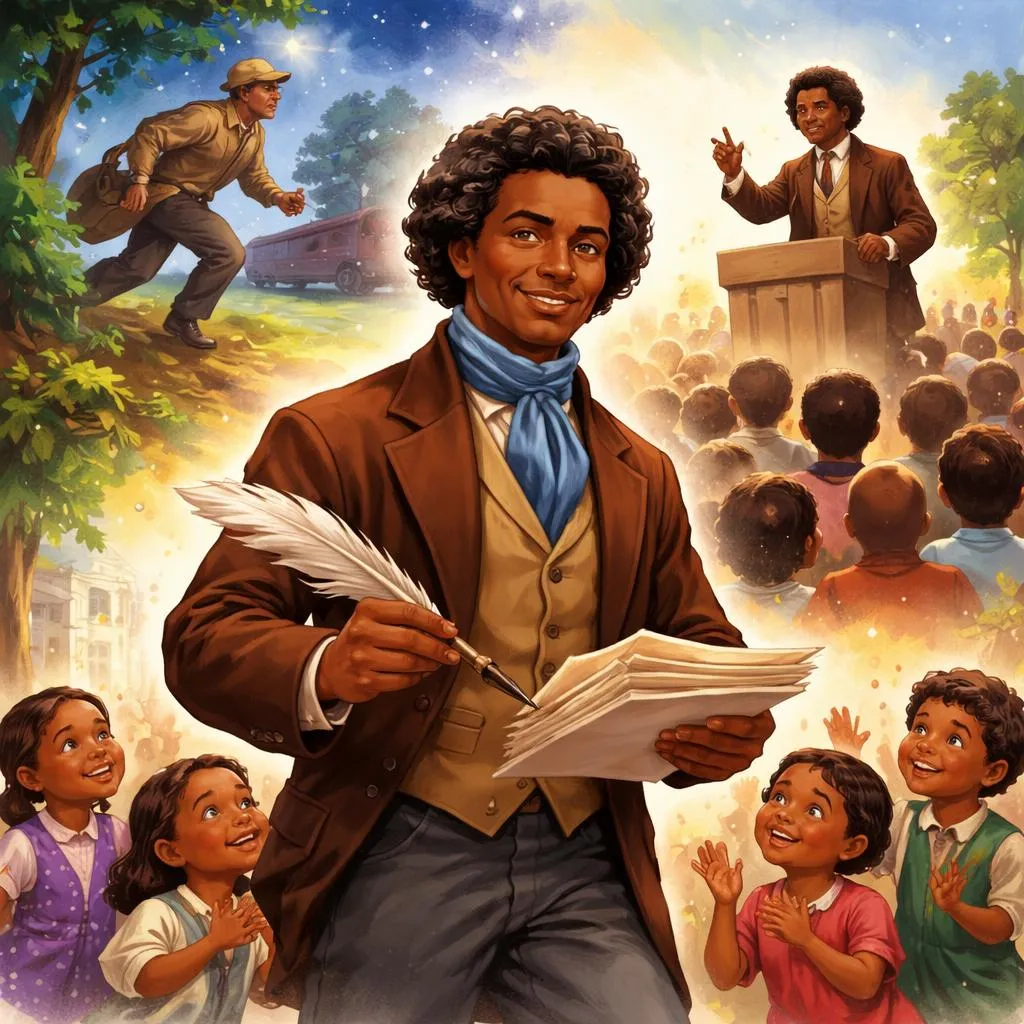

Who Is This Celebrity?
Frederick Douglass was a writer, speaker, and leader. He escaped from slavery and became one of the most famous Americans of his time. He advised presidents and changed laws.
This celebrity story follows a man who refused to stay silent. Frederick Douglass was born into slavery. He taught himself to read. Then he taught America about justice.
Kids who love reading and speaking will find his story powerful. Douglass showed that words can break chains. He proved that one voice can move a nation.
He wrote three autobiographies. His first book became a bestseller. People around the world read his story and joined the fight against slavery.
Early Life and Childhood
Frederick Douglass was born into slavery in 1818. He was born in Maryland. He did not know his exact birth date.
His mother was an enslaved woman named Harriet. She worked on a different farm. Frederick saw her only a few times before she died.
His father was a white man. Frederick never knew his name. He grew up without parents.
As a young child, Frederick lived with his grandmother. She cared for him in a small cabin. He played with other children and did not know he was a slave.
When Frederick was six years old, his grandmother took him to a big farm. She left him there. Frederick cried and ran after her. She did not look back.
He realized he was property. He belonged to someone else. No one would ever ask his permission for anything.
Young Frederick worked hard. He ate from a trough like an animal. He wore a shirt that went to his knees. He had no shoes in winter.
But something happened that changed his life. His owner's wife began to teach him the alphabet.
Education and Learning Journey
Frederick Douglass learned to read in secret. His owner's wife taught him a few letters. Then her husband ordered her to stop. Teaching a slave to read was illegal.
Frederick did not stop. He traded bread to poor white boys for reading lessons. He carried a book with him everywhere.
He found a book called “The Columbian Orator.” This book contained speeches about freedom and human rights. Frederick read it over and over.
He learned that all people deserve to be free. He learned that slavery was wrong. He learned that he had the same rights as anyone else.
But knowledge brought pain. Frederick understood his situation clearly now. He wrote later that learning to read was a curse and a blessing.
He tried to escape many times. Each attempt failed. Each failure brought severe punishment.
At age 16, his owner sent him to work for a man named Edward Covey. Covey was known for breaking slaves’ spirits. He whipped Frederick every week.
One day, Frederick fought back. He grabbed Covey’s throat. They fought for two hours. Covey never touched Frederick again.
Frederick had found his courage. He knew he would escape or die trying.
How Did They Become Successful?
Frederick Douglass escaped slavery in 1838. He was 20 years old. He borrowed papers from a free Black sailor. He dressed as a sailor and boarded a train.
He traveled 24 hours without sleeping. He arrived in New York City. He had never felt so alone or so free.
A group of abolitionists helped him. They gave him a place to stay. They encouraged him to speak about his experiences.
In 1841, Frederick attended an abolitionist meeting. The leaders asked him to say a few words. He stood up and told his story.
The audience wept. They had never heard a former slave speak so clearly and powerfully. They asked him to become a full-time speaker.
Frederick traveled across the North. He spoke to thousands of people. He described the whippings, the hunger, the families torn apart.
Some people doubted him. They said no former slave could speak so well. They said he must have invented his story.
To prove them wrong, Frederick wrote a book. He called it “Narrative of the Life of Frederick Douglass.” He named his owners and described his escapes.
The book became a bestseller. People finally believed him. But now his former owner knew where he was. Frederick had to flee to England to stay free.
Big Ideas and Achievements
Frederick Douglass achieved many things that changed America. His biggest idea was simple. Slavery is not just wrong. It is a sin against God and humanity.
He believed that the Constitution was an antislavery document. He argued that the founding fathers meant for all people to be free.
During the Civil War, Douglass advised President Abraham Lincoln. He urged Lincoln to let Black men fight in the Union Army.
Lincoln listened. More than 180,000 Black soldiers fought for freedom. Their courage helped win the war.
After the war, Douglass fought for voting rights. He demanded that Black men receive the right to vote. The 15th Amendment passed in 1870.
Douglass also fought for women’s rights. He attended the first women’s rights convention in 1848. He said, “Right is of no sex.”
He became the first Black man to hold high government positions. He served as US Marshal for Washington, DC. He also served as ambassador to Haiti.
Douglass wrote three autobiographies. His final book, “Life and Times of Frederick Douglass,” covered his entire journey from slave to statesman.
He died in 1895. His funeral was held at the Metropolitan AME Church in Washington. Thousands came to say goodbye.
Challenges and Difficult Times
Frederick Douglass faced many challenges. He grew up hungry, cold, and beaten. He watched his aunt get whipped until she screamed.
When he tried to learn to read, people threatened to kill him. He learned anyway. He kept his book hidden in his shirt.
After escaping, he lived in fear of being caught. The Fugitive Slave Law allowed slave catchers to capture him anywhere in America.
Friends raised money to buy his freedom legally. Douglass finally became a free man under the law in 1846. He was 28 years old.
Even as a famous speaker, Douglass faced racism. Hotels turned him away. People called him names. Men threatened to beat him.
In 1872, someone set fire to his house. The fire killed many of his papers and books. Douglass rebuilt his life again.
His first wife Anna died in 1882. He married a white woman named Helen Pitts. People criticized him harshly. He ignored them.
Douglass kept working into his 70s. He gave his last speech on February 20, 1895. He returned home and died of a heart attack that evening.
Fun Facts About the Celebrity
Frederick Douglass has many fun facts that kids enjoy. He chose his last name from a poem by Sir Walter Scott. He wanted a name that sounded noble.
He never celebrated his birthday. He chose February 14 as his best guess. He liked Valentine’s Day.
Douglass loved photography. He was the most photographed American of the 19th century. He believed photos showed the truth of Black humanity.
He could read and write in two languages. He learned some German during his travels.
Douglass grew his hair long and white. People recognized him from across the room. He looked like a wise elder.
He loved to sing. He sang spirituals from his childhood. He said music kept him alive during the worst times.
Douglass’s great-great-grandson is the actor Ken Morris. Morris still speaks about his ancestor’s legacy.
Why Is This Celebrity Important Today?
Frederick Douglass remains very important today. His autobiographies are still in print. Students read his words in school.
His fight for voting rights continues. People still work to make sure every citizen can vote. Douglass’s words inspire them.
He showed that a person born into slavery could become a leader. His life proves that circumstances do not define destiny.
Douglass spoke about immigration, education, and justice. His speeches apply to modern problems. People still quote him in debates.
The Frederick Douglass National Historic Site stands in Washington, DC. Visitors tour his home and learn his story.
His birthday is celebrated in many communities. February 14 is Frederick Douglass Day. People read his speeches aloud.
Douglass also teaches us to speak up. He saw wrong and said something. He did not stay quiet to be polite. His courage calls us to be brave too.
What Can Kids Learn from This Story?
Kids can learn many lessons from Frederick Douglass. The first lesson is about the power of reading. Douglass taught himself to read. Reading set him free.
The second lesson is about never giving up. Douglass failed many escapes before he succeeded. He kept trying.
The third lesson is about using your voice. Douglass spoke even when people threatened him. Your voice matters.
The fourth lesson is about learning from pain. Douglass turned his suffering into speeches that changed minds. Hard times can make you stronger.
The fifth lesson is about standing up for others. Douglass fought for women’s rights too. He believed everyone deserved freedom.
The final lesson is about telling your story. Douglass wrote his truth. People believed him because he was honest. Your story has power too.
Quick Quiz or Practice Time
Let us see what you remember about Frederick Douglass. Ask a parent to help with these questions.
Question 1: What did Frederick Douglass trade to white boys for reading lessons?
Question 2: What was the name of Frederick’s first book?
Question 3: Who did Frederick advise during the Civil War?
Question 4: What job did Frederick hold in Washington, DC?
Question 5: What date did Frederick choose as his birthday?
Activity Time: Draw Frederick Douglass standing at a podium giving a speech. Draw people listening in the audience. Add a book in his hand.
Another Activity: Write a short speech about something you believe in. It can be about kindness, fairness, or protecting nature. Practice reading it out loud.
Talk about a time you learned something hard. Write down what made you keep trying. Remember Frederick learned to read when it was illegal.
Frederick Douglass was born with no rights. He grew up hungry and beaten. He taught himself to read when reading was a crime. He escaped slavery and learned to speak. His voice shook America. He talked to presidents and changed laws. He wrote books that still live. His story tells every child that no matter where you start, you can rise. Pick up a book. Learn something new. Tell your story. Use your voice. That is how you change the world.