
Who Is This Celebrity?
Mae Jemison is a doctor, engineer, and astronaut. She became the first African American woman to travel into space. She flew on the space shuttle Endeavour in 1992.
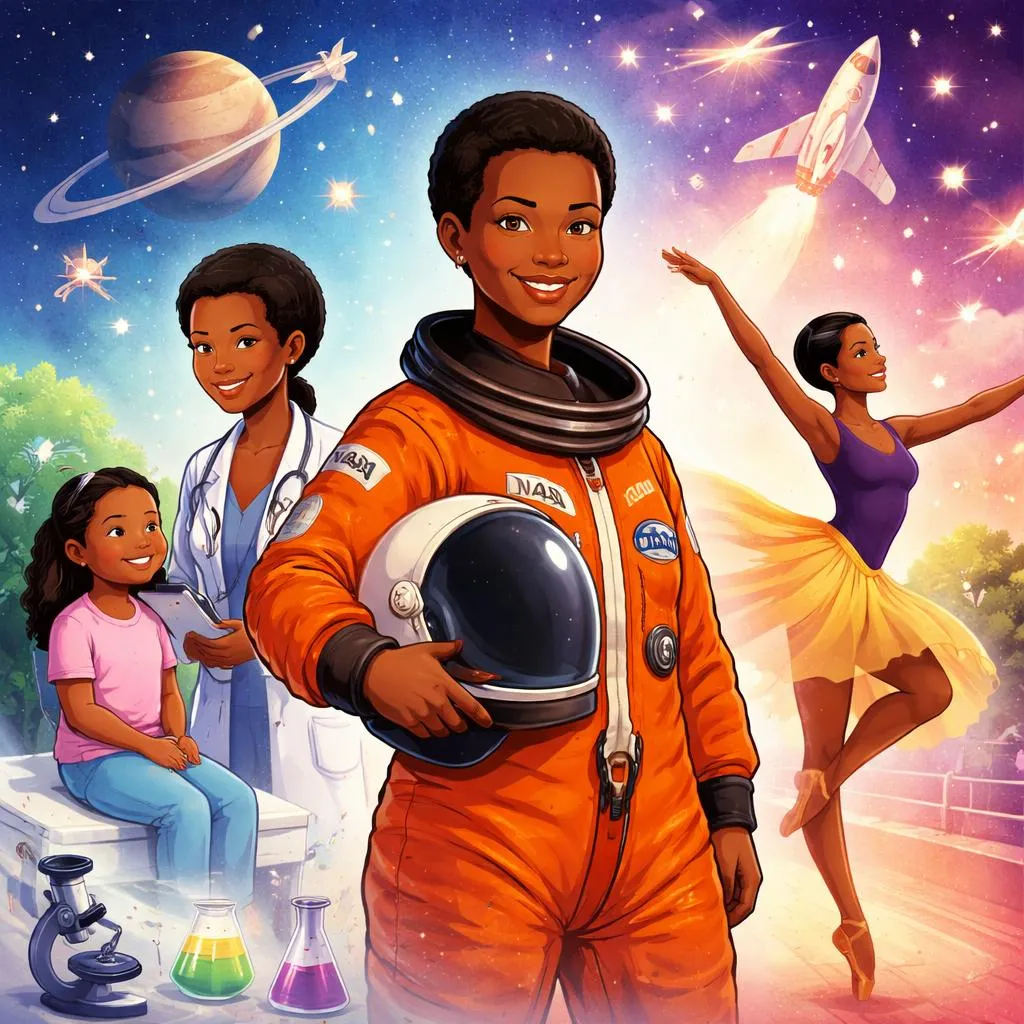
This celebrity story follows a woman who never limited herself. Mae Jemison did not pick just one career. She became a scientist, a doctor, a dancer, and a teacher.
Kids who love many different things will find her inspiring. Mae shows that you do not have to choose just one path. You can be good at science and art at the same time.
She also worked as a doctor in Africa. She speaks several languages. She even appeared on a famous TV show. Mae Jemison proves that curiosity has no limits.
Early Life and Childhood
Mae Jemison was born in 1956. She grew up in Chicago, Illinois. Her parents encouraged her to ask questions about everything.
Young Mae loved to read. She visited the library every week. She read books about space, animals, and faraway places.
She also loved to dance. She took ballet lessons for many years. She dreamed of becoming a professional dancer someday.
When Mae was very young, she watched the Apollo space missions on TV. She saw Neil Armstrong walk on the moon. But she noticed something strange.
All the astronauts were white men. Mae looked around her living room. She did not see anyone who looked like those astronauts.
She asked her mother, “Where are the women astronauts?” Her mother did not have a good answer. Mae decided she would become one herself.
Her teachers told her to be realistic. They said girls did not become astronauts. Mae did not listen. She kept dreaming of the stars.
She also kept dancing. She believed that art and science belonged together.
Education and Learning Journey
Mae Jemison worked extremely hard in school. She graduated from high school at age 16. She was one of the youngest students in her class.
She went to Stanford University in California. She studied chemical engineering and African American studies. Most students focus on one subject. Mae studied two very different fields.
At Stanford, Mae faced discrimination. Some professors ignored her questions. Some students assumed she was not smart. She proved them wrong with her grades.
She graduated from Stanford in 1977. Then she went to Cornell Medical School in New York. She studied to become a doctor.
At Cornell, Mae traveled to other countries. She worked in a refugee camp in Thailand. She helped sick people in Cuba and Kenya.
She earned her medical degree in 1981. Then she worked as a doctor in Liberia. She served people in West Africa for two years.
While in Africa, Mae remembered her childhood dream. She still wanted to go to space. She applied to NASA when she returned to America.
How Did They Become Successful?
Mae Jemison became successful by never giving up. When she applied to NASA, thousands of people applied too. NASA accepted only a few.
Mae got accepted in 1987. She joined NASA’s astronaut training program. She learned to fly jets and repair space equipment.
She also studied how the human body reacts to space. Her medical training helped her understand these problems very well.
In 1992, Mae got her chance. The space shuttle Endeavour would carry her into space. She would become the first African American woman in orbit.
The mission lasted eight days. Mae conducted science experiments on the shuttle. She studied how weightlessness affected human cells.
She also studied how frogs and bones reacted to space. Her medical background made her very valuable to the mission.
During the flight, Mae spoke to students on Earth. She answered their questions about space and science. She loved talking to children.
When she returned, people cheered. Mae had broken a color barrier that had stood for decades. Young girls of every background saw someone who looked like them in space.
Big Ideas and Achievements
Mae Jemison achieved many things that changed the world. Her biggest idea is simple. Science and art belong together. You do not have to pick one.
She proved that diversity makes science stronger. Different people bring different ideas. Different ideas lead to better discoveries.
After NASA, Mae started her own company. The Jemison Group develops new technologies. The company focuses on solving real-world problems.
She also started an international science camp. Children from many countries attend this camp. They learn to work together on science projects.
Mae appeared on the TV show “Star Trek: The Next Generation.” She became the first real astronaut to appear on the show. She played a character named Lieutenant Palmer.
She wrote many books for children. Her book “Find Where the Wind Goes” tells her own story. Kids love reading about her adventures.
Mae also teaches at Cornell University. She encourages young people to follow their dreams. She tells them that no door is closed to them.
In 2015, a group of students asked Mae to name a new spacecraft. She chose the name “Endeavour” after her shuttle. That spacecraft now carries supplies to the space station.
Challenges and Difficult Times
Mae Jemison faced many challenges as a young woman. People told her she could not be an astronaut. They said girls did not do that kind of work.
In college, she felt lonely sometimes. She was one of only a few Black students. Some people assumed she did not belong there.
She used those feelings as fuel. She worked harder than everyone else. Her grades silenced the doubters.
At NASA, Mae faced challenges too. Some people questioned whether a doctor could become an astronaut. She proved that medical training helps in space.
She also faced pressure to be perfect. As the first African American woman in space, everyone watched her. Any mistake would be blamed on her race or gender.
Mae handled this pressure with grace. She did her job better than anyone expected. She let her work speak for itself.
After her space flight, Mae faced a different challenge. People wanted her to speak only about being the first Black woman in space. She wanted to speak about science instead.
She found a balance. She acknowledged her historic role. But she also talked about the importance of science education for everyone.
Fun Facts About the Celebrity
Mae Jemison has many fun facts that kids enjoy. She loves to dance. She brought a poster from her dance school into space with her.
She speaks four languages. She speaks English, Russian, Japanese, and Swahili. She learned Swahili while working in Africa.
Mae appeared on the cover of Essence magazine. She also appeared on the cover of Ebony magazine. Both magazines celebrated her achievement.
She has an asteroid named after her. Asteroid 1993 AL is called 9755 Mae Jemison. That piece of rock flies through space forever.
Mae collects African art. Her home is filled with sculptures and masks from many countries. She says art reminds her of humanity’s creativity.
She loves to cook. She learned to make dishes from Africa, Asia, and Europe. Her friends say her food is delicious.
Mae was the first real astronaut to appear on “Star Trek.” The show’s creator, Gene Roddenberry, invited her personally.
Why Is This Celebrity Important Today?
Mae Jemison remains very important today. She showed that space belongs to everyone. Her flight encouraged millions of children to dream big.
She leads a program called the 100 Year Starship. This project works on sending humans to another star. It will take many generations to finish.
Mae speaks at schools around the world. Children listen to her with wide eyes. They ask her questions about space and science.
Her science camp continues to grow. Children from more than 30 countries have attended. They learn that science crosses all borders.
Mae has received many awards. The National Women’s Hall of Fame honored her. The International Space Hall of Fame honored her too.
She proves that you can have many careers. Doctor. Astronaut. Dancer. Teacher. Mae did all of these things. She shows that we can be more than one thing.
What Can Kids Learn from This Story?
Kids can learn many lessons from Mae Jemison. The first lesson is about loving many things. Mae loved science and dancing. She did not choose one. You do not have to either.
The second lesson is about ignoring people who say no. Teachers told Mae she could not be an astronaut. She proved them wrong.
The third lesson is about helping others. Mae became a doctor to heal people. She worked in Africa to help the poor. Success means lifting others up.
The fourth lesson is about staying curious. Mae learned four languages. She studied many subjects. Curiosity makes life more interesting.
The fifth lesson is about breaking barriers. Mae knew she would be the first Black woman in space. She did not let that pressure stop her.
The final lesson is about having fun. Mae danced in space. She laughed with her crew. She enjoyed every moment of her journey.
Quick Quiz or Practice Time
Let us see what you remember about Mae Jemison. Ask a parent to help with these questions.
Question 1: What year did Mae Jemison fly into space?
Question 2: What two subjects did Mae study at Stanford University?
Question 3: What was the name of the space shuttle Mae flew on?
Question 4: What TV show did Mae appear on as an actress?
Question 5: How many languages does Mae speak?
Activity Time: Draw Mae Jemison floating inside the space shuttle Endeavour. Draw a poster from her dance school floating next to her.
Another Activity: Write down three things you love to do. They can be very different, like science, sports, and drawing. Then write down one way to combine them.
Talk about a dream you have. It can be big or small. Write down one step you can take toward that dream tomorrow. Remember Mae took many small steps before she reached space.
Mae Jemison looked at the stars and decided to go there. She also looked at sick people and decided to heal them. She looked at a stage and decided to dance. She did not let anyone tell her to choose. She became a doctor, a dancer, and an astronaut. She became a symbol of what happens when you refuse to shrink. Her story says to every child: Be as big as you want. Love science and art. Speak many languages. Help everyone you can. The universe has room for all of you. Go be amazing.