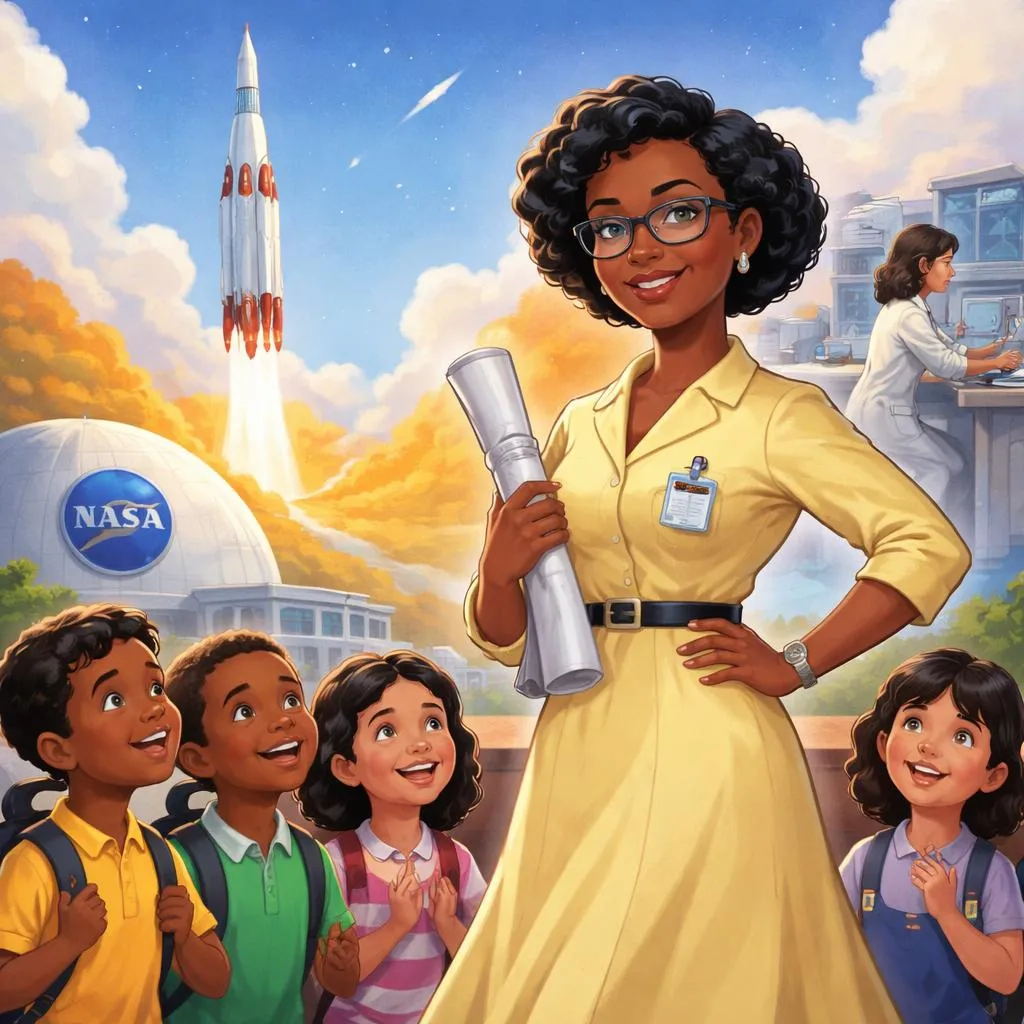

Who Is This Celebrity?
Mary Jackson was an engineer and mathematician at NASA. She became the first Black female engineer at the agency. She helped design spacecraft that sent astronauts into orbit.
This celebrity story follows a woman who refused to accept limits. Mary Jackson did not let unfair rules stop her. She fought for the right to become an engineer.
Kids who love building things and solving problems will find her inspiring. Mary showed that engineering is for everyone. She proved that talent matters more than skin color.
She worked at NASA for 34 years. Later in her career, she helped other women and minorities become scientists.
Early Life and Childhood
Mary Jackson was born in 1921. She grew up in Hampton, Virginia. Her family lived near the Langley Research Center, where she would later work.
Young Mary loved school. She finished her classes with excellent grades. Math and science came easily to her.
Her parents encouraged her curiosity. They gave her books and puzzles. They told her she could become anything she wanted.
Mary also loved building things. She took apart small machines to see how they worked. She always put them back together correctly.
In high school, Mary graduated with highest honors. She was the valedictorian of her class. That means she had the best grades of all students.
Her teachers noticed her talent for math. They encouraged her to study further. Mary dreamed of a career that used her skills.
But in the 1930s, few careers were open to Black women. Most became teachers or nurses. Mary thought she might become a teacher too.
Education and Learning Journey
Mary Jackson attended Hampton Institute in Virginia. This was a famous college for Black students. She graduated in 1942.
She earned a double degree in math and physical science. She studied hard and made many friends.
After college, Mary became a teacher. She taught math at a school in Maryland. Then she worked as a receptionist and a bookkeeper.
During World War II, Mary took a job at Langley Laboratory. She worked as a mathematician in a segregated group. She calculated numbers for wind tunnel experiments.
Her boss saw her talent. He encouraged her to apply for an engineering position. Mary had never considered becoming an engineer before.
But Virginia law said Black people could not take engineering classes with white people. The classes Mary needed were only offered at all-white schools.
Mary decided to fight this rule. She petitioned the city of Hampton. She asked permission to attend the classes anyway.
The city granted her request. Mary became the first Black person allowed in those classrooms. She attended night classes while working during the day.
She completed the courses in 1958. She earned the title of engineer. NASA promoted her immediately.
How Did They Become Successful?
Mary Jackson became successful through courage. She did not accept "no" as an answer. When Virginia said she could not take engineering classes, she fought back.
She spent many hours studying after work. Her family supported her. They cooked dinner and cleaned the house so she could focus.
Mary also found mentors who believed in her. One white engineer named Kazimierz Czarnecki saw her potential. He encouraged her to pursue engineering.
She joined the sonic wind tunnel team. This tunnel tested model airplanes at very high speeds. Mary's calculations helped design faster and safer aircraft.
She studied how air moved over wings and fuselages. Her work improved the shape of planes. Pilots flew more safely because of her calculations.
Mary also worked on the Apollo program. She helped design spacecraft that went to the moon. Her engineering made the lunar missions possible.
She wrote research papers about air flow. Other engineers read her work and used her methods. She became known as an expert in her field.
Mary stayed at NASA for 34 years. She retired in 1985. By then, she had helped change the agency forever.
Big Ideas and Achievements
Mary Jackson achieved many things that changed engineering. Her biggest idea was simple. Talent has no color. Ability has no gender.
She became the first Black female engineer at NASA. That achievement opened doors for everyone who came after her.
Mary's work in the wind tunnel improved aircraft design. She studied something called boundary layer effects. This research made planes fly faster and use less fuel.
She co-authored more than a dozen research papers. These papers helped other engineers understand aerodynamics. Her name appears in scientific journals.
But Mary's biggest achievement came later in her career. She took a demotion to help others. She left her engineering position to lead diversity programs.
She became the Federal Women's Program Manager at NASA. She also served as the Affirmative Action Program Manager.
In these roles, Mary helped hire more women and minorities. She mentored young scientists. She told them to study hard and never give up.
She changed NASA from the inside. Because of Mary, thousands of people got opportunities they would not have had.
Challenges and Difficult Times
Mary Jackson faced many challenges as a Black woman. When she started at NASA, her office was in a segregated building. She could not eat with white coworkers.
The engineering classes she needed were for white students only. She had to get special permission to attend. The city of Hampton had to change its rules just for her.
Even after becoming an engineer, Mary faced disrespect. Some men refused to work with her. Some questioned her skills.
She did not let this stop her. She produced excellent work every day. She showed up on time and stayed late. Her results spoke louder than any insult.
Mary also faced the challenge of being a working mother. She had a son named Levi. She balanced engineering with raising a child.
She brought her son to work sometimes. He watched his mother solve complex problems. He grew up to become an engineer too.
Later in life, Mary faced the challenge of choosing between her own career and helping others. She chose to step down from engineering to run diversity programs.
This was a difficult decision. She loved engineering. But she loved helping people more.
Fun Facts About the Celebrity
Mary Jackson has many fun facts that kids enjoy. She started working at NASA as a "human computer." That meant she did math with a pencil and paper all day.
She built model airplanes at her desk. These small models helped her understand how real planes would fly.
Mary loved to travel. She visited many countries after retiring. She wanted to see the world beyond the laboratory.
Her son Levi became an engineer at NASA too. He worked alongside his mother for several years. They ate lunch together in the cafeteria.
Mary played the piano beautifully. She learned as a child and never stopped. Music relaxed her after long workdays.
She was an excellent cook. Her coworkers loved when she brought food to office parties. Her sweet potato pie was famous.
The movie "Hidden Figures" tells Mary's story. Actress Janelle Monáe played her in the film. Mary's family helped make sure the story was true.
Why Is This Celebrity Important Today?
Mary Jackson remains very important for many reasons. She proved that Black women belong in engineering. Her courage opened doors for thousands.
NASA named its Washington DC headquarters after her. The Mary W. Jackson NASA Headquarters building stands as a monument to her legacy.
Her story inspired the book and movie "Hidden Figures." Millions of people learned about her for the first time. Children now know her name.
The engineering field has more women because of Mary. She mentored countless young scientists. She told them to never give up on their dreams.
Schools across America teach her story. Students learn about her fight for education. They learn that talent matters more than rules.
Mary's work in the wind tunnel helped send astronauts to the moon. Every Apollo mission benefited from her calculations. America reached the moon partly because of Mary Jackson.
She also taught us that helping others is as important as personal success. Mary stepped down from engineering to lift others up. That is true leadership.
What Can Kids Learn from This Story?
Kids can learn many lessons from Mary Jackson. The first lesson is about fighting for your dreams. Mary had to go to court just to take a class. She did not give up.
The second lesson is about using your skills. Mary loved math and building things. She turned those interests into a career.
The third lesson is about ignoring disrespect. Some men refused to work with Mary. She did not let their attitudes stop her.
The fourth lesson is about balancing life. Mary worked hard and raised a son. She found time for music and cooking too.
The fifth lesson is about helping others. Mary gave up her engineering job to help more people join NASA. Lifting others up is a great achievement.
The final lesson is about being first. Mary was the first Black female engineer at NASA. Being first is hard. But someone must go first so others can follow.
Quick Quiz or Practice Time
Let us see what you remember about Mary Jackson. Ask a parent to help with these questions.
Question 1: What title did Mary Jackson earn at NASA in 1958?
Question 2: Where did Mary grow up in Virginia?
Question 3: What kind of tunnel did Mary work in at NASA?
Question 4: What movie told Mary Jackson's story?
Question 5: What building did NASA name after Mary Jackson?
Activity Time: Draw Mary Jackson working at her desk with a model airplane. Draw a wind tunnel in the background. Add numbers and blueprints around her.
Another Activity: Build something small with blocks, paper, or recycled materials. It does not have to be perfect. Engineers learn by building and trying again.
Talk about something you want to learn. Write down one person who could help you learn it. Remember Mary found mentors who believed in her.
Mary Jackson grew up near the place where she would make history. She saw the Langley Research Center as a child. She never imagined working there. But she studied hard and fought for her place. She became the first Black woman engineer at NASA. She helped send people to the moon. Then she helped others follow her path. Her story tells every child that you belong wherever you work hard enough to be. Do not let anyone tell you otherwise. Go build something amazing.