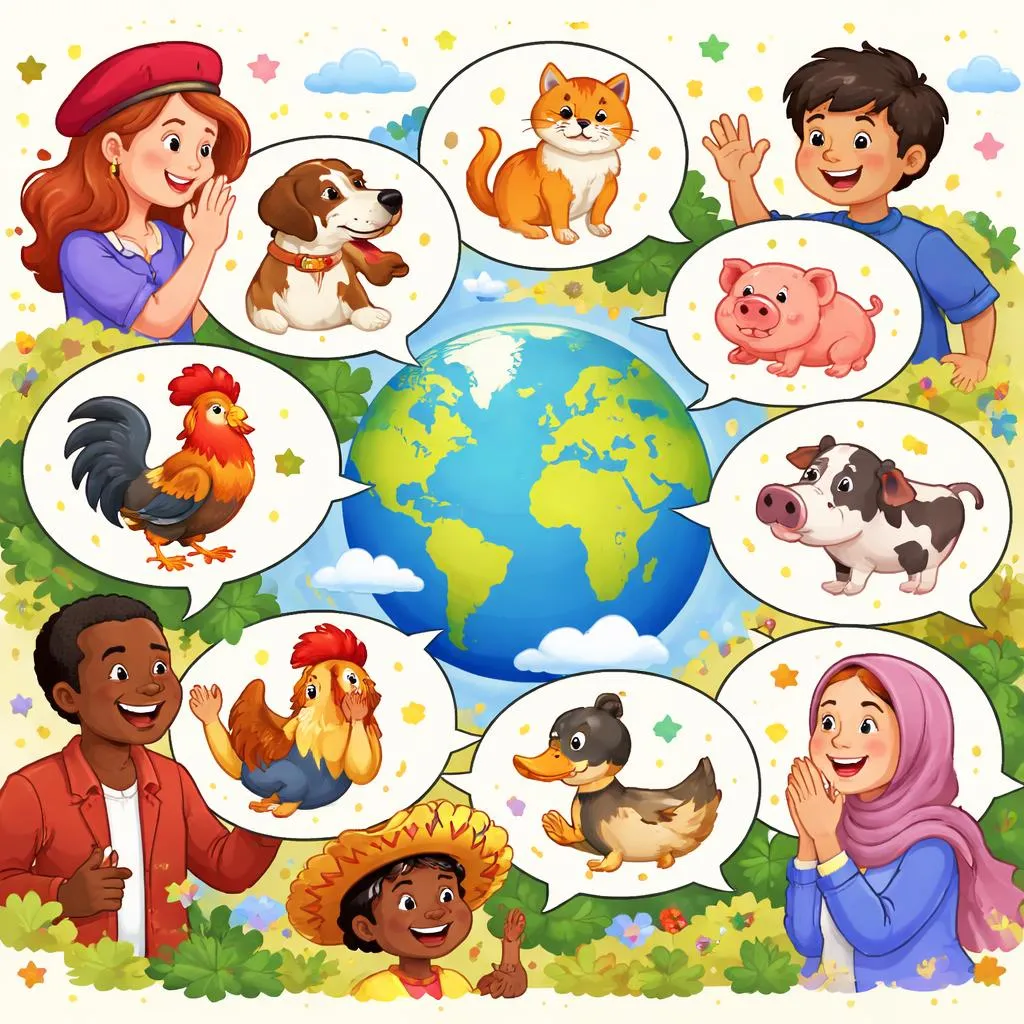

Animal sounds are represented differently in various languages because each language uses its own sound system to imitate what people hear. These sound-imitating words are called onomatopoeia, and they often reflect how speakers of a language naturally interpret and spell sounds.
Even though animals make the same natural noises everywhere, people describe those sounds in different ways depending on their language.
Dog Sounds
In English, a dog says:
Woof
Bark
Bow-wow
In Chinese, a dog says:
Wang wang
In Spanish, a dog says:
Guau guau
In Japanese, a dog says:
Wan wan
Although the actual sound made by a dog is similar around the world, each language writes it differently.
Cat Sounds
In English:
Meow
In Chinese:
Miao miao
In Spanish:
Miau
In Korean:
Yaong
These variations show how languages adjust spelling to match their own pronunciation patterns.
Cow Sounds
In English:
Moo
In Chinese:
Mou mou
In Spanish:
Muu
In French:
Meuh
The cow’s sound is long and low, but each language captures it in its own way.
Rooster Sounds
In English:
Cock-a-doodle-doo
In Chinese:
Wo wo wo
In Spanish:
Quiquiriquí
In Japanese:
Kokekokko
Rooster sounds are especially interesting because they are quite different across languages.
Duck Sounds
In English:
Quack
In Chinese:
Ga ga
In French:
Coin coin
In Japanese:
Ga ga
The spelling changes, but the idea of a short repeating sound remains similar.
Sheep Sounds
In English:
Baa
In Spanish:
Bee
In French:
Bêê
In Japanese:
Mee mee
Again, the same animal produces a similar sound, but languages represent it differently.
Why Animal Sounds Are Different in Languages
Animal sounds are filtered through the sound system of each language. Every language has specific letters and sound patterns. When people hear an animal, they describe the sound using familiar phonetic rules.
Children often learn animal sounds early when studying vocabulary, which makes these words an important part of language learning. Comparing animal sounds across languages also helps learners understand pronunciation differences.
Learning Animal Sounds as Vocabulary Practice
Practicing animal sounds can make language learning fun and interactive. Students can match animals with their sounds, compare different languages, and notice spelling differences. These activities improve listening skills and phonetic awareness.
Although animals make natural sounds that are universal, the way humans describe them reflects the creativity and structure of each language.
More Animal Sounds Around the World
Animal sounds vary not only between English and Asian languages, but also across many European and Middle Eastern languages. Exploring more examples helps learners notice patterns in pronunciation and spelling.
Pig Sounds
In English, a pig says:
Oink
In Spanish, a pig says:
Oin oin
In French, a pig says:
Grouin grouin
In Japanese, a pig says:
Buu buu
Although the real sound of a pig is similar everywhere, each language adapts it to fit its own sound system.
Horse Sounds
In English:
Neigh
In Chinese:
Hui hui
In Spanish:
Hiii
In French:
Hennissement (used to describe the sound), often written as “hii” in children’s books
The English spelling “neigh” looks unusual because English spelling does not always match pronunciation exactly.
Frog Sounds
In English:
Ribbit
In Spanish:
Croac
In French:
Croa
In Japanese:
Kero kero
Interestingly, the word “ribbit” is strongly connected to American English, while frogs in other English-speaking countries are sometimes described differently.
Bee Sounds
In English:
Buzz
In Spanish:
Bzzz
In French:
Bzzz
In Japanese:
Buun
The repeating “z” sound represents vibration. Many languages use similar letters to show this continuous sound.
Lion Sounds
In English:
Roar
In Spanish:
Rugir (verb form), sometimes written as “grrr”
In French:
Rugir
In Japanese:
Gao
The lion’s deep sound is interpreted differently depending on the language’s phonetic structure.
Cultural Influence on Animal Sounds
Animal sounds are not only shaped by phonetics but also by culture. For example, in English-speaking countries, the rooster says “cock-a-doodle-doo,” which is long and rhythmic. In Spanish, “quiquiriquí” reflects Spanish pronunciation patterns. In Japanese, “kokekokko” matches Japanese syllable structure, which often follows a consonant-vowel pattern.
These differences show how languages organize sounds according to their own rules. A language with many consonant clusters may represent sounds differently from a language that prefers simple syllables.
Animal Sounds and Early Language Learning
Animal sounds are often introduced in early childhood education because they are easy to remember and fun to repeat. Picture books, songs, and classroom games frequently include animal sound vocabulary. When children imitate sounds like “moo” or “quack,” they practice pronunciation and rhythm naturally.
Comparing animal sounds in different languages can also improve listening awareness. Learners begin to notice how each language uses specific letters and sound combinations.
Onomatopoeia and Language Creativity
Animal sounds are examples of onomatopoeia, which are words that imitate real-life sounds. Every language has onomatopoeic words not only for animals but also for environmental noises such as rain, wind, or knocking on a door.
Because languages interpret sounds differently, onomatopoeia highlights the creative aspect of communication. It demonstrates that language is not just a direct copy of reality, but a human interpretation shaped by culture and sound patterns.
Why Comparing Animal Sounds Is Useful
Studying animal sounds in different languages strengthens phonetic awareness and vocabulary development. It encourages learners to think about how spelling connects to pronunciation. It also makes language learning more engaging, especially for younger students.
Although animals make universal sounds, the way people describe those sounds reflects the structure and creativity of each language. Exploring these differences offers insight into both linguistics and cultural expression.