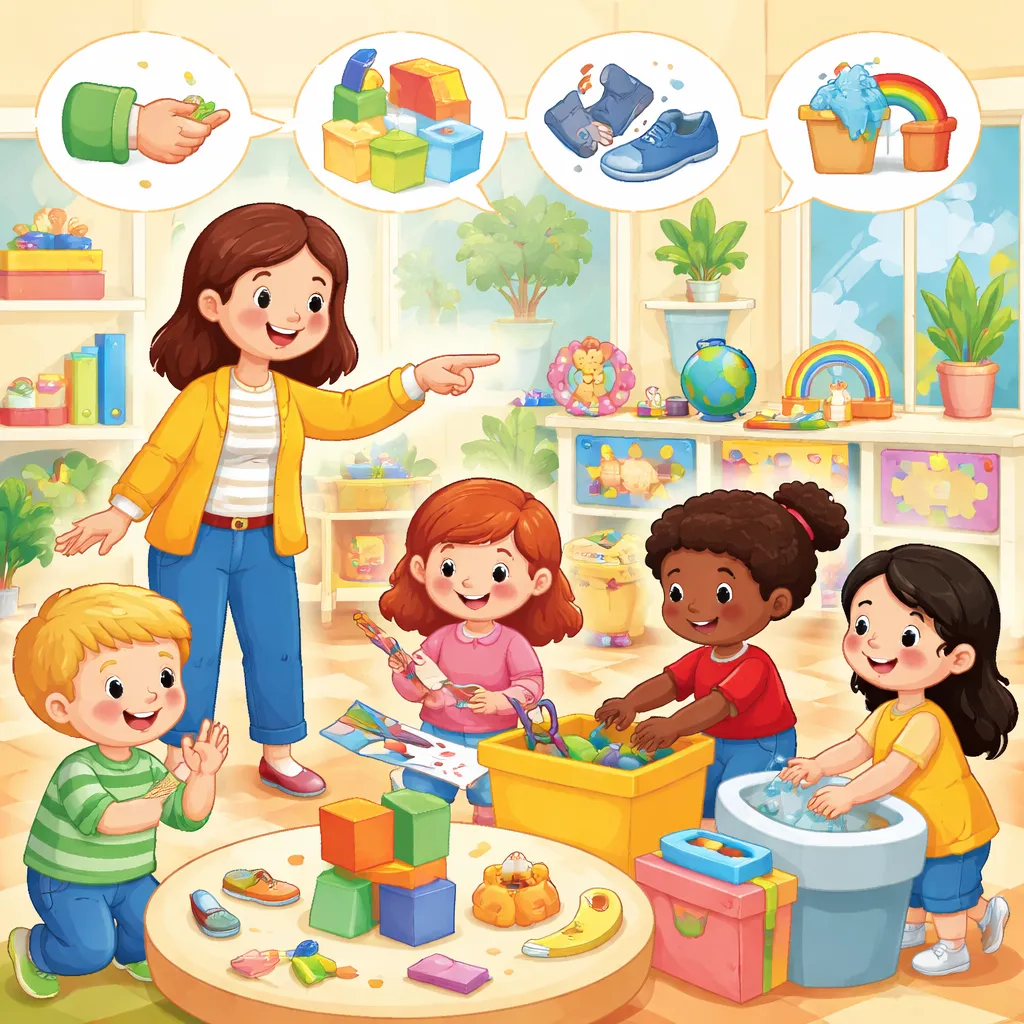

Hello, little leader! Do you know how to ask for help? Can you tell a friend how to play a game? We use a special kind of talk for that. It is called an imperative sentence. An imperative sentence gives a direction, a command, or makes a request. It tells someone to do something. Today, you are a team captain! Your coach is Izzy the Imperative Captain. Izzy holds a whistle. She gives clear directions so the team can work together. Let's learn to give good directions at home, on the playground, at school, and outside!
What Is an Imperative Sentence?
An imperative sentence is a sentence that tells someone to do something. Its main job is to guide action. Think of it like being the leader in a game. The leader says, "Line up here. Toss the ball. Run to the tree!" The leader is not just telling a fact. The leader is not asking a question. The leader is telling people what to do. That is an imperative sentence. It often sounds strong and direct. It usually starts with a verb. The subject 'you' is hiding but we understand it. It can end with a period (.) or an exclamation mark (!). "Please sit down. Look at that! Pass the butter."
Why Are Direction Sentences So Useful?
Using imperative sentences helps everyone work together. It helps your ears listen. You can follow instructions from your teacher or parent. "Please wash your hands." It helps your mouth speak. You can ask for what you need in a clear way. "Help me, please." It helps your eyes read. You can follow recipe steps or game rules. "Mix the flour. Roll the dough." It helps your hand write. You can write simple notes and lists. "Call Grandma. Buy milk." Knowing how to give a clear direction is a super skill.
Two Friendly Ways to Give Directions.
Captain Izzy says we can give directions in two main ways. Both are imperative sentences.
The Direct Command: This is clear and strong. It often starts with the action verb. We use this for quick instructions or warnings. "Stop! Look both ways. Close the door. Listen to me."
The Polite Request: This is kind and gentle. We often add 'please' at the start or the end. It is the best way to ask for help or favors. "Please sit down. Share your toys, please. May I have some water, please?" ('Please' makes it an imperative sentence too!)
How Can You Spot a Direction Sentence?
Captain Izzy has some easy team rules to find an imperative sentence.
Look at the start. Does the sentence begin with an action word (verb)? Words like 'Sit', 'Look', 'Go', 'Put', 'Give', 'Throw' often start imperatives. "Throw the ball."
Look for the hidden 'you'. The subject is almost always 'you', but we don't say it. We understand it. "(You) come here. (You) be quiet." If you can add 'you' at the start, it's probably an imperative.
Listen to the feeling. Does the sentence tell someone to do something? Does it sound like an instruction or a request? "Color inside the lines. Try your best."
Check the end mark. It can end with a period (.) for a normal direction or an exclamation mark (!) for a strong command or warning. "Please wait. Watch out!"
How Do We Build a Good Direction?
Building a good imperative sentence is simple. We start with the action we want.
The Basic Formula: [Verb] + [The Rest of the Direction]. The verb is the most important part. It tells the main action. "Sit on the chair. Eat your veggies. Hold my hand."
To Make it Polite: Add 'please'. You can put it at the start or the end. "Please be quiet. Be quiet, please." You can also start with 'Let's' to include yourself. "Let's go. Let's play a game."
To Make it Strong or for a Warning: Use an exclamation mark (!). "Stop! Look out! Run!"
Where Do the Words Go?
The action word (verb) goes first. This is the key. The person you are talking to is always 'you', but we hide it. The sentence is short and to the point. Your voice can be flat for a normal direction or loud and strong for a warning. Always remember your period or exclamation mark at the end.
Let’s Fix Some Confusing Directions!
Sometimes our directions get mixed up. Let's help Captain Izzy fix the play.
Forgetting to Start with the Verb.
Wrong: "You give me that toy." This is a statement, not a clear command. It sounds a bit bossy. For a clear direction, we hide the 'you' and start with the verb.
Right: "Give me that toy, please." or just "Give me that."
Using a Question Mark for a Command.
Wrong: "Can you close the door?" This is a question. It asks if the person can close it. If you want the action done, use an imperative.
Right: "Please close the door."
Making a Sentence That Is Not a Direction.
Wrong: "Running fast." This is not a full sentence. It is just an action. Who should run? We need a verb command.
Right: "Run fast!" or "Please start running."
Being Too Bossy Without 'Please'.
Wrong: "Give it." This can sound rude. For requests, it's nice to add 'please'.
Better: "Give it, please." or "Please give it to me."
Can You Be the Team Captain?
You are great at this! Let’s play. I will say a sentence. You tell me if it is an imperative sentence. "Please walk." Yes! It starts with 'Please' and is a direction. "The dog walks." No. That tells a fact. "Look at the bird!" Yes! It starts with 'Look' and is a command. "Is the bird pretty?" No. That is a question. Excellent! You are a natural leader.
Captain Izzy's Playbook: 100 Common Imperative Sentences.
Here is a playbook of one hundred directions. They are all imperative sentences. You can use them every day.
At Home:
Please sit down. Eat your dinner. Wash your hands. Go to bed. Brush your teeth. Clean your room. Pick up your toys. Close the door. Turn off the TV. Listen to me. Come here. Give me a hug. Set the table. Pass the salt. Help your sister. Be quiet. Take a bath. Get dressed. Put on your shoes. Hang up your coat. Try your best. Use your words. Share with your brother. Wait your turn. Ask for help.
At the Playground:
Push me on the swing. Throw the ball. Catch it. Slide down. Take turns. Be careful. Wait in line. Go down the slide. Swing higher. Share the shovel. Play nice. Watch out. Get off the monkey bars. Come play with us. Run to the tree. Pick up the trash. Drink some water. Hold my hand. Look both ways. Don't run. Climb up. Be a good friend. Line up here. Have fun. Let's go.
At School:
Line up quietly. Raise your hand. Look at the board. Listen to the teacher. Open your book. Write your name. Color the picture. Cut on the line. Glue it here. Share the crayons. Walk in the hall. Please be quiet. Clean up your space. Put your backpack away. Sit on the carpet. Stand up straight. Work together. Ask a question. Try again. Do your work. Listen carefully. Help your friend. Wait patiently. Follow the rules. Be kind.
In Nature and with Animals:
Look at the bird. Be very quiet. Don't touch that. Pet the dog gently. Feed the fish. Water the plants. Pick the flower. Look both ways. Stay on the path. Listen to the frogs. Watch the clouds. Touch the tree bark. Smell the rose. Hold the worm. Let the butterfly go. Don't scare the squirrel. Walk slowly. Come see this. Pick up the stick. Throw the ball for the dog. Call the cat. Be still. Listen. Watch. Learn.
Strong Commands and Warnings:
Stop! Look out! Watch it! Be careful! Go away! Get back! Don't move! Hurry up! Freeze! Help! Run! Wait! Hush! Quiet! Listen up!
You Are a Master of Directions!
You did it! You know that an imperative sentence gives a direction or makes a request. It often starts with a verb. Captain Izzy gives you a leadership badge. You have learned one hundred common direction sentences. You can now give clear, kind, and helpful directions.
Here is what you learned from our team adventure. You know an imperative sentence tells someone to do something. You learned the two friendly ways: direct commands and polite requests. You can spot them because they often start with an action verb. You can build one using the simple "[Verb] + [The Rest]" formula. You know to add 'please' to be polite.
Now, let’s do some life practice! Your mission is today. Be the Family Helper Captain for one hour. Use polite imperative sentences to help. You can say: "Please pass the peas." or "Let's set the table." or "Look, I cleaned my room!" You are a wonderful and helpful leader