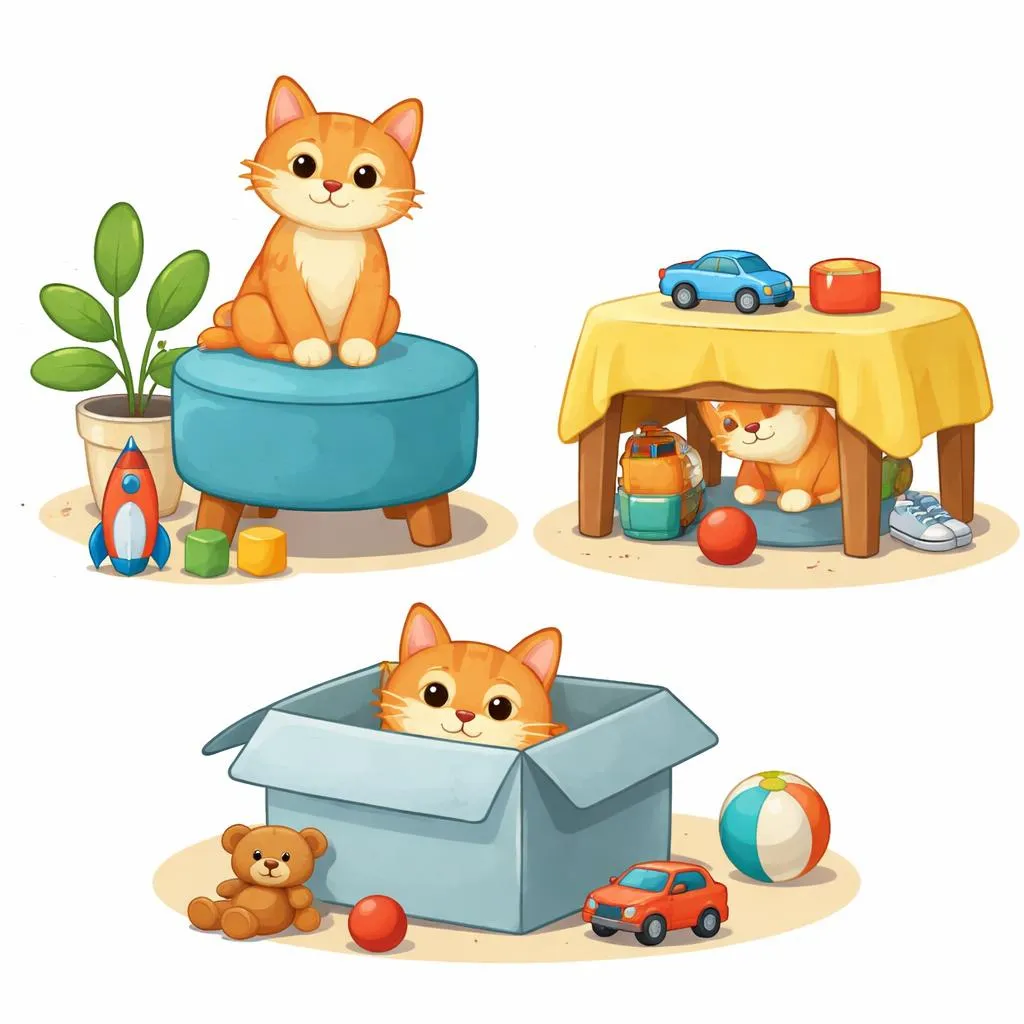

What is the Concept?
Let's explore three little words that tell us a lot: on, in, under. These words are prepositions. They are special words that describe the position or location of something in relation to something else. Learning on in under helps children give clear answers to the question "Where?"
Understanding on in under is about building spatial awareness and descriptive language. It moves communication from vague ("It's there") to specific ("It's under the table"). This knowledge is essential for following and giving instructions, playing games, and describing the world with accuracy.
Meaning and Explanation
Each of the words on in under has a distinct meaning related to position.
On means something is touching the surface of another thing, often from above. The book is on the table.
In means something is surrounded by or enclosed within another thing. The toy is in the box.
Under means something is below or beneath another thing, often covered or hidden. The ball rolled under the sofa.
These prepositions create a mental picture of where objects are located in space. Mastering them allows for precise and clear descriptions.
Categories or Lists
The words on in under belong to the category of basic place prepositions. Other common prepositions in this group include:
Next to / Beside
Behind
In front of
Between
Above / Over
Below
However, on in under are often the first and most crucial set to learn. They cover fundamental spatial relationships that children encounter dozens of times every day. We can think of them as the primary colors of location words.
Daily Life Examples
We use on in under constantly in daily life. We give instructions: "Put your plate on the table." "Your shoes are in the closet." "Look under your bed for the missing sock."
We ask questions: "Where is the cat?" "She is sleeping on the chair." We describe scenes in books: "The fish is in the bowl." During tidy-up time, these words are especially useful: "Put the blocks in the bin." Pointing out these relationships in real-time makes the learning immediate and practical.
Printable Flashcards
Effective printable flashcards for on in under should be visual and clear. A great design shows three nearly identical scenes with one key change. For example:
Card 1: A cat on a mat.
Card 2: A cat in a box (on the mat).
Card 3: A cat under the mat (peeking out).
The word (on, in, or under) is written boldly on the card. This allows children to see how changing one preposition changes the entire meaning of the picture.
Learning Activities and Games
A wonderful activity is the "Preposition Treasure Hunt." Give simple instructions using on in under: "Find something that is under a chair." "Bring me something that is on a shelf." Children love the search and it turns grammar into an active game.
Play "Simon Says with Prepositions." Give commands like: "Simon says, put your hand on your head." "Simon says, put a pencil under your book." This combines listening comprehension with physical movement, solidifying the meaning of each word.
Another engaging game is "Where's the Toy?" Hide a small toy in the room in a very obvious way related to on in under (e.g., under a cushion, in a cup, on a windowsill). The child must describe its location using a full sentence: "The bear is under the blue pillow!" This practices production of the grammar.
Learning Tips
A key tip is to model and expand. When a child points and says "Ball!" you can expand their language by saying, "Yes! The ball is under the table." This gently introduces the preposition in a correct and natural sentence.
Use consistent, contrasting examples. Place the same object (like a teddy bear) in three different spots while saying the sentence: "The bear is on the bed. Now the bear is in the bed. Look, the bear is under the bed!" This direct contrast helps clarify the distinct meaning of each word.
Mastering on in under gives children powerful tools for clear communication. These small words build a foundation for more complex prepositions and detailed descriptions. By turning practice into playful hunts, games, and daily conversations, we help children internalize these concepts not as abstract grammar, but as useful keys to explaining their world. With confidence in on in under, they can navigate, describe, and interact with their environment more effectively.