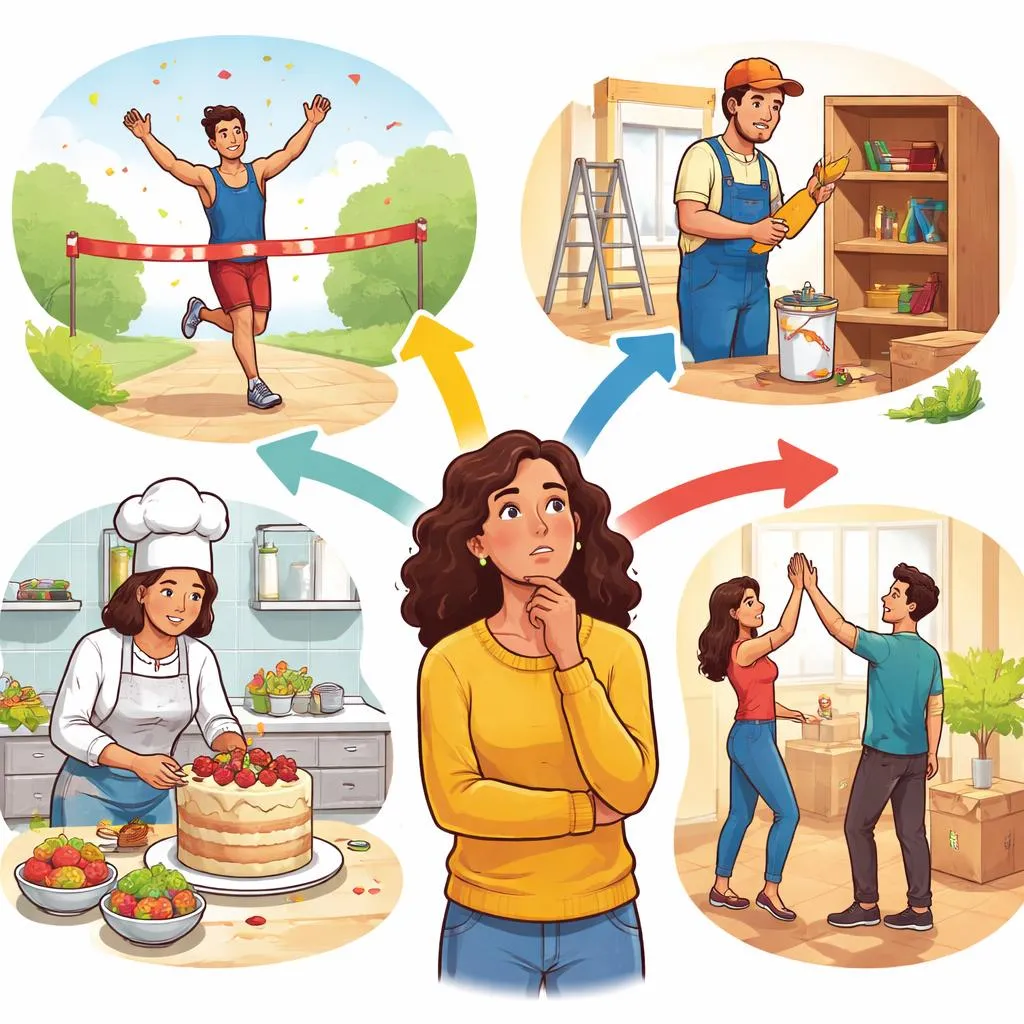

Hey there, word champion! Have you ever run a race? You sprint to the finish line. The fastest runner is the finisher. The act of crossing the line is the finishing. Then, the race is finished. They all talk about ending something. But they are not the same! The words finish, finisher, finishing, and finished are a "Word Race Team". They all connect to completion. Each team member has a special lane. Your job is to learn their lanes. Let's see a quick example at home.
At home, you might say: "I will finish my homework." That is an action you will do. But you could also say: "My homework is finished." That describes the homework's state. Which one is right? They both are! You need the right runner for your sentence race. Let's start our word race!
Adventure! Decoding the Race Team
Welcome to the word stadium! Our four race words are here. They share a root idea. But they are different. Meet Finish, the main action runner. It's a verb or a noun. Meet Finisher, the noun for the person. Meet Finishing, the noun for the act or the -ing form. Meet Finished, the past form and adjective. Let's learn their race strategies.
Dimension One: The Time of Completion – When is the Ending?
Words can show when an action happens. Is it a future plan? Is it happening now? Or is it already done? Let's check the race clock.
Finish: The "Will Do" or "Do Now" Action. This is the basic action. It can happen in the present or future. It is a general action. Look at "school" and "playground" examples.
School example: "We finish class at three o'clock." This is a regular schedule. It happens often.
Playground example: "Can you finish the obstacle course?" This is a request for future action. It will happen.
Finishing: The "Right Now" Action. This word shows the action is in progress. It is happening at this very moment. It's like watching a runner near the line.
Home example: "I am finishing my breakfast right now." The action is ongoing. We can see it.
Animal example: "The beaver is finishing its dam." The action is live. It happens now.
Finished: The "Already Done" Action or State. This form points to the past. The action of finishing is complete. It is finished. It can also describe the current state.
School example: "I finished my science project yesterday." The action is over. It happened earlier.
Playground example: "The game is finished. Let's go home." This describes the game's state now.
Dimension Two: The Role Reveal – Action, Person, Act, or State?
Every word has a role on the "race track". Is it the main action? Is it the name of the doer? Is it the name of the act? Or is it the past action or state?
Finish: The Double-Role Runner. This word has two common roles. First, as a verb. It shows the action of completing. Second, as a noun. It names the end of something.
As a verb (action): "Please finish your milk." Here, "finish" is the action you do. As a noun (the end): "The race had a photo finish." Here, "finish" is the name of the race's end.
Finisher: The Person Noun. This word is a noun. It names a person or thing that finishes. It is the one who completes.
Playground example: "She is always the first finisher in our races." It names her role. She is the completer.
School example: "He is a strong finisher on tests." It names his skill in completing tests.
Finishing: The Act or Ongoing Action. This word is often a noun. It names the act of completing. It can also be the verb's -ing form for ongoing action.
As a noun (act): "The finishing of the mural took a week." This is the name of the completing act. As a verb (ongoing action): "They are finishing the decorations." (With "are", shows ongoing action)
Finished: The Past Action or State Adjective. This word is the past tense and past participle of the verb "finish". It shows a completed action. It can also work as an adjective describing something that is complete.
As a past action (verb): "We finished the puzzle last night." This tells a finished past event. As an adjective (state): "The cake is finished and ready to eat." This describes the cake's condition.
Dimension Three: The Team-Up – What Words Do They Like?
These runners have favorite partners. Knowing their common "teammates" helps us use them correctly.
Finish (Verb): It often takes an object. You finish something. "Finish the book." It teams with helpers like "will", "must", "can". "I will finish soon."
Finish (Noun): It likes articles and adjectives. "A strong finish", "the final finish", "a close finish".
Finisher (Noun): It likes articles and often has a descriptor. "A fast finisher", "the last finisher", "a good finisher".
Finishing (Noun - act): It is often used with "the" or a possessive. "The finishing touch", "my finishing of the job".
Finishing (Verb -ing): It needs a helper verb. "Am/is/are finishing", "was/were finishing". "She is finishing her song."
Finished (Past/Participle): For simple past, it can stand alone. "I finished." For the state, it loves "is", "was", "seems". "The job is finished."
Our Discovery Map: The Race Team Guide
Our race guide is clear. Do you want to talk about the action of completing, in the present or future? Use the verb finish. Do you want to name the end of an event? Use the noun finish. Do you want to name the person or thing that completes? Use the noun finisher. Do you want to name the act of completing? Use the noun finishing. Do you want to show the action is happening right now? Use finishing with "is" or "are". Do you want to talk about the action in the past? Use finished. Do you want to describe something that is complete? Use finished with "is" or "was". Remember, finish is the action or the end. Finisher is the person. Finishing is the act or ongoing action. Finished is the past or the state.
Challenge! Become a Word Race Master
-
Best Word Choice: Read the scene. Pick the best word. (Nature/Animal Scene) A caterpillar has been inside its cocoon. Now, it is in the process of coming out as a butterfly. This action is happening right now. a) The butterfly is a beautiful finisher. b) The butterfly is finishing its transformation. Which one describes the action happening at this very moment? (Answer: b)
-
Two-Word Sentence Showdown: (Home/Kitchen Scene) Imagine cleaning up after dinner. First, use "finish" as a verb to give a command for the action. Example: "Please finish washing the dishes." Now, use "finished" as an adjective to describe the state of the kitchen. Example: "The kitchen is finished and clean."
-
Eagle Eye! Find the Glitch: Look at this sentence. One word form is in the wrong job. Can you fix it? (School/Art Class Scene) "My painting is finish and drying on the rack." What's wrong? "Finish" is a verb or noun. Here, we are trying to describe the state of the painting. We need the adjective form. Fixed sentence: "My painting is finished and drying on the rack."
Your Takeaway and Mission! Make Your Sentences Complete
Great race, word champion! You learned the special roles of each word. You can now choose the right word for any situation. Your English will be precise and clear.
What you can learn from this article:
You now see that finish, finisher, finishing, and finished are a team. But they have different functions. You learned to use "finish" for the action of completing or the end of something. You use "finisher" to name the person or thing that finishes. You use "finishing" for the act of completing or an ongoing action. You use "finished" to talk about a past action or a completed state. You know that "finish" is a verb or noun. "Finisher" and "finishing" are nouns (but finishing can also be a verb). "Finished" is the past or an adjective.
Live Practice Application:
Try this today! Do a task. Talk about the action: "I will finish my bed." Name the person: "I am the finisher of this chore." Talk about the act: "The finishing took five minutes." Describe the state: "My room is finished." When you write or speak, think: Is it the action? Use finish. Is it the person? Use finisher. Is it the act or ongoing? Use finishing. Is it done or in the past? Use finished. Choosing the right word makes your language complete. You are now a master of the race team. Well done!