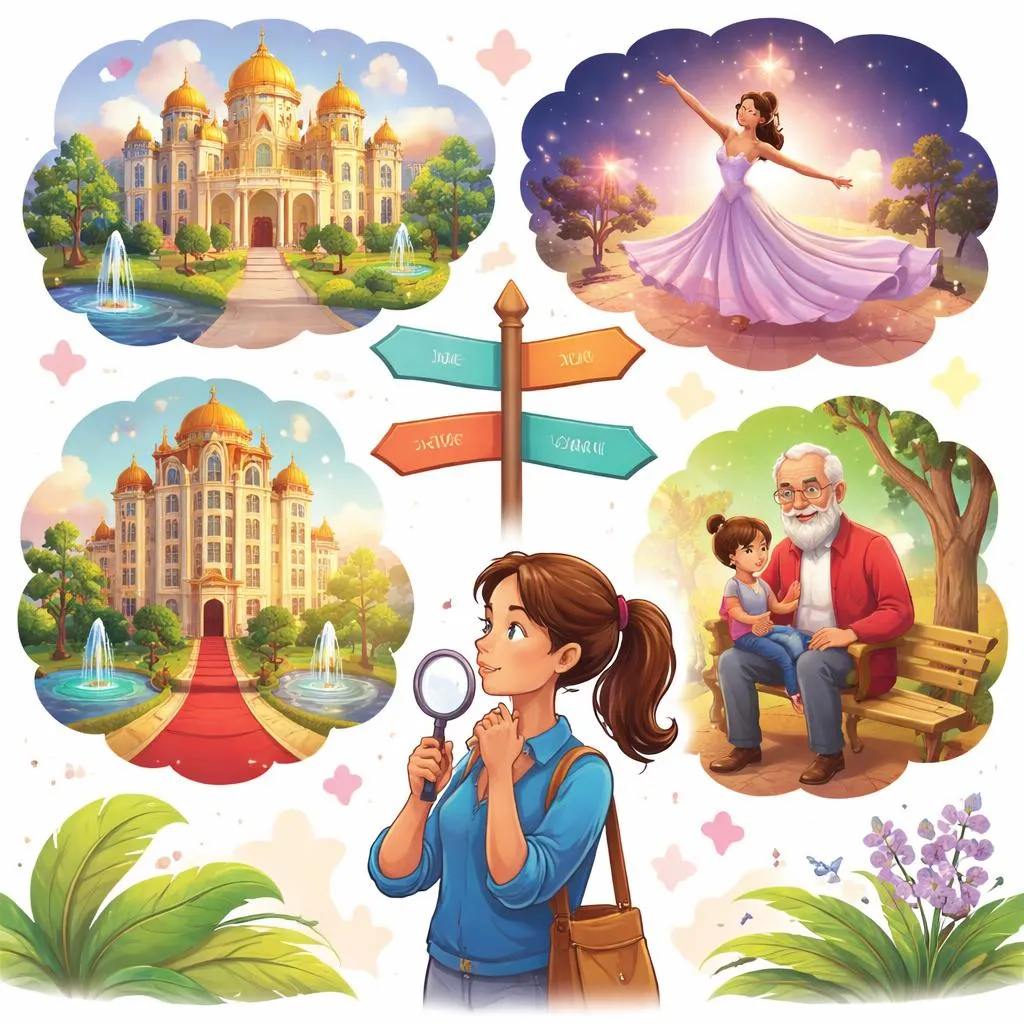

Hello, word explorer! Have you ever seen a huge palace? It is a grand building. The king lives there grandly. The palace is full of grandeur. Your mom's dad is your grandfather. They all have "grand" in them! But they are not the same! The words grand, grandly, grandeur, and grandfather are a "Word Palace Team". They talk about size, style, and family. Each team member is a different part. Your mission is to learn their parts. Let's see a quick example at home.
At home, you might say: "We had a grand family dinner." That describes the dinner. But you could also say: "My grandfather tells great stories." That names a person. Which one is right? They both are! You need the right team member. Let's start our palace tour!
Adventure! Decoding the Palace Team
Welcome to the word palace! Our four palace words are here. They share a root idea. But they are different. Meet Grand. It is an adjective for size or importance. Meet Grandly. It is an adverb for style. Meet Grandeur. It is a noun for impressive quality. Meet Grandfather. It is a noun for a family member. Let's learn their rooms.
Dimension One: The Role Reveal – Description, Manner, Quality, or Person?
Every word has a role. Is it a describing word? Is it a way of doing? Is it a thing? Or is it a person?
Grand: The Size/Importance Adjective. This word is an adjective. It describes a noun. It tells us the noun is large, impressive, or important.
School example: "The school play was a grand success." The word "grand" describes the success.
Nature example: "We saw the grand canyon from the sky." The word "grand" describes the canyon.
Grandly: The Style Adverb. This word is an adverb. It describes how an action is done. It often ends in "-ly". It means in a magnificent or impressive way.
Playground example: "The team celebrated grandly after winning." It describes how they celebrated.
Home example: "The hall was grandly decorated for the party." It describes how it was decorated.
Grandeur: The Quality Noun. This word is a noun. It names the quality of being grand. It is the impressive beauty or large scale of something.
Nature example: "We admired the grandeur of the mountains." It names the impressive quality.
School example: "The old library has a sense of grandeur." It names the feeling.
Grandfather: The Family Noun. This word is a noun. It names the father of a person's parent. It is a family title.
Home example: "My grandfather taught me to fish." It names the person.
Playground example: "Her grandfather picks her up from school." It names the family member.
Dimension Two: The Time Connection – General, Event, or Always?
These words relate to time differently. One is a description. One is a manner tied to an event. One is a timeless quality. One is a permanent relationship.
Grand: A General Description. This describes something in a general way. It can be true now or in the past.
Home example: "They made grand plans for the summer." These are plans for the future.
Grandly: Manner of a Specific Event. This describes how a specific past or present action is performed.
School example: "The principal grandly announced the new library." This happened at a specific time.
Grandeur: A Timeless Quality. This names a quality that exists across time. It doesn't change quickly.
Nature example: "The grandeur of the ocean is timeless." This is always true.
Grandfather: A Permanent Relationship. This names a family role that is always true, from birth.
Dimension Three: The Team-Up – What Words Do They Like?
Knowing their common "palace partners" helps us use them correctly.
Grand (Adjective): It comes before a noun. "Grand opening", "grand piano", "grand idea".
Grandly (Adverb): It modifies action verbs. "Live grandly", "announce grandly", "dress grandly".
Grandeur (Noun): It is used with verbs like "have", "admire", "lack". "Full of grandeur", "the sheer grandeur".
Grandfather (Noun): It likes possessives. "My grandfather", "his grandfather's watch", "our grandfather".
Our Discovery Map: The Palace Team Guide
Our palace guide is clear. Do you want to describe something as large, impressive, or important? Use the adjective grand. Do you want to describe how an action is done, in a magnificent way? Use the adverb grandly. Do you want to name the impressive quality of something big or beautiful? Use the noun grandeur. Do you want to name the father of your parent? Use the noun grandfather. Remember, grand is the description. Grandly is the magnificent manner. Grandeur is the impressive quality. Grandfather is the family member.
Challenge! Become a Word Palace Master
-
Best Word Choice: Read the scene. Pick the best word. (Nature/Animal Scene) A lion walks slowly and proudly across the open plain. It moves in a way that shows it is majestic and impressive. a) The lion walked with grand. b) The lion walked grandly. Which one describes how the lion walked (in a majestic way)? (Answer: b)
-
Two-Word Sentence Showdown: (School/History Lesson) Imagine you are learning about ancient kings. First, use the noun to name the impressive quality of their palaces. Example: "The ruins still show the grandeur of the ancient kingdom." Now, use the adjective to describe one of their big ideas. Example: "They had a grand plan to build a huge wall."
-
Eagle Eye! Find the Glitch: Look at this sentence. One word is not quite right for the meaning. Can you fix it? (Home/Family Tree) "On the family tree, I saw a picture of my mother's grand." What's wrong? "Grand" is an adjective. Here, we are trying to name a person (her parent's father). We need the noun for the family member. Fixed sentence: "On the family tree, I saw a picture of my mother's grandfather."
Your Takeaway and Mission! Make Your Sentences Impressive
Great exploring, word expert! You learned the special roles of each word. You can now choose the right word for any situation. Your English will be precise and clear.
What you can learn from this article:
You now see that grand, grandly, grandeur, and grandfather are a team. But they have different functions. You learned to use "grand" to describe something large or important. You use "grandly" to describe an action done in a magnificent way. You use "grandeur" to name the impressive quality of something. You use "grandfather" to name the father of a parent. You know that "grand" is an adjective, "grandly" is an adverb, "grandeur" and "grandfather" are nouns.
Live Practice Application:
Try this today! Describe a plan: "We have a grand idea for a fort." Talk about a party: "They celebrated grandly." Visit a museum: "Feel the grandeur of the old statues." Talk about family: "My grandfather loves gardening." When you write or speak, think: Is it a description? Use grand. Is it the manner? Use grandly. Is it the impressive quality? Use grandeur. Is it a family member? Use grandfather. Choosing the right word makes your language accurate. You are now a master of the palace team. Well done!