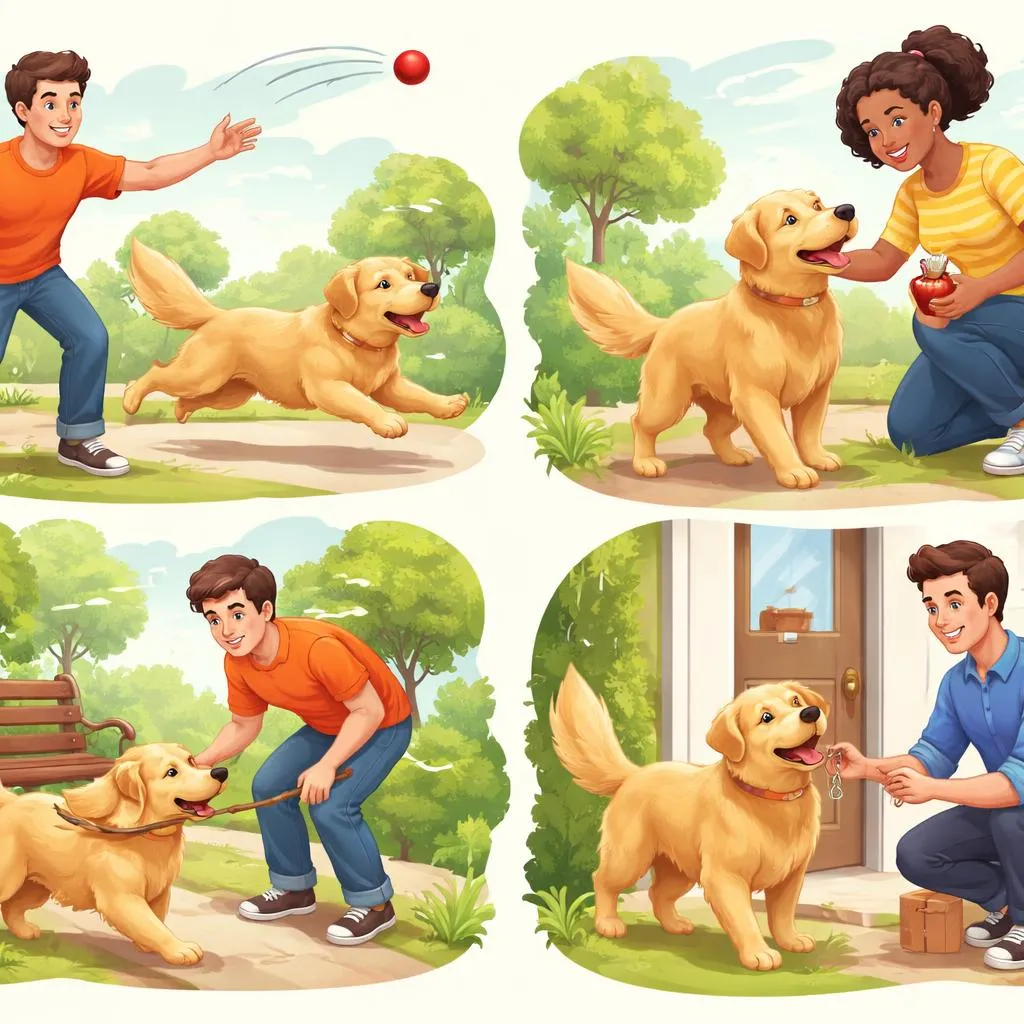

Hello, word adventurer! Do you play fetch with a dog? You throw a ball. The dog runs and gets it. That's the game! But look at these sentences: "I will fetch the ball." "My dog is a good fetcher." They talk about the same idea. Why use different words? The words fetch, fetcher, fetching, and fetched are a "Word Action Team". They all connect to getting and bringing. Each team member has a special skill. Your job is to learn their special moves. Let's see a quick example at home.
At home, you might say: "The dog will fetch the stick." That is an action that will happen. But you could also say: "The dog is a natural fetcher." That describes the dog's talent. Which one is right? They both are! You just need the right team member for your sentence goal. Let's start our training!
Adventure! Decoding the Action Team's Moves
Welcome to the word training ground! Our four action team members are here. They share a root idea. But they do different jobs. Meet Fetch, the main action star. It's the verb. Meet Fetcher, the noun for the doer. Meet Fetching, the -ing form for ongoing action. Meet Fetched, the past form for completed action. Let's learn their playbook.
Dimension One: The Action Timeline – When is the Getting Done?
Words can show when an action happens. Is it a habit? Is it happening now? Or is it already finished? Let's run the clock.
Fetch: The "Will Do" or "Often Do" Action. This is the basic action. It can be a future plan. It can be a regular game. It is a general truth. Look at "playground" and "school" examples.
Playground example: "We often fetch the soccer ball when it goes far." This is a regular activity. It happens often.
School example: "Can you fetch the book from the shelf?" This is a request for a future action. It will happen.
Fetching: The "Right Now" Action. This word shows the action is in progress. It is happening at this very moment. It's like a live video of the game.
Home example: "Look! The dog is fetching the ball right now." The action is ongoing. We can see it.
Animal example: "The retriever is fetching the duck for the hunter." The action is live. It happens now.
Fetched: The "Already Done" Action. This form points to the past. The action of going to get something is complete. It is finished. It tells a story about before.
Home example: "I already fetched the mail this morning." The action is over. It happened earlier.
Playground example: "She fetched the frisbee from the tree." The action happened in the past. It is done.
Dimension Two: The Role Reveal – Action, Person, or Description?
Every word has a role on the "sentence field". Is it the main action? Is it the name of the doer? Or is it a describing word?
Fetch: The Action Star (Verb). Its main job is to show the action of going to get and bring back. It tells us what someone or something does.
Animal example: "The dog can fetch a stick from the lake." The word "fetch" is the main action. It gets the stick.
School example: "Please fetch a chair for our guest." The word "fetch" is the action you are asked to do.
Fetcher: The Doer Noun. This word is a noun. It names the person or animal that does the fetching. It is the one who performs the action.
Home example: "My golden retriever is a champion fetcher." It names the dog's role. The dog is the doer.
Playground example: "In our game, you are the designated fetcher." This names the player's job. The person is the fetcher.
Fetching: The Double-Role Player. This word can have two roles. First, it can be the verb for ongoing action. Second, it can be an adjective meaning "attractive" (less common for kids, but we'll note the main use). We focus on the verb use.
As a verb (ongoing action): "The puppy is fetching the toy." (With "is", shows ongoing action) As an adjective (descriptive): "She wore a fetching hat." This means a charming hat. (We mention but focus on the verb.)
Fetched: The Past Action or State. This word is the past tense and past participle of "fetch". It shows a completed action. It can also work with helpers to form perfect tenses.
As a past action (verb): "He fetched the newspaper an hour ago." This tells a finished past event. With a helper (perfect tense): "The dog has fetched the ball ten times!" This shows an action completed at an unspecified time.
Dimension Three: The Team-Up – What Words Do They Like?
These words have favorite partners. Knowing their common "teammates" helps us use them correctly.
Fetch (Verb): It often takes an object. You fetch something. "Fetch the ball." It teams with helpers like "will", "can", "please".
Fetcher (Noun): It likes articles like "a", "the", or "my". "A good fetcher", "the best fetcher", "my little fetcher".
Fetching (Verb -ing): It almost always needs a helper verb. "Am/is/are fetching", "was/were fetching". "I am fetching the keys."
Fetched (Past/Participle): For simple past, it can stand alone. "I fetched it." For perfect tenses, it loves "have" or "had". "I have fetched the water." It can also be used with "is" in passive voice, but we avoid passive for kids. We'll stick to active voice examples.
Our Discovery Map: The Action Team Playbook
So, what did we find? Our playbook is clear. Do you want to talk about the action of going to get and bring back? Use the verb fetch. Do you want to name the person or animal that does the fetching? Use the noun fetcher. Do you want to show the action is happening right now? Use fetching with "is" or "are". Do you want to talk about the action in the past? Use fetched. Remember, fetch is the main move. Fetcher is the player. Fetching is the move in progress. Fetched is the move that's already done. Their teammates help them shine: fetch takes an object, fetcher needs "a" or "the", fetching loves "is", and fetched for the past stands alone or works with "have".
Challenge! Become a Word Action Master
-
Best Word Choice: Read the scene. Pick the best word. (Nature/Animal Scene) You watch a bird. It flies to get a twig for its nest. It brings the twig back. a) The bird is a good fetcher. b) The bird is fetching a twig. Which one describes the action happening at this very moment? (Answer: b)
-
Two-Word Sentence Showdown: (Home/Laundry Scene) Imagine helping with laundry. Clothes are in the dryer. First, use "fetch" as a verb to give a command for a general action. Example: "Please fetch the clothes from the dryer." Now, use "fetched" as a past action to say what you just did. Example: "I just fetched the socks and shirts."
-
Eagle Eye! Find the Glitch: Look at this sentence. One word form is in the wrong job. Can you fix it? (School/Classroom Scene) "My job is the fetch of the art supplies for the teacher." What's wrong? "Fetch" is a verb. Here, we are trying to name the job or activity. We need a noun form for the activity. Fixed sentence: "My job is the fetching of the art supplies for the teacher." Or, more naturally: "My job is fetching the art supplies for the teacher."
Your Takeaway and Mission! Make Your Sentences Energetic
Great work, action team coach! You learned the special skills of each word. You can now choose the right word for any play. Your sentences will be lively and clear.
What you can learn from this article:
You now see that fetch, fetcher, fetching, and fetched are a team. But each plays a different part. You learned to use "fetch" for the action of going to get something. You use "fetcher" to name the person or animal that fetches. You use "is fetching" for an action happening right now. You use "fetched" to talk about a past action. You found that "fetch" often has an object. "Fetcher" is a person or animal. "Fetching" as a verb needs "is". And "fetched" tells a past story.
Live Practice Application:
Try this today! Play a game with a pet or a friend. Give a command: "Fetch the toy!" Talk about the player: "You are a great fetcher!" Describe the ongoing action: "He is fetching it now!" Talk about what's done: "She fetched it already!" When you write a story, think: Is it a general action? Use fetch. Is it the doer? Use fetcher. Is it happening now? Use is fetching. Is it in the past? Use fetched. Picking the right word makes your story active and fun. You are now a master of the fetch action team. Well done