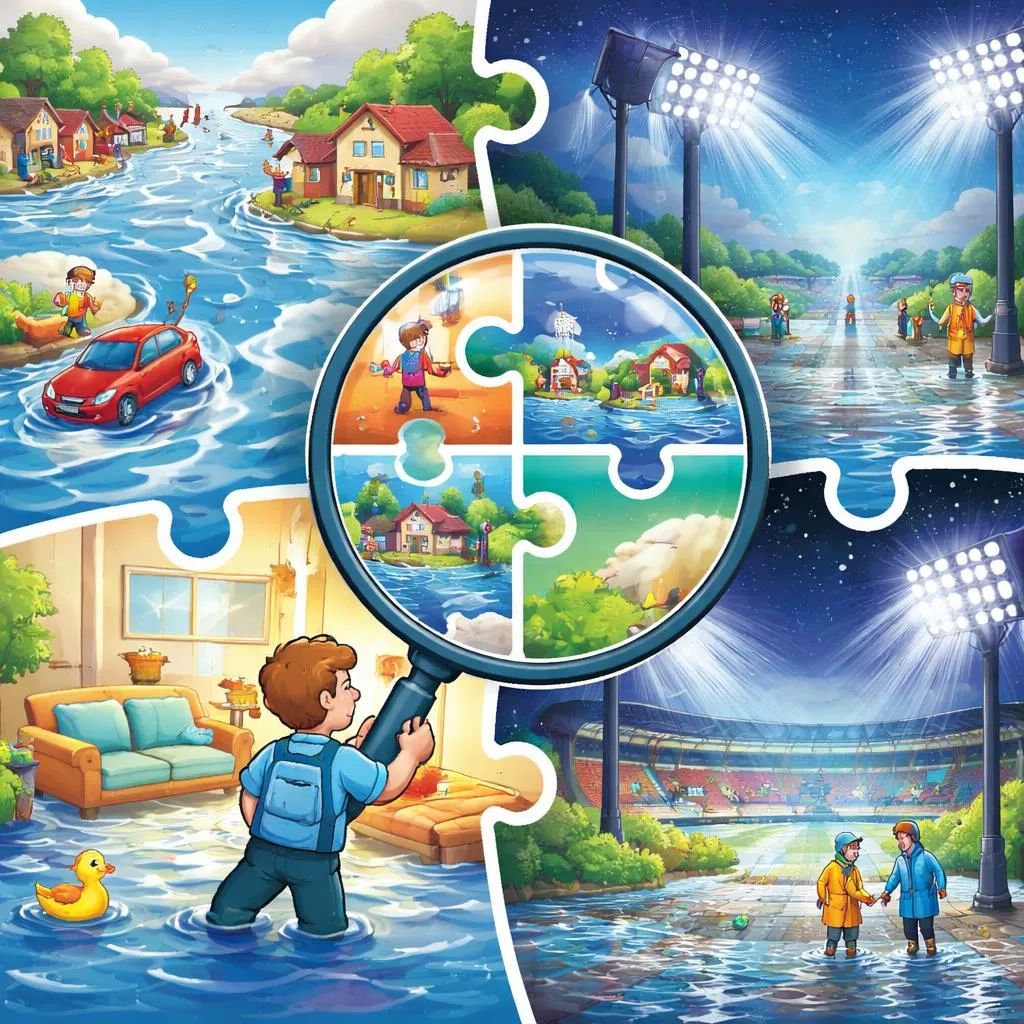

Hello, word explorer! Have you ever seen a heavy rainstorm? Too much rain can cause a flood. The water is flooding the streets. Yesterday, the basement was flooded. At night, a bright floodlight helps people see. They all have "flood" in them. But they are not the same! The words flood, flooding, flooded, and floodlight are a "Word Weather Team". They all connect to water or light. Each team member gives a different warning. Your job is to learn their signals. Let's see a quick example at home.
At home, you might say: "The heavy rain may flood the garden." That is a possible event. But you could also say: "The garden is flooded now." That describes the garden's state. Which one is right? They both are! You need the right team member for your sentence. Let's start our weather watch!
Adventure! Decoding the Weather Team
Welcome to the word weather station! Our four weather words are here. They share a root idea. But they are different. Meet Flood. It is a noun for a water event or a verb for the action. Meet Flooding. It is a noun for the process or the -ing form. Meet Flooded. It is the past form and adjective. Meet Floodlight. It is a compound noun for a bright light. Let's learn their forecasts.
Dimension One: The Time of Water – When is the Water Rising?
Words can show when an action happens. Is it a general event? Is it happening now? Or is it already done? Let's check the weather timeline.
Flood: The "May Happen" or "General" Event. This word can be a noun for a large amount of water. It can be a verb for the action of covering with water. Look at "school" and "playground" examples.
School example: "The river might flood after the storm." This is a possible future event. It may happen.
Nature example: "A flood can damage homes." This is a general noun for the event.
Flooding: The "Right Now" Process. This word shows the action is in progress. Water is covering an area now. It's like watching the water rise.
Home example: "The heavy rain is flooding the basement now." The action is ongoing. We can see it.
Playground example: "Water is flooding the soccer field." The action is live. It happens now.
Flooded: The "Already Done" Action or State. This form points to the past. The action of flooding is complete. It can also describe the current wet state.
School example: "The heavy rains flooded the streets yesterday." The action is over. It happened earlier.
Home example: "The kitchen floor is flooded and wet." This describes the floor's state now.
Dimension Two: The Role Reveal – Event, Process, State, or Object?
Every word has a role. Is it an event? Is it a process? Is it a state? Or is it an object?
Flood: The Double-Role Word. This word has two common roles. First, as a noun. It names a large overflow of water. Second, as a verb. It means to cover with water.
As a noun (event): "The flood was very destructive." Here, "flood" is the event. As a verb (action): "The river will flood the valley." Here, "flood" is the action it will do.
Flooding: The Process or Ongoing Action. This word is often a noun. It names the process of water covering an area. It can also be the verb's -ing form for ongoing action.
As a noun (process): "The flooding lasted for two days." This is the name of the process. As a verb (ongoing): "The creek is flooding its banks." (With "is", shows ongoing action)
Flooded: The Past Action or State Adjective. This word is the past tense and past participle of the verb "flood". It shows a completed action. It can also work as an adjective describing something covered with water.
As a past action (verb): "The storm flooded the town last week." This tells a finished past event. As an adjective (state): "The path is flooded and closed." This describes the path's condition.
Floodlight: The Object Noun. This word is a compound noun. It names a very bright light that covers a wide area. It is not about water.
Playground example: "The football field has tall floodlights." It names the lights. School example: "A floodlight lit up the parking lot." It names the object.
Dimension Three: The Team-Up – What Words Do They Like?
Knowing their common "teammates" helps us use them correctly. Safety is important.
Flood (Noun): It likes articles and adjectives. "A terrible flood", "the great flood", "flash flood".
Flood (Verb): It often takes an object. "The rain will flood the streets." It teams with helpers: "may flood", "could flood".
Flooding (Noun): It is often used with "the" or adjectives. "The severe flooding", "constant flooding".
Flooding (Verb -ing): It needs a helper verb. "Is/are flooding", "was/were flooding". "Water is flooding the road."
Flooded (Past/Participle): For simple past, it can stand alone. "The river flooded." For the state, it loves "is", "was", "has been". "The field is flooded."
Floodlight (Noun): It likes articles and can be part of compounds. "A powerful floodlight", "the stadium floodlights", "floodlight tower".
Our Discovery Map: The Weather Team Guide
Our forecast guide is clear. Do you need to name a large overflow of water? Use the noun flood. Do you want to talk about the action of water covering an area? Use the verb flood. Do you want to name the process of water covering? Use the noun flooding. Do you want to show the action is happening right now? Use flooding with "is" or "are". Do you want to talk about the action in the past? Use flooded. Do you want to describe an area covered with water? Use flooded with "is" or "was". Do you want to name a very bright light? Use the noun floodlight. Remember, flood is the event or the action. Flooding is the process or ongoing action. Flooded is the past or the state. Floodlight is a bright light.
Challenge! Become a Word Weather Master
-
Best Word Choice: Read the scene. Pick the best word. (Nature/Animal Scene) After days of rain, a beaver's pond has risen. Water is currently overflowing and covering the nearby forest floor. This action is happening now. a) The beaver dam caused a flood. b) Water is flooding the forest floor. Which one describes the action happening at this very moment? (Answer: b)
-
Two-Word Sentence Showdown: (School/Safety Drill Scene) Imagine a safety lesson about storms. First, use the verb to warn about a possible future event. Example: "Heavy rain could flood the lower playground." Now, use the adjective to describe the playground after the storm. Example: "After the storm, the playground was flooded."
-
Eagle Eye! Find the Glitch: Look at this sentence. One word is not quite right for the meaning. Can you fix it? (Home/Evening Scene) "We turned on the flood in the backyard to play at night." What's wrong? "Flood" by itself usually refers to water. We need the word for the bright light. Fixed sentence: "We turned on the floodlight in the backyard to play at night."
Your Takeaway and Mission! Make Your Sentences Clear
Great forecasting, word weather expert! You learned the special roles of each word. You can now choose the right word for any situation. Your English will be precise and safe.
What you can learn from this article:
You now see that flood, flooding, flooded, and floodlight are a team. But they have different functions. You learned to use "flood" for the water event or the action of covering with water. You use "flooding" for the process or an ongoing action. You use "flooded" for a past action or a water-covered state. You use "floodlight" for a bright outdoor light. You know that "flood" is a noun or verb. "Flooding" is a noun or verb. "Flooded" is a verb or adjective. "Floodlight" is a compound noun.
Live Practice Application:
Try this today! Listen to a weather report. Talk about a risk: "The river may flood." See water rising: "The street is flooding." See a wet area: "The field is flooded." See a bright light: "The floodlight is on." When you write or speak, think: Is it the event? Use flood. Is it the process? Use flooding. Is it the state or past? Use flooded. Is it the light? Use floodlight. Choosing the right word makes your language accurate. You are now a master of the weather team. Well done!