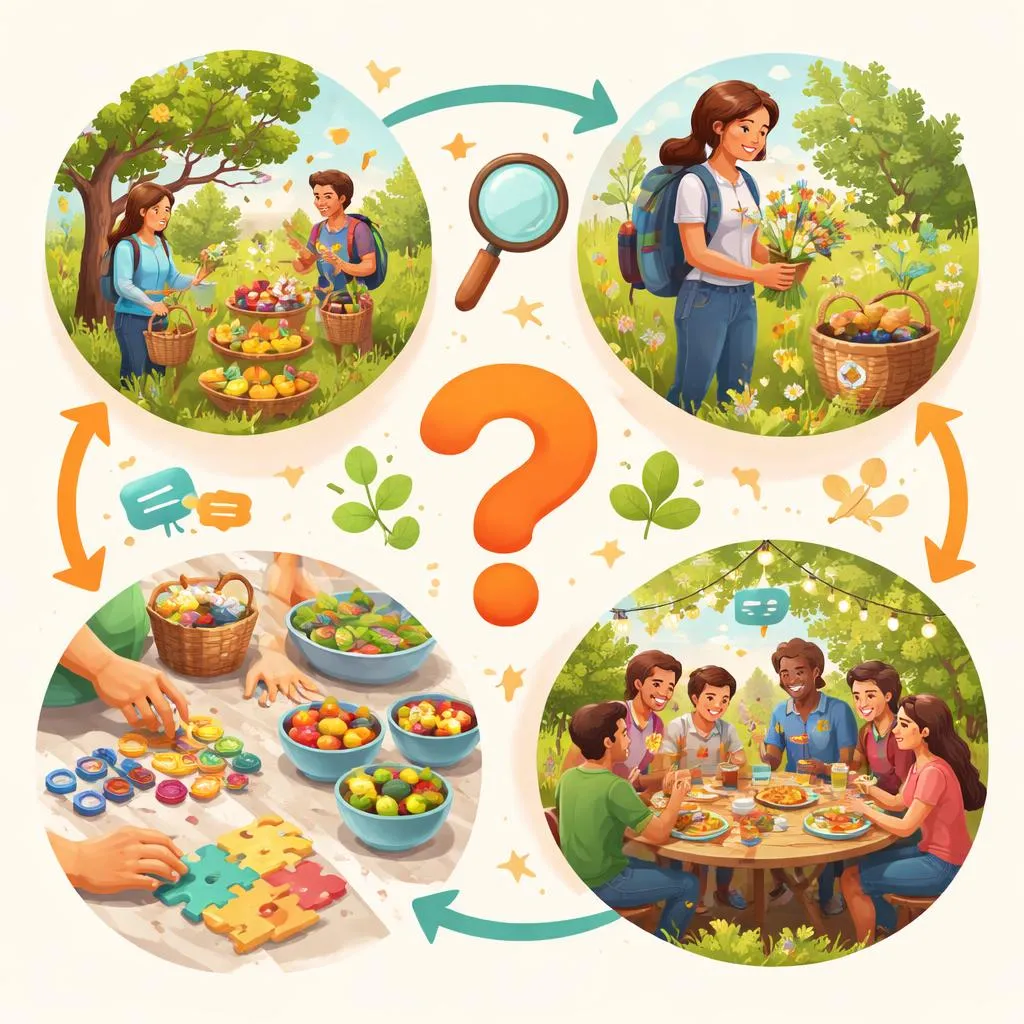

Hey there, word collector! Have you ever picked up toys? You gather them into a box. In history, a person who collected food was a gatherer. A party is a fun gathering. Yesterday, you gathered your friends for a game. They all talk about collecting or coming together. But they are not the same! The words gather, gatherer, gathering, and gathered are a "Word Collection Team". They all connect to bringing things or people together. Each team member has a different basket. Your mission is to learn their baskets. Let's see a quick example at home.
At home, you might say: "Let's gather the dirty dishes." That is an action. But you could also say: "Our family gathering is next week." That names an event. Which one is right? They both are! You need the right collector for your sentence. Let's start our collection!
Adventure! Decoding the Collection Team
Welcome to the word meeting place! Our four collection words are here. They share a root idea. But they are different. Meet Gather. It is a verb for the action. Meet Gatherer. It is a noun for the person. Meet Gathering. It is a noun for the event or act. Meet Gathered. It is the past form of the verb. Let's learn their collections.
Dimension One: The Time of Action – When is the Collecting?
Words can show when an action happens. Is it a plan? Is it happening now? Or is it already done? Let's check the collection clock.
Gather: The "Will Do" or "Can Do" Action. This is the basic action. It can happen in the present or future. It is a general instruction. Look at "school" and "playground" examples.
School example: "We gather for assembly every Monday." This is a present habit. It happens regularly.
Playground example: "Gather your team before the game starts." This is a future instruction. Do it soon.
Gathering: The "Right Now" Action or Planned Event. This word can show the action is in progress. It can also name a planned meeting. It's like watching people come together now.
As a verb (ongoing): "The kids are gathering for the story time." (With "are", shows ongoing action) As a noun (event): "The school picnic is a big gathering." It names the event.
Gathered: The "Already Done" Action. This form points to the past. The action of gathering is complete. It is finished. It tells a story about before.
School example: "The class gathered around the science experiment." The action is over. It happened.
Home example: "We gathered all the laundry this morning." The collecting happened in the past.
Dimension Two: The Role Reveal – Action, Person, Event, or Past Action?
Every word has a role. Is it the main action? Is it a person? Is it a thing? Or is it a past action?
Gather: The Action Verb. This word is a verb. It shows the action of collecting things or people into one place. It tells us what someone or something does.
Playground example: "Gather the balls after recess." The word "gather" is the action.
Nature example: "Birds gather twigs to build nests." The word "gather" is what they do.
Gatherer: The Person Noun. This word is a noun. It names a person who collects things. In history, hunter-gatherers collected wild food. Today, it can mean a collector.
School example: "We learned about ancient hunter-gatherers." It names the type of people.
Nature example: "The squirrel is a gatherer of nuts for winter." It names the squirrel's role.
Gathering: The Event or Activity Noun. This word is a noun. It names an event where people meet. It can also name the activity of collecting.
Home example: "Our family gathering is at Grandma's house." It names the event.
Playground example: "The gathering of leaves took an hour." It names the activity.
Gathered: The Past Action. This word is the past tense and past participle of the verb "gather". It shows a completed action. It can also be used with helpers like "have" or "had".
As a past action: "I gathered my courage and went on stage." This tells a finished past event. With a helper: "She has gathered a large stamp collection." This shows an experience up to now.
Dimension Three: The Team-Up – What Words Do They Work With?
Knowing their common "collection partners" helps us use them correctly.
Gather (Verb): It often takes an object. "Gather information", "gather flowers". It teams with prepositions. "Gather around", "gather up", "gather in".
Gatherer (Noun): It likes articles and adjectives. "A skilled gatherer", "the primary gatherer", "berry gatherers".
Gathering (Noun - Event): It likes articles and adjectives. "A social gathering", "the annual gathering", "large gathering".
Gathering (Noun - Activity): It is often used with "the". "The gathering of data", "the gathering of supplies".
Gathered (Past/Participle): It can stand alone. "We gathered." It is used with helpers. "Has gathered", "had gathered". It can be an adjective: "the gathered crowd".
Our Discovery Map: The Collection Team Guide
Our collection guide is clear. Do you want to talk about the action of collecting or coming together? Use the verb gather. Do you want to name a person who collects things? Use the noun gatherer. Do you want to name a meeting event or the activity of collecting? Use the noun gathering. Do you want to talk about the action in the past? Use gathered. Remember, gather is the action. Gatherer is the person. Gathering is the event or activity. Gathered is the past action.
Challenge! Become a Word Collection Master
-
Best Word Choice: Read the scene. Pick the best word. (Nature/Animal Scene) In autumn, a colony of squirrels is busy collecting and storing acorns. This activity of collecting food is their main job right now. a) The squirrels are in gather mode. b) The squirrels are in gathering mode. Which one names the activity of collecting that they are doing? (Answer: b)
-
Two-Word Sentence Showdown: (School/Project Day) Imagine your class is working on a history project about early humans. First, use the noun to name the type of person who collected plants. Example: "A gatherer would collect berries and roots." Now, use the verb in the past to say what the class did with information. Example: "We gathered facts from books and the internet."
-
Eagle Eye! Find the Glitch: Look at this sentence. One word is not quite right for the meaning. Can you fix it? (Home/Picnic Scene) "For the picnic, we need to gatherer all the plates and cups." What's wrong? "Gatherer" is a noun for a person. Here, we are trying to use the action verb. We need the base form of the verb. Fixed sentence: "For the picnic, we need to gather all the plates and cups."
Your Takeaway and Mission! Make Your Sentences Complete
Great collecting, word expert! You learned the special roles of each word. You can now choose the right word for any situation. Your English will be precise and clear.
What you can learn from this article:
You now see that gather, gatherer, gathering, and gathered are a team. But they have different functions. You learned to use "gather" for the action of collecting or coming together. You use "gatherer" to name a person who collects. You use "gathering" to name a meeting event or the activity of collecting. You use "gathered" to talk about a past action of collecting. You know that "gather" is a verb, "gatherer" and "gathering" are nouns, and "gathered" is a verb.
Live Practice Application:
Try this today! Clean your room: "I will gather my toys." Talk about history: "Early humans were gatherers." Plan an event: "We are having a family gathering." Talk about yesterday: "I gathered shells at the beach." When you write or speak, think: Is it the action? Use gather. Is it the person? Use gatherer. Is it the event or activity? Use gathering. Is it in the past? Use gathered. Choosing the right word makes your language accurate. You are now a master of the collection team. Well done!