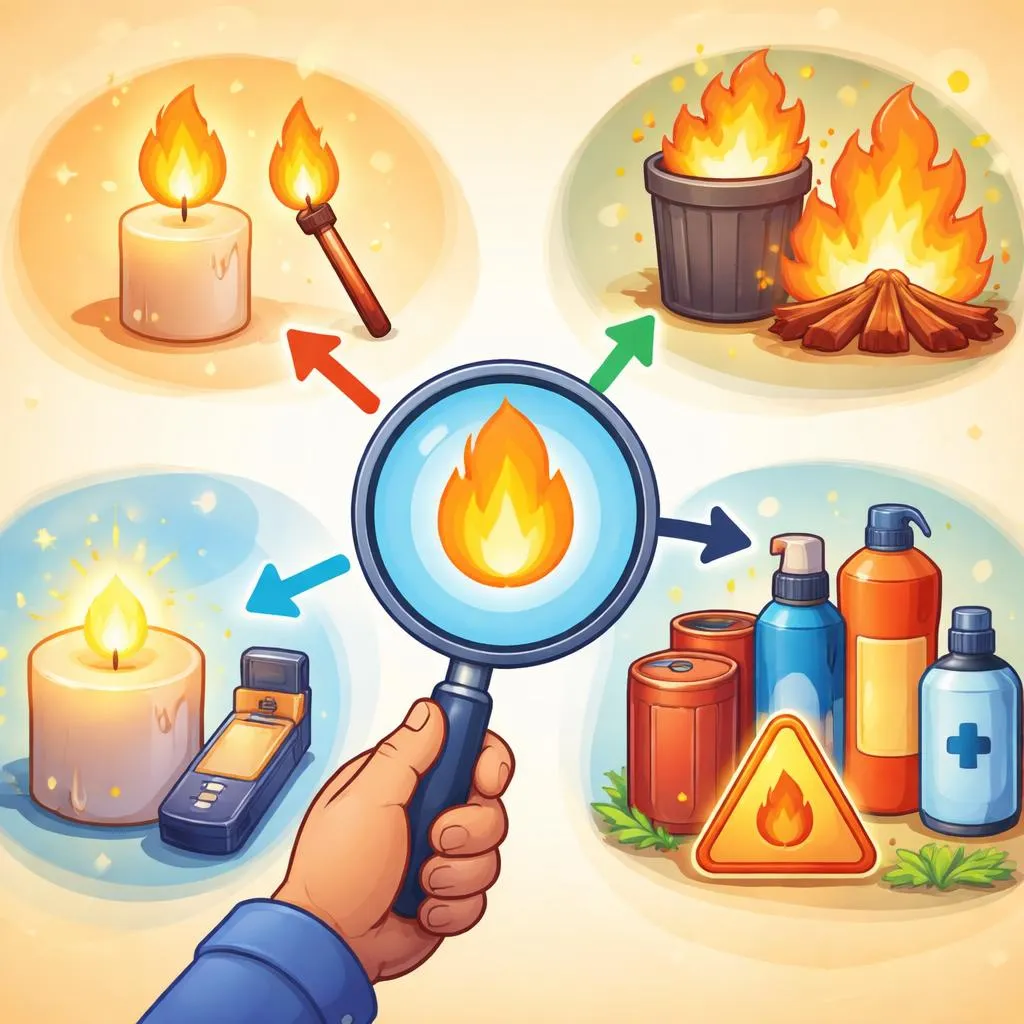

Hey there, word scientist! Have you ever watched a candle? It has a bright flame. The wick is flaming. A battery-powered light is flameless. A piece of paper is flammable. They all talk about fire. But they are not the same! The words flame, flaming, flameless, and flammable are a "Word Fire Team". They all connect to burning. Each team member gives a different warning. Your job is to learn their safety signals. Let's see a quick example at home.
At home, you might say: "Do not touch the candle flame." That names the dangerous part. But you could also say: "The paper is flammable." That warns about a danger. Which one is right? They both are! You need the right team member for your sentence. Let's start our safety lesson!
Adventure! Decoding the Fire Team
Welcome to the word lab! Our four fire words are here. They share a root idea. But they are different. Meet Flame. It is a noun for the burning part. It can also be a verb. Meet Flaming. It is an adjective for something on fire. It is also the -ing form. Meet Flameless. It is an adjective for no flame. Meet Flammable. It is an adjective for easy to burn. Let's learn their safety rules.
Dimension One: The State of Burning – Is It On Fire, Off, or Risky?
These words describe different states about fire. One is the fire itself. One is the state of burning. One is the absence of flame. One is the potential for fire.
Flame: The Fire Itself (Noun). This word is a noun. It names the visible, glowing part of a fire. It is the thing you see.
School example: "The Bunsen burner has a blue flame." The word "flame" is the thing. It is the fire part.
Playground example: "The campfire's flame was warm." The word "flame" names the fire's light.
Flaming: The Burning State (Adjective). This word is an adjective. It describes something that is on fire. It is actively burning. It can also mean very bright or angry.
Home example: "The flaming logs crackled in the fireplace." It describes the logs. They are on fire.
Nature example: "The flaming torch lit the path." It describes the torch. It is burning.
Flameless: The Safe State (Adjective). This word is an adjective. It describes something that works without a flame. It is safe from open fire.
Home example: "We use a flameless candle for decoration." It describes the candle. It has no real flame.
School example: "The science demo used a flameless heater." It describes the heater. It is electric.
Flammable: The Dangerous Potential (Adjective). This word is an adjective. It describes a material that can catch fire easily. It is a warning.
School example: "The label says the liquid is flammable." It warns about the liquid. It can burn.
Playground example: "Dry leaves are very flammable." It warns about the leaves. They burn easily.
Dimension Two: The Role Reveal – Noun, Adjective, or Verb?
Every word has a role. Is it a thing? Is it a describing word? Or is it an action?
Flame: The Double-Role Word. This word has two roles. First, as a noun. It names the fire. Second, as a verb. It means to burn with flames or to get angry.
As a noun (thing): "The flame danced on the candle." Here, "flame" is the object. As a verb (action): "The logs began to flame." Here, "flame" is the action. (Less common for kids)
Flaming: The Describing Adjective or Verb Form. This word is mainly an adjective. It describes a noun as being on fire. It can also be the -ing form of the verb.
As an adjective: "He threw the flaming stick into the fire." It describes the stick. As a verb (ongoing): "The fire is flaming brightly." (With "is", shows ongoing action)
Flameless: The Describing Adjective. This word is always an adjective. It describes a noun as having no flame. It is a safe description.
Flammable: The Describing Adjective. This word is always an adjective. It describes a noun as being able to catch fire. It is a warning description.
Dimension Three: The Team-Up – What Words Do They Work With?
Knowing their common "partners" helps us use them correctly. Safety is key.
Flame (Noun): It likes articles and adjectives. "A hot flame", "the candle flame", "a small flame".
Flame (Verb): It is less common. It can be used: "The fire flamed up."
Flaming (Adjective): It usually comes before a noun. "Flaming arrows", "flaming passion", "flaming hot".
Flaming (Verb -ing): It needs a helper verb. "Is/are flaming", "was/were flaming". "The volcano is flaming."
Flameless (Adjective): It often comes before a noun. "Flameless heater", "flameless device", "flameless technology".
Flammable (Adjective): It often comes before a noun or after "is". "Flammable gas", "the material is flammable", "highly flammable".
Our Discovery Map: The Fire Team Guide
Our safety guide is clear. Do you need to name the visible, burning part of a fire? Use the noun flame. Do you want to describe something that is on fire right now? Use the adjective flaming. Do you want to describe something that works without an open flame? Use the adjective flameless. Do you want to warn that something can catch fire easily? Use the adjective flammable. Remember, flame is the thing or the action. Flaming is the burning state. Flameless is the safe, no-flame state. Flammable is the dangerous potential. Their partners help them: the noun flame needs "a" or "the", the adjectives describe nouns, and safety comes first!
Challenge! Become a Word Safety Master
-
Best Word Choice: Read the scene. Pick the best word. (Nature/Animal Scene) A forest ranger sees a pile of very dry twigs and pine needles. These materials can catch fire very easily in hot weather. a) The pile is flaming. b) The pile is flammable. Which one describes the material's dangerous potential to catch fire? (Answer: b)
-
Two-Word Sentence Showdown: (Home/Kitchen Scene) Imagine you are with an adult who is cooking. First, use the noun to name what you see on the gas stove. Example: "I see a blue flame under the pot." Now, use the adjective to describe a safe, battery-powered light used at night. Example: "I have a flameless nightlight in my room."
-
Eagle Eye! Find the Glitch: Look at this sentence. One word is not quite right for the meaning. Can you fix it? (School/Science Class) "For the experiment, we used a flammable heater to avoid any fire risk." What's wrong? "Flammable" means it can catch fire easily. That would be risky, not safe. We want a heater that does not have a flame. Fixed sentence: "For the experiment, we used a flameless heater to avoid any fire risk."
Your Takeaway and Mission! Make Your Sentences Safe
Great work, word safety expert! You learned the special roles of each word. You can now choose the right word for any situation. Your English will be precise and safe.
What you can learn from this article:
You now see that flame, flaming, flameless, and flammable are a team. But they have different safety messages. You learned to use "flame" for the burning part of a fire. You use "flaming" to describe something that is on fire. You use "flameless" to describe something safe with no flame. You use "flammable" to warn about things that can burn easily. You know that "flame" is a noun or verb. "Flaming" is an adjective or verb. "Flameless" and "flammable" are adjectives.
Live Practice Application:
Try this today! Look at a candle safely. Name it: "That is a flame." See a fire: "The wood is flaming." See a safe light: "That is a flameless lamp." Read a warning label: "This is flammable." When you write or speak, think: Is it the fire? Use flame. Is it burning? Use flaming. Is it safe without fire? Use flameless. Is it a fire hazard? Use flammable. Choosing the right word keeps your meaning clear and safe. You are now a master of the fire team. Well done!