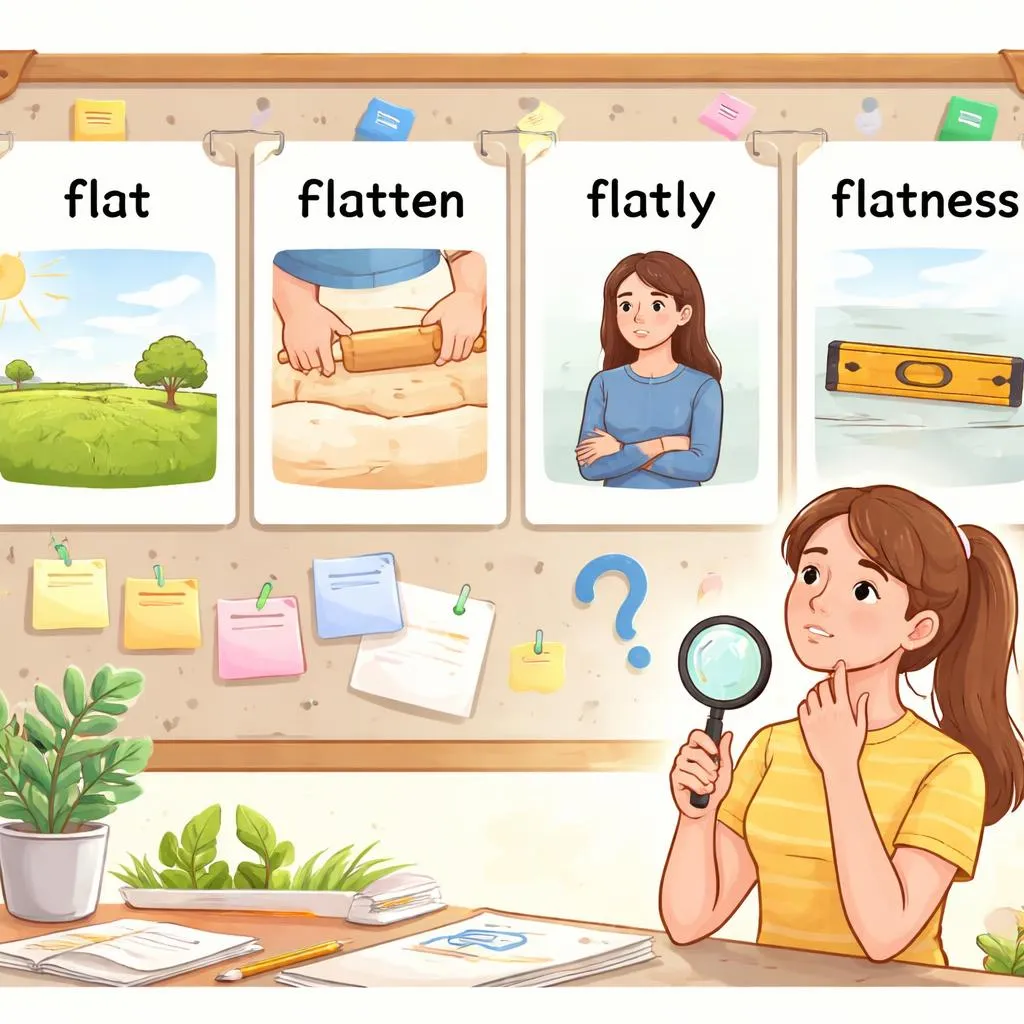

Hey there, word explorer! Have you ever seen a pancake? It is flat. You flatten the dough. Someone might say flatly, "No more pancakes." The flatness of the plate helps. They all have "flat" in them. But they are not the same! The words flat, flatten, flatly, and flatness are a "Word Shape Team". They all connect to being level or smooth. Each team member has a different job. Your job is to learn their jobs. Let's see a quick example at home.
At home, you might say: "The tabletop is flat." That describes the table. But you could also say: "I will flatten the wrinkled paper." That is an action. Which one is right? They both are! You need the right team member for your sentence. Let's start our shaping adventure!
Adventure! Decoding the Shape Team
Welcome to the word workshop! Our four shape words are here. They share a root idea. But they are different. Meet Flat. It is an adjective for a level surface. Meet Flatten. It is a verb for making something flat. Meet Flatly. It is an adverb for a direct way of speaking. Meet Flatness. It is a noun for the quality of being flat. Let's examine their shapes.
Dimension One: The Role Reveal – What's Your Job in the Sentence?
Every word has a role. Is it a describing word? Is it an action? Is it a way of doing? Or is it a thing?
Flat: The Describing Adjective. This word is an adjective. It describes a noun. It tells us the noun is level, smooth, or without curves.
School example: "The playground has a flat area for running." The word "flat" describes the noun "area". It means level.
Nature example: "The land is very flat here." The word "flat" describes the noun "land".
Flatten: The Action Verb. This word is a verb. It means to make something flat. It is the action of pressing or smoothing.
Home example: "We flatten the dough with a roller." The word "flatten" is the action we do.
Playground example: "The heavy roller can flatten the sand." The word "flatten" is the action the roller does.
Flatly: The Manner Adverb. This word is an adverb. It describes how someone says something. It often means in a direct, firm way without emotion.
School example: "She flatly refused to cheat on the test." It describes how she refused. It means directly.
Home example: "He stated flatly that he was finished." It describes how he stated.
Flatness: The Quality Noun. This word is a noun. It names the state or quality of being flat. It is the idea of levelness.
Nature example: "The flatness of the desert is amazing." It names the quality of the desert. It is the thing that is amazing.
Playground example: "We checked the flatness of the field for the game." It names the quality we checked.
Dimension Two: The Meaning Focus – State, Action, Way of Speaking, or Idea?
These words point to different aspects. One is the state of being level. One is the action of making level. One is the manner of speaking. One is the abstract idea of levelness.
Flat: The State of Being. This word focuses on the condition of a surface. It is not sloping or curved.
Flatten: The Process of Making. This word focuses on the action of changing something to become flat.
Flatly: The Style of Communication. This word focuses on the way words are spoken—directly and without extra feeling.
Flatness: The Abstract Concept. This word focuses on the concept of being flat. It is the noun form of the adjective.
Dimension Three: The Team-Up – What Words Do They Work With?
Knowing their common "partners" helps us use them correctly.
Flat (Adjective): It usually describes a noun. It can come before the noun or after a linking verb. "A flat tire", "The road is flat."
Flatten (Verb): It often takes an object. You flatten something. "Flatten the clay." It teams with helpers: "will flatten", "must flatten".
Flatly (Adverb): It usually modifies a verb about speaking. It often comes before the verb or at the end. "He flatly denied it." "She answered flatly."
Flatness (Noun): It is often used with "the" or a possessive. "The flatness of the paper", "its perfect flatness".
Our Discovery Map: The Shape Team Guide
Our workshop guide is clear. Do you want to describe a surface as level or smooth? Use the adjective flat. Do you want to talk about the action of making something level? Use the verb flatten. Do you want to describe how someone says something in a direct, firm way? Use the adverb flatly. Do you want to talk about the abstract quality of being level? Use the noun flatness. Remember their teams: flat describes nouns, flatten is an action on an object, flatly describes verbs of speaking, and flatness is a thing.
Challenge! Become a Word Shape Master
-
Best Word Choice: Read the scene. Pick the best word. (Nature/Animal Scene) A steamroller is working on a new road. It is pressing the asphalt to make it smooth and level. This action is happening now. a) The steamroller is flat. b) The steamroller is flattening the road. Which one describes the action happening at this very moment? (Answer: b)
-
Two-Word Sentence Showdown: (School/Art Class Scene) Imagine you are making a clay sculpture. First, use the adjective to describe the clay board. Example: "I need a flat board to work on." Now, use the verb to describe what you do to the clay first. Example: "First, I flatten the clay with my hands."
-
Eagle Eye! Find the Glitch: Look at this sentence. One word is not quite right for the meaning. Can you fix it? (Home/Cooking Scene) "My mom told me flat to set the table." What's wrong? "Flat" is an adjective. Here, we are trying to describe how she told me. We need the adverb. Fixed sentence: "My mom told me flatly to set the table."
Your Takeaway and Mission! Make Your Sentences Clear
Great shaping, word expert! You learned the special roles of each word. You can now choose the right word for any situation. Your English will be more precise.
What you can learn from this article:
You now see that flat, flatten, flatly, and flatness are a team. But they have different functions. You learned to use "flat" to describe a level surface. You use "flatten" for the action of making something flat. You use "flatly" to describe a direct way of speaking. You use "flatness" to name the quality of being flat. You know that "flat" is an adjective, "flatten" is a verb, "flatly" is an adverb, and "flatness" is a noun.
Live Practice Application:
Try this today! Look at a surface. Describe it: "This desk is flat." Do an action: "I will flatten this box." Hear someone speak firmly: "She said flatly, 'No.'" Talk about a quality: "The flatness of the ice is good for skating." When you write or speak, think: Is it a description? Use flat. Is it an action? Use flatten. Is it the way of speaking? Use flatly. Is it the idea? Use flatness. Choosing the right word makes your language accurate. You are now a master of the shape team. Well done!