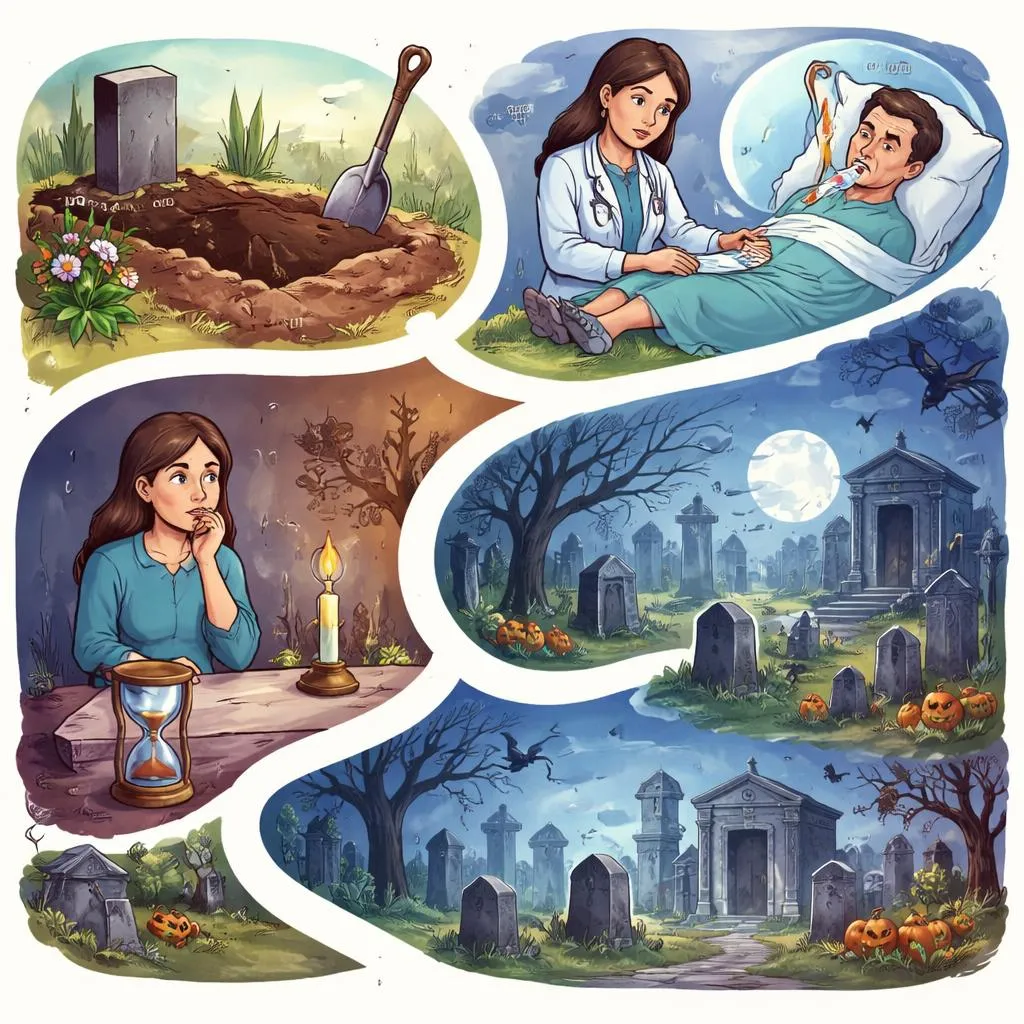

Hey there, word explorer! Have you ever felt very serious? A serious situation is grave. People might speak gravely about it. The quality of seriousness is graveness. A place for remembering is a graveyard. They all connect to seriousness. But they are not the same! The words grave, gravely, graveness, and graveyard are a "Word Seriousness Team". They talk about deep feelings and places. Each team member is different. Your mission is to learn their meanings. Let's see a quick example at home.
At home, you might say: "The news was grave." That describes the news. But you could also say: "My dad spoke gravely." That describes how he spoke. Which one is right? They both are! You need the right word. Let's start our thoughtful adventure!
Adventure! Decoding the Seriousness Team
Welcome to the word quiet place. Our four seriousness words are here. They share a root idea. But they are different. Meet Grave. It is an adjective for seriousness. Meet Gravely. It is an adverb for manner. Meet Graveness. It is a noun for the quality. Meet Graveyard. It is a noun for a place. Let's learn their tones.
Dimension One: The Role Reveal – Description, Manner, Quality, or Place?
Every word has a role. Is it a describing word? Is it a way of doing? Is it a thing? Or is it a location?
Grave: The Seriousness Adjective. This word is an adjective. It describes a noun. It tells us the noun is very serious or important. It is not funny or light.
School example: "The teacher had a grave look on her face." The word "grave" describes her look.
Home example: "It is a grave mistake to touch a hot stove." The word "grave" describes the mistake.
Gravely: The Serious Manner Adverb. This word is an adverb. It describes how an action is done. It often ends in "-ly". It means in a very serious and solemn way.
Playground example: "The coach gravely explained the safety rules." It describes how he explained.
Nature example: "The old owl watched gravely from the tree." It describes how it watched.
Graveness: The Serious Quality Noun. This word is a noun. It names the quality of being grave. It is the seriousness itself. It is a formal word.
School example: "The graveness of the warning was clear." It names the serious quality.
Home example: "We understood the graveness of the storm alert." It names the importance.
Graveyard: The Place Noun. This word is a noun. It names a place where dead people are buried. It is also called a cemetery. It is a quiet, thoughtful place.
Nature example: "The old graveyard was peaceful and still." It names the place.
School example: "We visited a historic graveyard on our field trip." It names the site.
Dimension Two: The Time Connection – Current, Event, or Timeless?
Words can connect to time differently. Is it a current state? Is it tied to an event? Is it a lasting quality? Or is it a permanent place?
Grave: A Current or Lasting State. This describes a situation or feeling that exists now. It can last for a while.
Home example: "His illness is a grave concern for us." The concern exists now.
Gravely: Manner of a Specific Action. This describes how a specific action is performed, often at a particular moment.
Playground example: "She nodded gravely when she heard the news." This happened at that moment.
Graveness: A Timeless or Lasting Quality. This names the seriousness of something. The quality can last or be timeless.
School example: "The graveness of his decision weighed on him." The quality lasted.
Graveyard: A Permanent Place. This names a location that exists over a long time. It does not change quickly.
Dimension Three: The Team-Up – What Words Do They Like?
Knowing their common "serious partners" helps us use them correctly.
Grave (Adjective): It comes before a noun or after linking verbs. "Grave danger", "grave error", "The matter is grave."
Gravely (Adverb): It modifies verbs of speaking or acting. "Say gravely", "speak gravely", "look gravely".
Graveness (Noun): It is used with "the" or "of". "The graveness of the situation", "with great graveness".
Graveyard (Noun): It is a countable noun. It likes articles. "A quiet graveyard", "the old graveyard", "visit a graveyard".
Our Discovery Map: The Seriousness Team Guide
Our guide is clear. Do you want to describe something as very serious? Use the adjective grave. Do you want to describe how an action is done, in a very serious way? Use the adverb gravely. Do you want to name the quality of being very serious? Use the noun graveness. Do you want to name a burial ground? Use the noun graveyard. Remember, grave is the description. Gravely is the serious manner. Graveness is the serious quality. Graveyard is the place.
Challenge! Become a Word Seriousness Master
-
Best Word Choice: Read the scene. Pick the best word. (Nature/Animal Scene) A mother bear sees a forest fire in the distance. She understands the very serious danger to her cubs. This is the quality of the situation. a) The mother bear sensed the grave of the danger. b) The mother bear sensed the graveness of the danger. Which one names the serious quality of the danger? (Answer: b)
-
Two-Word Sentence Showdown: (School/History Lesson) Imagine your class is learning about a difficult time in history. First, use the adjective to describe the challenges people faced. Example: "They lived through grave times of hardship." Now, use the adverb to describe how a leader might have spoken. Example: "The leader addressed the people gravely about the future."
-
Eagle Eye! Find the Glitch: Look at this sentence. One word is not quite right for the meaning. Can you fix it? (Home/Community) "Behind the old church, there is a grave where many pioneers are buried." What's wrong? "Grave" is an adjective or a single burial site noun. Here, we are trying to name the whole area with many burial sites. We need the noun for the place. Fixed sentence: "Behind the old church, there is a graveyard where many pioneers are buried."
Your Takeaway and Mission! Make Your Sentences Thoughtful
Great work, word expert! You learned the special roles of each word. You can now choose the right word for any situation. Your English will be precise and clear.
What you can learn from this article:
You now see that grave, gravely, graveness, and graveyard are a team. But they have different functions. You learned to use "grave" to describe something very serious. You use "gravely" to describe an action done in a very serious way. You use "graveness" to name the quality of seriousness. You use "graveyard" to name a burial ground. You know that "grave" is an adjective, "gravely" is an adverb, and "graveness" and "graveyard" are nouns.
Live Practice Application:
Try this today! Describe a problem: "This is a grave error." Listen to a talk: "The doctor spoke gravely." Think about importance: "I see the graveness of this choice." Learn about history: "We saw an old graveyard." When you write or speak, think: Is it a serious description? Use grave. Is it the serious manner? Use gravely. Is it the serious quality? Use graveness. Is it the burial place? Use graveyard. Choosing the right word makes your language accurate. You are now a master of the seriousness team. Well done!