
Opening Introduction
Mei was helping her grandmother clean the house. They moved the sofa and swept under the bed. "Why are we cleaning so much, Po Po?" Mei asked. Her grandmother smiled. "We are sweeping away the old year to welcome the new one. The Lunar New Year is coming! It is the most important festival in many cultures, especially in China. We call it Chinese New Year or the Spring Festival. It is full of beautiful traditions. Let me tell you about the Chinese New Year traditions in English. Then you can share our stories with all your friends." Mei was excited. She loved the red decorations and the lion dance. Now she could learn the English words for them. Let's join Mei and learn together.
Core Knowledge Explanation
Chinese New Year is a fifteen-day festival. It starts with the new moon between January 21 and February 20. It is a time for family, hope, and new beginnings. Each tradition has a special meaning. Learning about the Chinese New Year traditions in English helps us understand and share this joyful celebration. Let's explore the most important traditions.
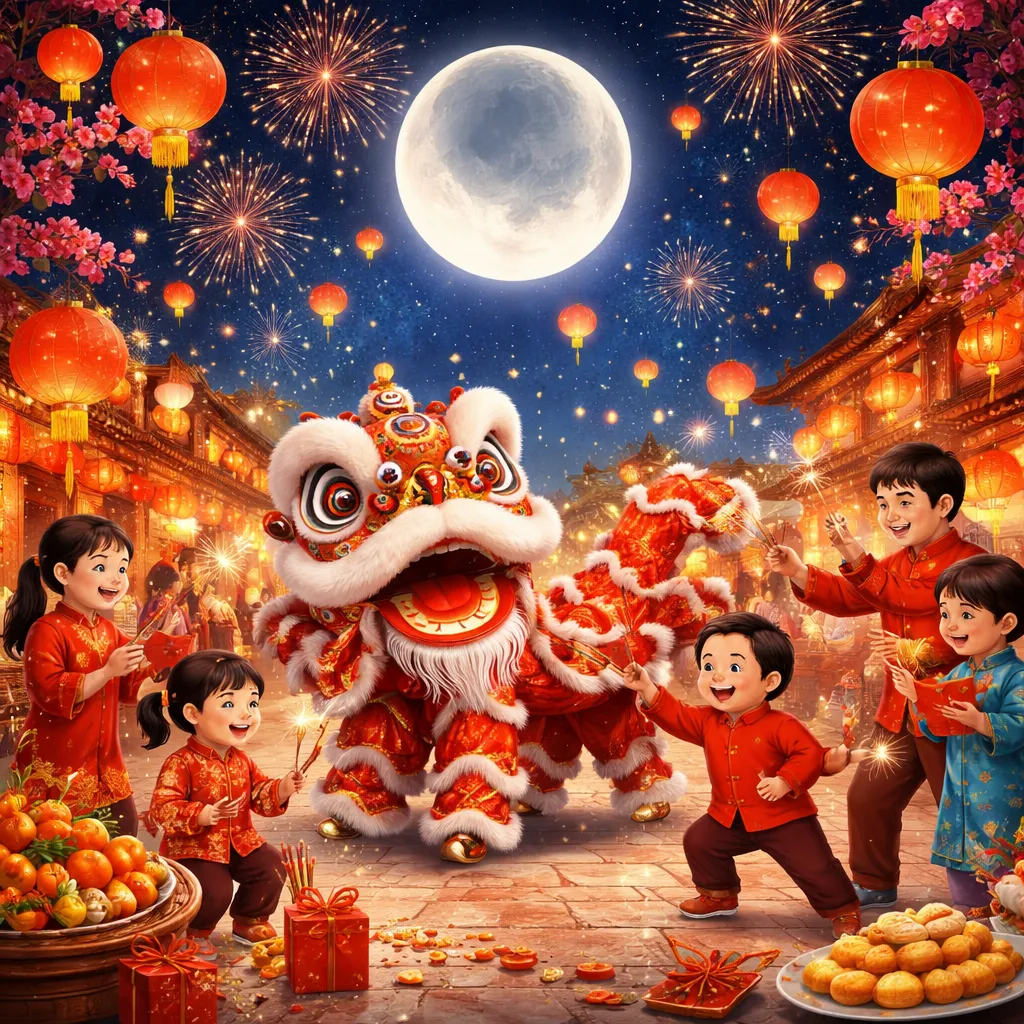
First, before the new year, families clean their homes thoroughly. This is called "spring cleaning." It means sweeping away any bad luck from the old year to make room for good luck. Then, they decorate. The color red is everywhere. Red is a lucky color. People hang red lanterns and red paper cuttings on windows. They also put up red couplets. Couplets are two lines of poetry on red paper. They are pasted on both sides of the front door. They bring good wishes for the new year.
On New Year's Eve, families have a huge dinner called the reunion dinner. It is the most important meal of the year. Everyone tries to come home. They eat special foods. Dumplings look like old Chinese gold money. They symbolize wealth. Fish is served because the word for fish, "yu," sounds like the word for surplus. It means you will have more than enough. Long noodles represent long life. After dinner, families stay up late. This is called "shou sui." It means guarding the year. They wait for the new year together.
At midnight, people set off firecrackers and fireworks. The loud noise is meant to scare away a monster called Nian and bad spirits. On New Year's Day, children wear new clothes, often in red. They greet their parents and elders. They say, "Xin Nian Kuai Le!" which means "Happy New Year!" Then, they receive red envelopes. These are called "hongbao." The red envelopes have money inside. They are a gift for good luck. The money is called "lucky money."
During the fifteen days, there are parades and performances. The most famous is the lion dance. Dancers wear a lion costume and move to the beat of drums and cymbals. It brings happiness and good luck. Sometimes, there is also a longer dragon dance, with many people holding up a dragon puppet. These are the main Chinese New Year traditions in English. Each one is a symbol of hope, luck, and family love.
Fun Interactive Learning
Let's play a game called "Tradition Charades." Write the names of traditions on cards: Clean the house, Hang red lanterns, Eat dumplings, Set off firecrackers, Lion dance, Give red envelopes. Put them in a bowl. One player picks a card and acts it out. How do you act out "lion dance"? You might jump and pretend to be a lion. How do you act out "give red envelopes"? You might pretend to hand an envelope to a friend. The others guess. This is a fun way to remember the Chinese New Year traditions in English.
Another activity is "Make a Red Envelope." Take a red piece of paper. Fold it and glue the sides to make an envelope. Decorate it with gold markers. Write "Good Luck" or "Happy New Year" on it. You can put a pretend coin or a nice note inside. Give it to a family member. Say, "This is a red envelope, or hongbao. It brings good luck." This helps you practice the words. You can also draw a big picture of a dragon or a lion. Label the parts. "This is the lion's head. These are the drummers." This combines art and vocabulary.
Expanded Learning
Chinese New Year is celebrated not only in China but in many countries around the world. In Vietnam, it is called T?t. In Korea, it is Seollal. The traditions are similar but have their own names. The Chinese New Year traditions in English are a way for people everywhere to learn about this festival. The festival ends with the Lantern Festival on the 15th day. People light and watch beautiful lanterns. They eat sweet rice balls called tangyuan.
The festival follows a twelve-year cycle. Each year is named after an animal. This is the Chinese zodiac. There is the Year of the Rat, Ox, Tiger, Rabbit, Dragon, Snake, Horse, Goat, Monkey, Rooster, Dog, and Pig. People believe the animal of the year affects your personality. The dragon year is very lucky. Learning about the zodiac is part of the fun. Let's make a Chinese New Year chant. Chants are rhythmic and fun.
Clean the house, sweep away old luck, welcome the new with a happy pluck! Hang red lanterns, bright and round, happiness and luck are found! Eat dumplings, long noodles too, for a year that's fresh and new! Firecrackers bang and pop, all the bad spirits they will stop! Lion dancing, drummers play, on this happy, festive day! Red envelopes, a gift so sweet, make the new year a special treat!
What You Will Learn
You are learning about a major cultural festival and its symbols. You are learning the key Chinese New Year traditions in English: spring cleaning, red lanterns, red couplets, reunion dinner, dumplings, fish, long noodles, firecrackers, red envelopes (hongbao), lion dance, dragon dance, and the zodiac animals. You are also learning phrases like "Happy New Year" and "good luck."
You are learning descriptive and explanatory sentences. You can say, "We eat fish for the reunion dinner because it means surplus." You can explain, "The lion dance is performed to bring good luck." You can share, "Children receive red envelopes with lucky money inside." You are using English to talk about cultural practices with accuracy and respect. This builds cross-cultural communication skills.
You are building valuable knowledge and abilities. You are building vocabulary about a specific festival. You are building cultural awareness. You appreciate traditions from another part of the world. You are building sequencing skills. You learn the order of events in a long festival. You are building creativity. You make crafts and do activities. You are building confidence. You can explain a complex tradition in simple English.
You are forming an open-minded and curious habit. The habit of learning about and celebrating world festivals. You see that traditions are a way to share joy and hope. Learning about Chinese New Year traditions in English makes you a global citizen who can share in the happiness of others.
Using What You Learned in Life
Use your new words during Chinese New Year. If you see decorations, you can say, "Look at the red lanterns!" If you go to a parade, you can shout, "The lion dance is starting!" You can wish your friends "Happy New Year" in English. You can also make dumplings with your family and explain, "We are eating dumplings for wealth." If you receive a red envelope, you can say, "Thank you for the hongbao!"
At school, you can do a show-and-tell about Chinese New Year. Bring a red envelope or a paper lantern. Use the English words you learned. You can also read books or watch videos about the festival and point out the traditions. The more you use the Chinese New Year traditions in English, the more you will remember them. You are becoming a cultural bridge.
Closing Encouragement
You are a tradition explorer. You are a culture sharer. You are a curious and respectful learner. I am so proud of you. Learning all about Chinese New Year traditions in English shows you have a big, open heart for the world.
May your new year be filled with the joy of learning and the luck of the dragon. Remember, every tradition is a story of hope, and now you can tell that story in English.
You are knowledgeable, you are expressive, and you are learning to connect with celebrations around the globe. Great work, my wonderful cultural ambassador.