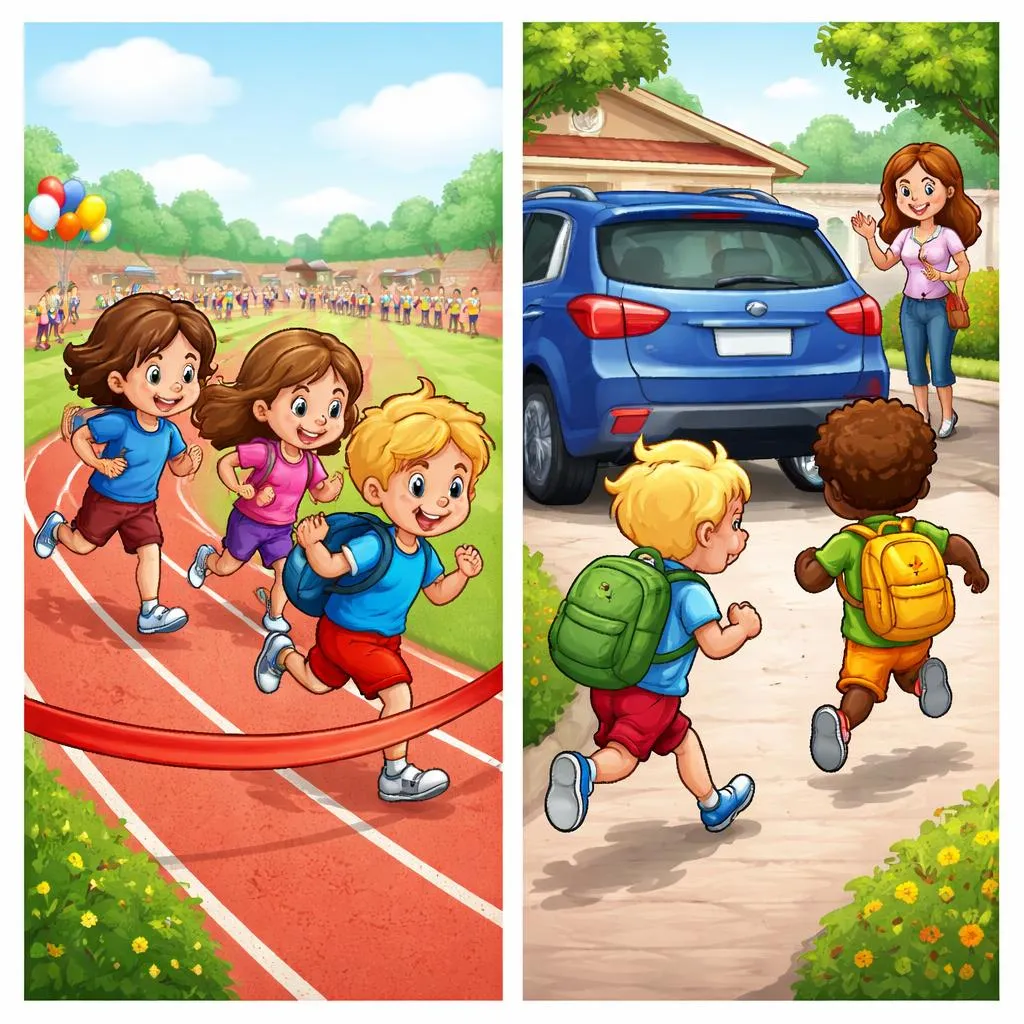

Children love to move fast. They sprint to the swings. They dash across the yard. Parents hear kids say, "Let us have a race" or "I will run to the tree". These two words seem very close. But they describe different kinds of fast movement. Knowing the difference between a "race to" and a "run to" helps children talk about speed and competition. Let us explore these two active words together.
What Do These Expressions Mean?
A "race to" means a competition of speed. Two or more people try to be the fastest to reach a goal. A race has a winner and losers. For example, a running race on a track. A swimming race in a pool. A "run to" means moving your legs quickly to go somewhere. Running is a way of moving. It does not have to be a competition. For example, you run to the bus stop. You run to get out of the rain. For a child, a race feels like a contest to see who is fastest.
A run feels like a fast way to get from one place to another. Both use fast leg movement. That is why the two expressions seem similar. A race is a type of run. A race involves running. But not every run is a race. You can run without competing. Understanding this difference helps children describe what their legs are doing and why.
What's the Difference?
The main difference lies in competition. A "race to" is always a competition. Someone wins. Someone loses. People compare speeds. A "run to" is just movement. No one wins or loses. You are just getting somewhere fast. One is about being faster than others. The other is about being faster than walking. Think of a race as a game where speed is the score. Think of a run as a tool to get to the bathroom before an accident.
Another difference is the goal. In a race, the goal is to beat others. In a run, the goal is to reach a place. You run to catch a ball. You run to the door when the bell rings. The focus is on the destination, not on beating someone. This difference helps children know when they are competing and when they are just moving quickly. Both are fun. Both are healthy. But they feel very different inside.
When Do We Use Each One?
Use a "race to" when there is competition. At a birthday party, a child says "Let us have a race to the fence." Use race for organized events. "I won the 100-meter race at school." Use race for any speed contest. "We raced to see who could finish dinner first." Race always means you are trying to be faster than someone else. If there is only one person running, it is not a race.
Use a "run to" when you are moving fast without competing. At home, a child says "I need to run to the store before it closes." Use run for exercise. "I run around the park every morning." Use run for urgency. "Run to your room and get your shoes." Run describes the action. Race describes the competition. You can run alone. You cannot race alone. A race needs at least two people or a clock.
Real-life situations use both naturally. A parent says "Please run to the car. It is starting to rain." That is not a race. The child is just moving fast. Later, the parent says "Let us race to the mailbox. First one there wins." That is a competition. The same legs do both things. But the intention is different. Another example: a child runs to the playground because they are excited. Then they race a friend down the slide. The run was solo. The race was with a friend.
Example Sentences for Kids
Here are simple examples of a "race to":
"We had a race to the big oak tree."
"My brother won the race by one second."
"Let us race to see who finishes their math first."
Here are simple examples of a "run to":
"I need to run to the bathroom before the movie starts."
"She ran to the door when she heard the knock."
"We run to the bus stop every morning."
Notice how the race examples always have competition and winners. The run examples just show fast movement to a place. A race is a special kind of run with a winner. You can run fast without racing. You cannot race without running (or swimming, or biking, etc.). That is the simple relationship.
Common Mistakes to Avoid
Many children say "race" when they mean "run". They say "I raced to the store" when they went alone. That is common in casual talk. But the precise way is to say "I ran to the store." A race needs another person or a clock. If you are alone, you ran. You did not race. Teach your child to ask "Was I trying to beat someone?" If yes, say race. If no, say run.
Another mistake is thinking races are only on foot. A child says "We had a swimming race" and thinks that is not a real race. The correct way is to know that races can be any speed competition. Swimming races, bike races, car races, and even boat races. Race is about speed and competition, not about the type of movement. So swimming race is correct. Running race is also correct.
A third mistake is forgetting that running can be slow. A child thinks running is always fast. The correct way is to know that running is faster than walking but can be slow jogging. A race is always about maximum speed. You race to go as fast as you can. You can run at a slow pace for exercise. That is still running. So race = fast and competitive. Run = any speed of leg movement faster than walking. This nuance helps children use both words accurately.
Easy Memory Tips
Here is a simple trick. Imagine a "race to" as a finish line with a ribbon. Two runners break the ribbon. One wins. One loses. The ribbon means competition. Imagine a "run to" as a sidewalk with no finish line. You just run to the end of the block. No ribbon. No winner. Just movement. So race = ribbon. Run = sidewalk. This visual trick works beautifully for children.
Another tip uses the first letters. Race starts with R. Think of "R for Rival." A race has a rival you try to beat. Run starts with R too. That is tricky. So use a different clue: Run has the letter U. Think of "U for You alone." You can run alone. Run = solo. Race needs an opponent. Practice with your child. Ask "Is there someone else trying to beat you?" If yes, race. If no, run. This question works for every situation.
Quick Practice Time
Try these simple exercises with your child.
Fill in the blank: Choose "race" or "run".
"Every morning I __________ to catch the school bus." (Answer: run)
"My cousin and I had a __________ to the corner store." (Answer: race)
Multiple choice: Pick the correct description.
Which one is a competition of speed with a winner and loser?
A) A run
B) A race
(Answer: B)
Which one is a way of moving fast, alone or with others, without competing?
A) A race
B) A run
(Answer: B)
These quick questions take only two minutes. They help children separate competition from simple movement. Go to a park. Ask your child to run to a tree (alone). Then ask them to race a friend to another tree. Feel the difference. That real practice builds lasting understanding of these two active words.
Wrap-up
The key difference is simple. A race is a competition of speed where you try to beat someone else. A run is the action of moving your legs quickly to get somewhere, with or without competition. Learning this difference helps children talk about sports, play, and daily movements with precision. Keep running together. Keep racing each other for fun. Your child will learn that every race is a run, but not every run needs to be a race. Sometimes the joy is just in the movement itself.