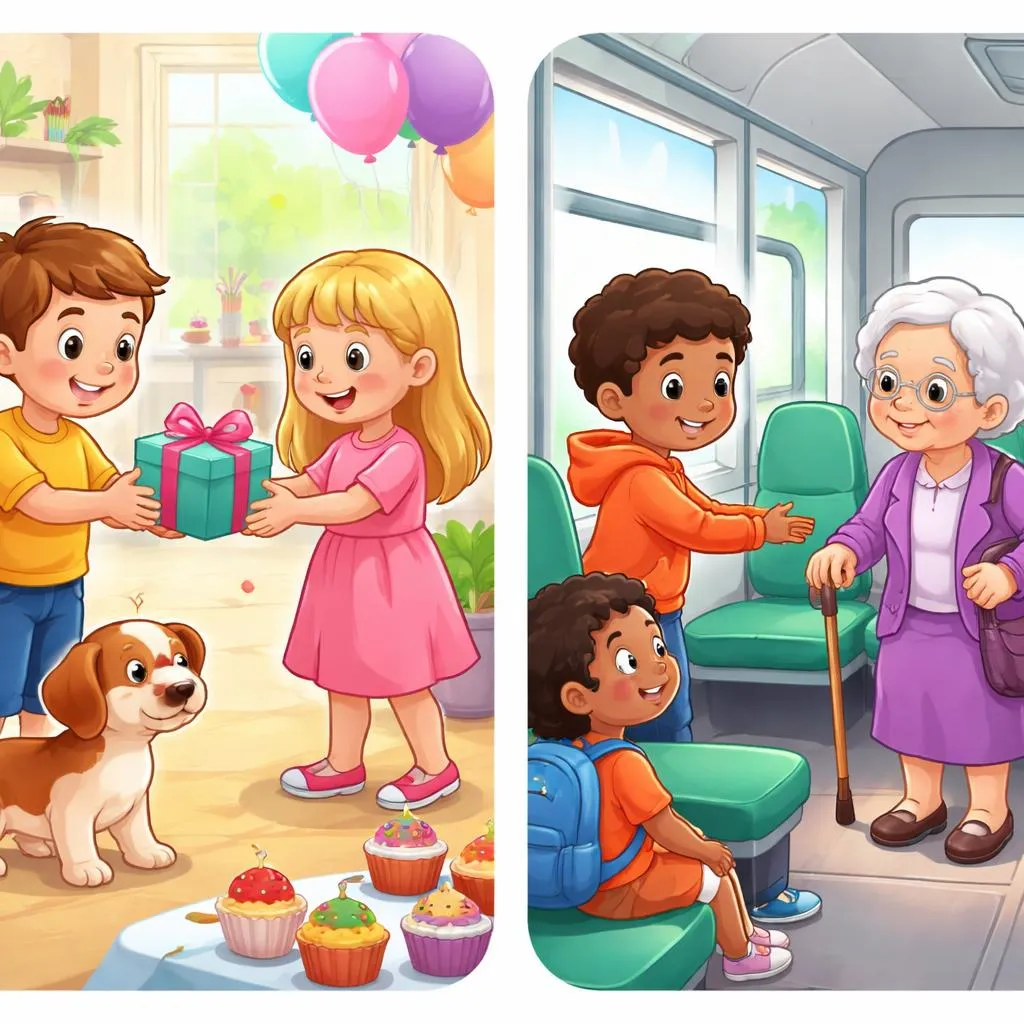

Children share with others every day. They give snacks to friends. They offer help to grandparents. Parents hear kids say, "I gave my pencil to her" or "I offered to share my snack". These two words seem very close. But they describe different kinds of sharing. Knowing the difference between a "give to" and an "offer to" helps children understand generosity and kindness. Let us explore these two giving words together.
What Do These Expressions Mean?
A "give to" means to transfer something to someone. The person receives it. Giving is complete. Once you give, you no longer have the item. For example, you give a birthday present. You give money to a charity. An "offer to" means to ask if someone wants something. Offering is a suggestion. The person can say yes or no. For example, you offer a seat to an elderly person. You offer to help with homework. For a child, giving feels like handing something over. Offering feels like asking "Would you like this?"
Both are about being kind and sharing. That is why the two expressions seem similar. Giving is the action of transferring. Offering is the action of suggesting a transfer. Understanding this difference helps children learn that offering respects the other person's choice. Giving happens when the other person accepts.
What's the Difference?
The main difference lies in whether the person accepts. A "give to" means the transfer happens. You give, and they take. A "offer to" means you present the option. They can say yes or no. One is a completed action. The other is an invitation. Think of giving as putting a cookie into someone's hand. The cookie is now theirs. Think of offering as holding out a cookie and saying "Do you want one?" They might say no. The cookie is still yours.
Another difference is about control. When you give, you decide to transfer. When you offer, you let the other person decide. This difference helps children understand consent and respect. Offering gives the other person power to choose. Giving is still kind, but it does not ask for permission. Teaching children to offer first is often more polite, especially with personal items.
When Do We Use Each One?
Use a "give to" when you are sure the person wants the item. At home, a child says "I gave my old toys to my little cousin." Use give for gifts. "We give presents on birthdays." Use give for donations. "She gave her allowance to the animal shelter." Use give when the transfer is complete. Give is final. Once you give, you cannot take it back easily. That is why giving is a big decision.
Use an "offer to" when you want to be polite or let the other person choose. In class, a child says "I offered to share my markers with the new student." Use offer for help. "He offered to carry the groceries." Use offer for seats. "She offered her seat to the pregnant woman." Use offer for food. "I offered the last cookie to my brother, but he said no." Offering is kind because it respects the other person's choice.
Real-life situations use both naturally. A parent says "You offered your friend a turn on the swing. That was kind. She said yes, so you gave her the swing. First you offered. Then she accepted. Then you gave. The offer was the question. The give was the action after she said yes." Another example: a child offers a snack to a friend. The friend says "No thank you." The child did not give the snack. The offer was still kind. The giving did not happen. That is okay.
Example Sentences for Kids
Here are simple examples of a "give to":
"I gave my sister a hug when she was sad."
"Please give this note to your teacher."
"He gave his old bicycle to the neighbor."
Here are simple examples of an "offer to":
"She offered to help me with my puzzle."
"I offered my friend the last piece of gum."
"He offered his seat to the older man on the bus."
Notice how the give examples involve a completed transfer. The offer examples involve a suggestion or question. You can offer without giving. The other person decides. That is the heart of the difference. Offering is polite. Giving is action.
Common Mistakes to Avoid
Many children say "give" when they mean "offer". They say "I gave him help" when they actually offered help. The correct way is to say "I offered to help." If the person said no, you did not give help. You only offered. This distinction helps children be precise about what actually happened. Offering is still good. Giving is the next step after a yes.
Another mistake is thinking offering is weaker than giving. A child says "Offering is not as kind as giving." The correct way is to know that offering is very kind. It shows respect. It asks the person what they need. Sometimes offering is even kinder than giving because it does not assume. You might give someone something they do not want. An offer lets them choose. That is thoughtful.
A third mistake is forgetting that you can offer something you cannot give. A child says "I offered to help my mom cook, but I cannot actually cook." That is fine. The offer was kind. Your mom might teach you. Or she might say no thank you. The offer is the intention. The giving is the action. This helps children understand that good intentions matter, even if the follow-through is not perfect.
Easy Memory Tips
Here is a simple trick. Imagine a "give to" as dropping a coin into a piggy bank. The coin is gone from your hand. It is in the bank. The action is done. Imagine an "offer to" as holding a coin in your open palm and asking "Would you like this?" The coin is still in your hand until they say yes. So give = coin in bank (completed). Offer = coin in open palm (still yours unless accepted). This comparison works beautifully.
Another tip uses the first letters. Give starts with G. Think of "G for Gone." Once you give, the item is gone from you. Offer starts with O. Think of "O for Option." An offer gives the other person an option. Practice with your child. Ask "Will the other person definitely get the item?" If yes, say give. If they have a choice, say offer. This question works for almost every situation.
Quick Practice Time
Try these simple exercises with your child.
Fill in the blank: Choose "give" or "offer".
"I __________ my friend a ride home, but she said her mom was coming." (Answer: offered)
"Please __________ this letter to the office after school." (Answer: give)
Multiple choice: Pick the correct description.
Which one means a completed transfer where the person receives the item?
A) Offer
B) Give
(Answer: B)
Which one means suggesting a transfer, leaving the choice to the other person?
A) Give
B) Offer
(Answer: B)
These quick questions take only two minutes. They help children see the difference between suggestion and completed action. Practice offering and giving. Offer a snack to your child. Let them say no. That was an offer. Then give them a snack they want. That was a give. That real practice builds vocabulary and social skills together.
Wrap-up
The key difference is simple. Give means to transfer something to someone, completing the action. Offer means to suggest giving something, leaving the choice to the other person. Learning this difference helps children be polite and respectful while still being generous. Keep offering and giving. Your child will learn that an offer opens the door, and a give walks through it. Both are beautiful acts of kindness.