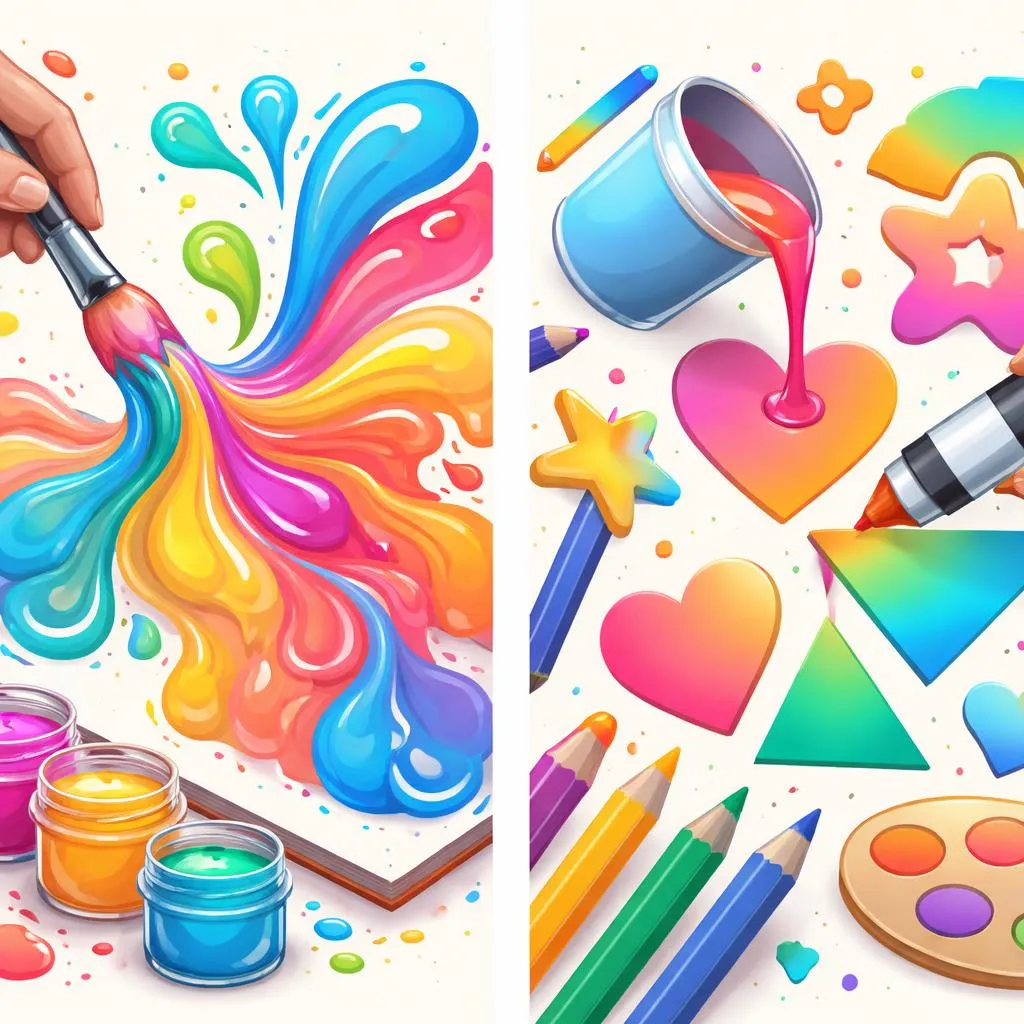

What Do These Expressions Mean?
Both “paint to” and “color to” talk about adding colors to a surface.
You make things look bright and beautiful.
You use different tools.
But one uses liquid paint. The other uses many different tools.
Let us explore these two art words.
“Paint to” – A Kid-Friendly Explanation
“Paint to” means you use liquid paint and a brush.
You dip the brush in paint.
You spread it on paper or canvas.
For example: “I want to paint to make a picture of the ocean.”
You mix blue and green paint.
You use a brush to make waves.
“Color to” – A Kid-Friendly Explanation
“Color to” means you add color to a shape or drawing.
You use crayons, markers, or colored pencils.
You stay inside the lines or make your own.
For example: “I will color to fill in this butterfly picture.”
You pick up a purple crayon.
You fill the wings with color.
Why Do They Seem Similar?
Both expressions add color to something.
Both make art more fun.
Both let you be creative.
But one uses liquid paint. The other uses dry coloring tools.
What's the Difference?
One expression focuses on liquid paint and brushes.
The other expression focuses on dry tools like crayons and markers.
Let us compare them.
Tone and Strength
“Paint to” feels messier and more artistic.
You need a brush, water, and paper.
“Color to” feels cleaner and simpler.
You just pick up a crayon and start.
One is for big art projects. The other is for everyday fun.
Subtle Meaning Differences
“Paint to” = use liquid color with a brush.
Example: “We will paint to create a mural on the wall.”
“Color to” = use dry coloring tools like crayons or markers.
Example: “Please color to fill in the map with different colors.”
See the difference?
Paint = liquid + brush. Color = dry tools.
Simple Comparison Language
“Paint to” is more about brushes and liquid paint.
“Color to” is more about crayons, markers, and pencils.
Think of it this way:
“Paint to” = I need a brush and water.
“Color to” = I just need my crayons.
When Do We Use Each One?
Let us look at real situations.
You will use both of these in art time.
Using “Paint to” in Daily Life
Use “paint to” when you use liquid paint and a brush.
At school: “We will paint to make self-portraits in art class.”
At home: “Dad painted the fence to protect it from rain.”
With friends: “Let us paint to decorate clay pots for Mother's Day.”
For crafts: “She painted to add details to her birdhouse.”
Using “Color to” in Daily Life
Use “color to” when you use crayons, markers, or colored pencils.
At school: “Color to show the different zones of the ocean on your worksheet.”
At home: “I love to color to relax after homework.”
With friends: “Let us color to make get-well cards for Grandma.”
For fun: “He colored the entire dinosaur picture in one afternoon.”
Natural Usage Reminder
Ask yourself one question.
“Am I using liquid paint or dry colors?” → liquid = “paint,” dry = “color.”
That question helps you choose.
Example Sentences for Kids
Here are short sentences.
Practice them with your family.
Sentences with “Paint to”
We will paint to make a sunset using orange, pink, and purple.
The artist paints to create huge murals on city walls.
I want to paint to decorate my room with a rainbow.
Sentences with “Color to”
Please color to fill in every shape on this coloring page.
She colored the sky blue and the grass green with her new markers.
He likes to color to make his drawings look bright and happy.
Notice the Tools
In the first group, you need a brush and paint.
In the second group, you use crayons or markers.
That is the big difference.
Common Mistakes to Avoid
Many learners mix these two up.
Let us fix those mistakes.
Mistake #1 – Using “Paint to” for Crayons
Wrong: “I painted this picture with my new crayons.”
Why? Crayons are for coloring, not painting.
Correct: “I colored this picture with my new crayons.”
Mistake #2 – Using “Color to” for Liquid Paint
Wrong: “I colored the canvas with blue paint.”
Why? Paint is liquid. You paint with it.
Correct: “I painted the canvas with blue paint.”
Mistake #3 – Forgetting the Word “To”
Wrong: “I paint a flower.”
Correct: “I paint to create a flower.”
Wrong: “She colors a picture.”
Correct: “She colors to fill a picture.”
Mistake #4 – Thinking Paint Is Only for Artists
Wrong: “Only professional artists can paint.”
Why? Anyone can paint for fun.
Correct: “Anyone can paint to express their feelings.”
Easy Memory Tips
Let us make this fun.
These tricks will help you remember.
The Wet vs. Dry Trick
Imagine two art boxes.
One box has a paintbrush and a cup of water. That is “paint to” – wet.
The other box has crayons and markers. That is “color to” – dry.
The Messy vs. Clean Trick
Painting can be messy. You need a smock.
Coloring is clean. You can do it anywhere.
The Short Sentence Trick
Say this to yourself:
“Paint with a brush. Color with a crayon.”
Brush = paint.
Crayon = color.
The Art Supply Game
Look at your art supplies.
If you need water, you paint.
If you just pick up and draw, you color.
Play this game every time you make art.
Quick Practice Time
Let us see what you learned.
Choose the correct expression.
Exercise 1 – Fill in the Blank
Choose: paint or color
Please _____________ the sky with your watercolors.
I will _____________ the clown's nose red with this marker.
The house painter will _____________ the whole bedroom blue.
She likes to _____________ in her coloring book before dinner.
Answers:
paint
color
paint
color
Exercise 2 – Multiple Choice
Which sentence uses liquid paint?
A. I colored the flower with a purple crayon.
B. She painted the fence with white paint and a brush.
C. He colored the map with colored pencils.
Answer: B
Exercise 3 – True or False
“Color to” is for dry tools like crayons and markers.
Answer: True
Check Your Answers
How many did you get right?
Three correct means you understand the difference.
If you missed any, play the art supply game.
You are creating colorful word skills every day.
Wrap-up
Use “paint to” when you use liquid paint and a brush to create pictures or cover surfaces, and use “color to” when you use dry tools like crayons, markers, or colored pencils to fill in shapes or add color to drawings.
Now you know two different ways to make your world more colorful and bright.