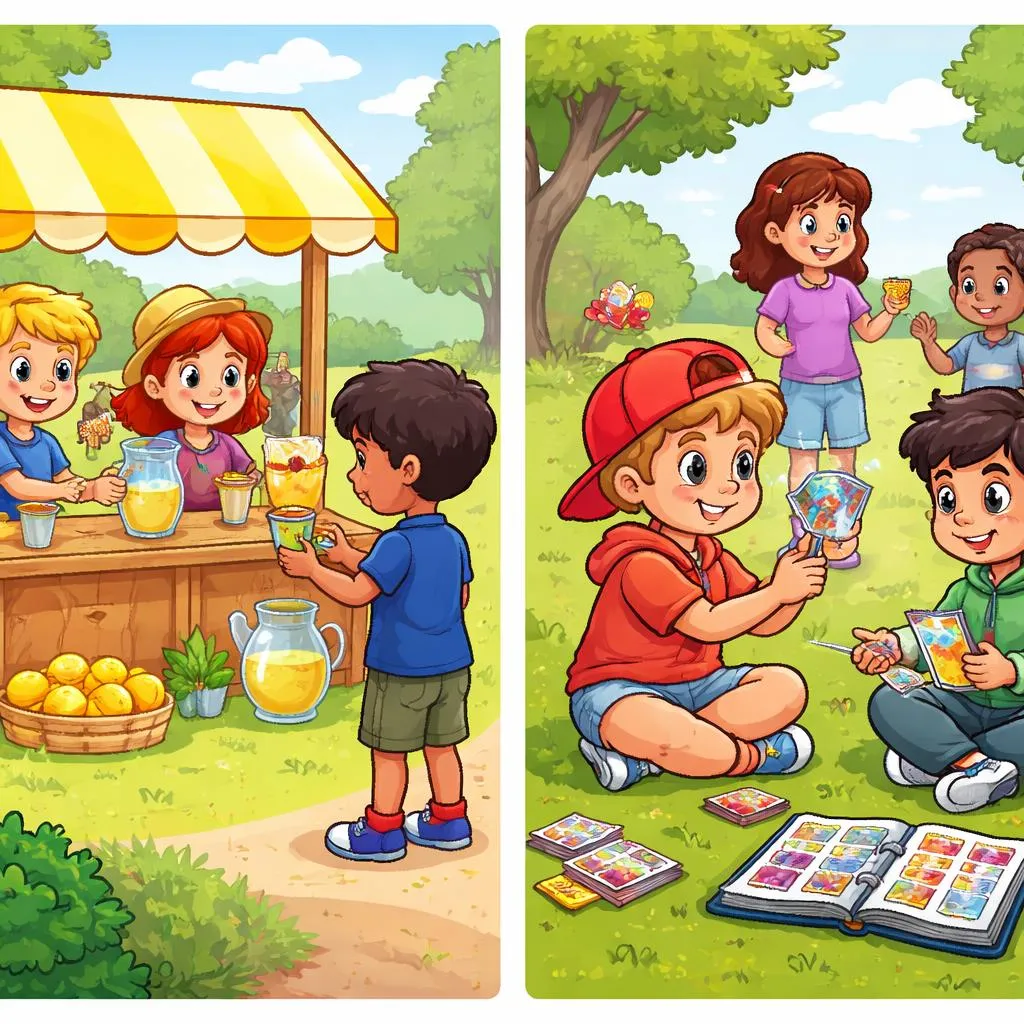

Children exchange things all the time. They sell lemonade for coins. They trade stickers with friends. Parents hear kids say, "I sold my old toys" or "Let's trade snacks". These two words seem different. But both are about giving something and getting something in return. Knowing the difference between a "sell to" and a "trade to" helps children understand how people exchange goods. Let us explore these two transaction words together.
What Do These Expressions Mean?
A "sell to" means to give something to someone in exchange for money. The seller gets money. The buyer gets the item. For example, you sell cookies at a bake sale. You sell your old bicycle. A "trade to" means to give something to someone and receive something else in return, without using money. Trading is swapping. For example, you trade a baseball card for a different card. You trade your sandwich for a friend's yogurt. For a child, selling feels like a store. Trading feels like swapping with friends.
Both are about giving and receiving. That is why the two expressions seem similar. Selling uses money. Trading uses other items. Understanding this difference helps children know whether they need coins or just a willing friend.
What's the Difference?
The main difference lies in what you get in return. A "sell to" gets you money. A "trade to" gets you another item. One uses currency. The other uses barter. Think of selling as giving a toy and getting five dollars. Think of trading as giving a toy and getting a different toy. Both are fair exchanges. But the result is different. Selling gives you money to spend later. Trading gives you something new right away.
Another difference is that selling often happens between strangers. Trading often happens between friends or people who know each other. You sell at a store. You trade with a classmate. This difference helps children understand social situations. Selling is business. Trading is often more personal and friendly.
When Do We Use Each One?
Use a "sell to" when money changes hands. At a yard sale, a child says "I sold my puzzle for two dollars." Use sell for businesses. "The store sells toys." Use sell for anything where you receive money. "She sold her artwork at the fair." Selling turns items into money. That money can buy other things later.
Use a "trade to" when items are swapped without money. On the playground, a child says "I will trade my red crayon for your blue one." Use trade for collectibles. "He traded baseball cards with his friend." Use trade for lunch. "I traded my apple for her banana." Trading is direct. You get what you want immediately. No money needed.
Real-life situations use both naturally. A parent says "When you sold your old video game to the neighbor, you got ten dollars. You can save that money. When you traded your extra sticker for your friend's sticker, no money changed hands. You both just swapped. Selling is for money. Trading is for swapping." Another example: a child wants a new book. They can sell their old book and use the money to buy the new one. Or they can trade their old book directly for a friend's book. Different paths to the same goal.
Example Sentences for Kids
Here are simple examples of a "sell to":
"I sold my old skateboard for twenty dollars."
"The bakery sells fresh bread every morning."
"She sold lemonade to the neighbors."
Here are simple examples of a "trade to":
"Let's trade snacks. I will give you my chips for your cookies."
"He traded his blue marble for two green ones."
"We traded seats so I could sit by the window."
Notice how the sell examples always involve money. The trade examples involve swapping items. Selling is about cash. Trading is about exchange. Both are fair. Both are useful. But they work in different situations.
Common Mistakes to Avoid
Many children say "trade" when they mean "sell". They say "I traded my bike for money." That is not correct. The correct way is to say "I sold my bike." Trading does not use money. Selling does. This distinction helps children be precise about transactions. It also helps them understand basic economics.
Another mistake is thinking trading is always equal. A child says "Trading has to be fair." The correct way is to know that trades can be unfair. Someone might trade a broken toy for a good one. That is a bad trade. Selling is usually more clear. The price is set. Trading depends on what both people want. This helps children learn to evaluate whether a trade is good for them.
A third mistake is forgetting that you can trade services, not just items. A child says "You can only trade things you hold." The correct way is to know that you can trade help. "I will trade helping you clean your room for you helping me with my math." That is trading time and effort. This understanding opens up many possibilities for cooperation and kindness.
Easy Memory Tips
Here is a simple trick. Imagine a "sell to" as a cash register. Ka-ching! Money comes out. Money goes in. Imagine a "trade to" as two hands swapping. Left hand gives a toy. Right hand takes a different toy. No money anywhere. So sell = cash register. Trade = swapping hands. This comparison works beautifully.
Another tip uses the first letters. Sell starts with S. Think of "S for Silver coins." Selling gets you silver coins. Trade starts with T. Think of "T for Take this, give that." Trading is take and give. Practice with your child. Ask "Does money change hands?" If yes, say sell. If no, say trade. This question works for almost every exchange.
Quick Practice Time
Try these simple exercises with your child.
Fill in the blank: Choose "sell" or "trade".
"I will __________ my old phone to buy a new one." (Answer: sell)
"Let's __________ our snacks. I like your crackers better." (Answer: trade)
Multiple choice: Pick the correct description.
Which one involves giving something in exchange for money?
A) Trade
B) Sell
(Answer: B)
Which one involves swapping one item for another item without money?
A) Sell
B) Trade
(Answer: B)
These quick questions take only two minutes. They help children see the money versus barter difference. Practice with toys. Ask your child to sell you a toy for pretend money. Then ask them to trade one toy for another. That real practice builds economic understanding and vocabulary together.
Wrap-up
The key difference is simple. Sell means to give something in exchange for money. Trade means to give something in exchange for another item, without using money. Learning this difference helps children understand basic economics and make good decisions about their belongings. Keep selling lemonade and trading cards. Your child will learn that both ways of exchanging are valuable, and knowing which to use when is a skill that will serve them for life.