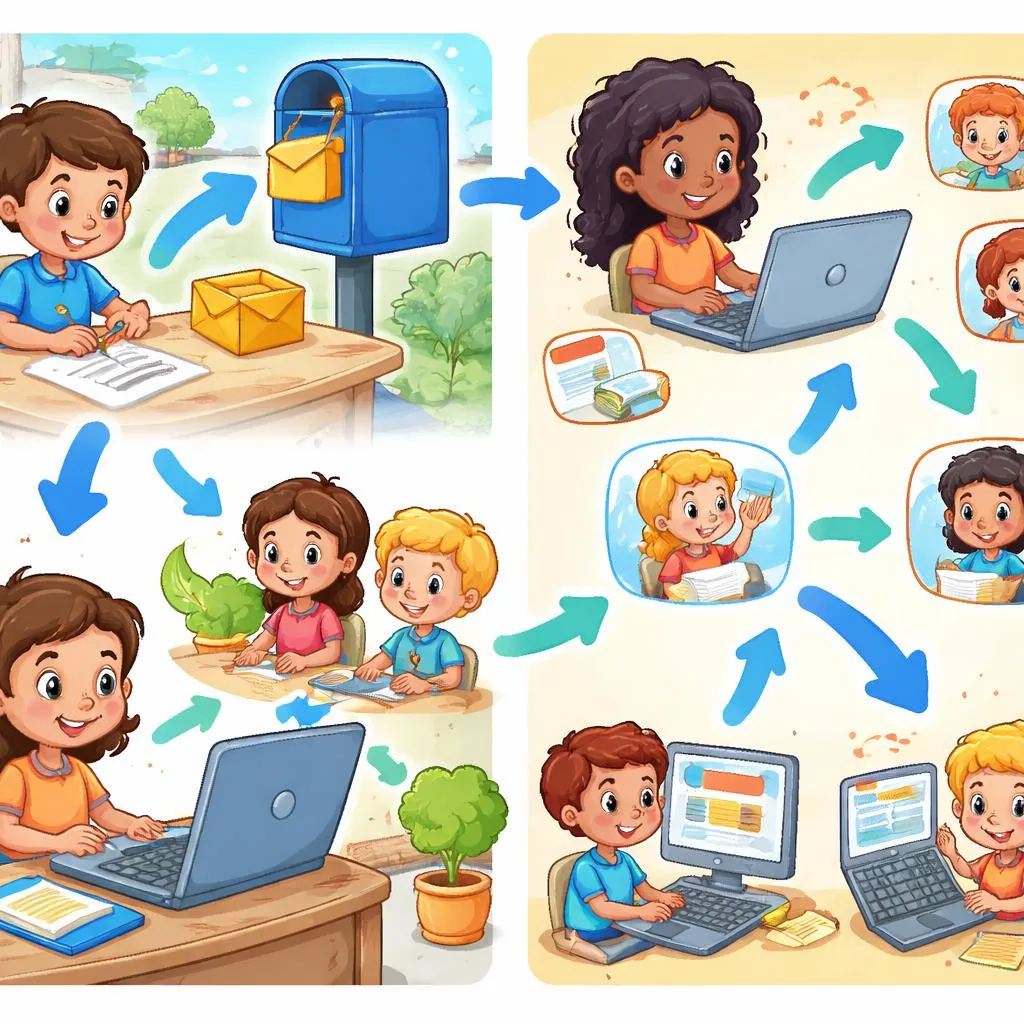

Children share messages every day. They send notes to friends. They forward funny videos to family. Parents hear kids say, "I sent a text" or "Please forward this to Grandma". These two words seem very close. But they describe different ways of passing along messages. Knowing the difference between a "send to" and a "forward to" helps children understand how communication travels. Let us explore these two transmission words together.
What Do These Expressions Mean?
A "send to" means to cause something to go from you to someone else. You are the original sender. The message starts with you. For example, you send a letter to a pen pal. You send a picture to your cousin. A "forward to" means to pass along something that someone else sent you. You are not the original creator. You are a relay. For example, you forward an email from your teacher to your parent. You forward a funny post from a friend to another friend. For a child, send feels like starting a message. Forward feels like sharing something you received.
Both are about moving messages to other people. That is why the two expressions seem similar. Both put information into someone else's hands. But send is original. Forward is a relay. Understanding this difference helps children know who created the message and who is just passing it along.
What's the Difference?
The main difference lies in who started the message. A "send to" means you are the source. The message came from you. A "forward to" means someone else was the source. You received it, and now you are sending it to another person. One is about creation. The other is about sharing. Think of send as writing a letter yourself and mailing it. Think of forward as getting a letter from a friend, reading it, and then putting it in a new envelope to send to someone else. The words are the same, but the situation is different.
Another difference is that forward often implies the message stays the same. You do not change it. Send includes messages you write yourself. Forward is for messages you pass along exactly as you got them. This difference helps children understand that forwarding is about sharing other people's words, not your own.
When Do We Use Each One?
Use a "send to" when you are the one creating or originating the message. At home, a child says "I will send a thank-you note to Aunt Sue." Use send for original messages. "Please send me the link to that game." Use send for packages. "Grandma sent a gift for your birthday." Use send for anything you start. Send is for first-time transmission. You are the starting point.
Use a "forward to" when you are passing along something you received. In class, a child says "Please forward this permission slip to your parents." Use forward for emails. "I forwarded the invitation to my sister." Use forward for messages. "Can you forward that funny meme to me?" Use forward for sharing information that came from someone else. Forward is for being a helper. You are not the creator. You are the passer.
Real-life situations use both naturally. A parent says "If you write an email to your teacher, you send it. If your teacher replies and you send that reply to me, you are forwarding it. You did not write the reply. The teacher wrote it. You just sent it to me. That is forwarding." Another example: a child gets a chain text from a friend. The child sends it to three other friends. That is forwarding. The child did not write the original text. The child is just passing it along.
Example Sentences for Kids
Here are simple examples of a "send to":
"I will send a birthday card to my best friend."
"Please send me the photos from the party."
"She sent a text message to her dad."
Here are simple examples of a "forward to":
"Please forward this email to everyone on the team."
"I forwarded the funny video to my cousin."
"Can you forward the lunch menu to me?"
Notice how the send examples involve the person being the origin. The forward examples involve passing along something that came from someone else. If you write it yourself, you send it. If someone else wrote it and you share it, you forward it. That is the simplest rule.
Common Mistakes to Avoid
Many children say "send" when they mean "forward". They say "I sent you that joke" when actually they forwarded it from someone else. The correct way is to say "I forwarded you that joke" if you did not write it. This helps give credit to the original creator. It also helps people know who to thank or ask questions. Forwarding is honest about where the message came from.
Another mistake is thinking forwarding is only for digital messages. A child says "You can only forward emails." The correct way is to know that you can forward anything that comes to you. You can forward a letter you received in the mail. You can forward a note someone gave you. Forwarding means passing along, no matter the medium. This understanding helps children use the word in many situations.
A third mistake is forgetting that you can forward your own message if you are relaying it. A child says "I cannot forward something I wrote." That is not entirely true. If you wrote a message to one person and then send the same message to another person without rewriting it, that is also forwarding. You are passing along your own words. But usually, forward is for passing along other people's words. This nuance helps children see that intent matters more than strict rules.
Easy Memory Tips
Here is a simple trick. Imagine a "send to" as a river starting at a spring. The spring is you. The water flows out for the first time. Imagine a "forward to" as a river that splits. The water came from upstream. You are just a point where the river divides. You did not create the water. You just directed it. So send = spring (origin). Forward = split in the river (relay). This comparison works beautifully.
Another tip uses the first letters. Send starts with S. Think of "S for Start." Send is where the message starts. Forward starts with F. Think of "F for From another." A forwarded message comes from another person first. Practice with your child. Ask "Did this message start with me or come from someone else?" If from you, say send. If from someone else, say forward. This question works for almost every message.
Quick Practice Time
Try these simple exercises with your child.
Fill in the blank: Choose "send" or "forward".
"I will __________ a thank-you text to my aunt for the gift." (Answer: send)
"Please __________ this announcement to all the parents." (Answer: forward)
Multiple choice: Pick the correct description.
Which one means you are the original creator of the message?
A) Forward
B) Send
(Answer: B)
Which one means you are passing along a message that came from someone else?
A) Send
B) Forward
(Answer: B)
These quick questions take only two minutes. They help children see the difference between origin and relay. Look at a text message chain. Ask your child "Who sent the first message? Who forwarded it to others?" That real practice builds digital literacy and vocabulary together.
Wrap-up
The key difference is simple. Send means to transmit a message that you created or originated. Forward means to pass along a message that someone else sent to you. Learning this difference helps children communicate clearly and give credit to the original source. Keep sending your own messages and forwarding the good things others share. Your child will learn that both actions keep the world connected, but forwarding adds the extra kindness of sharing what someone else started.