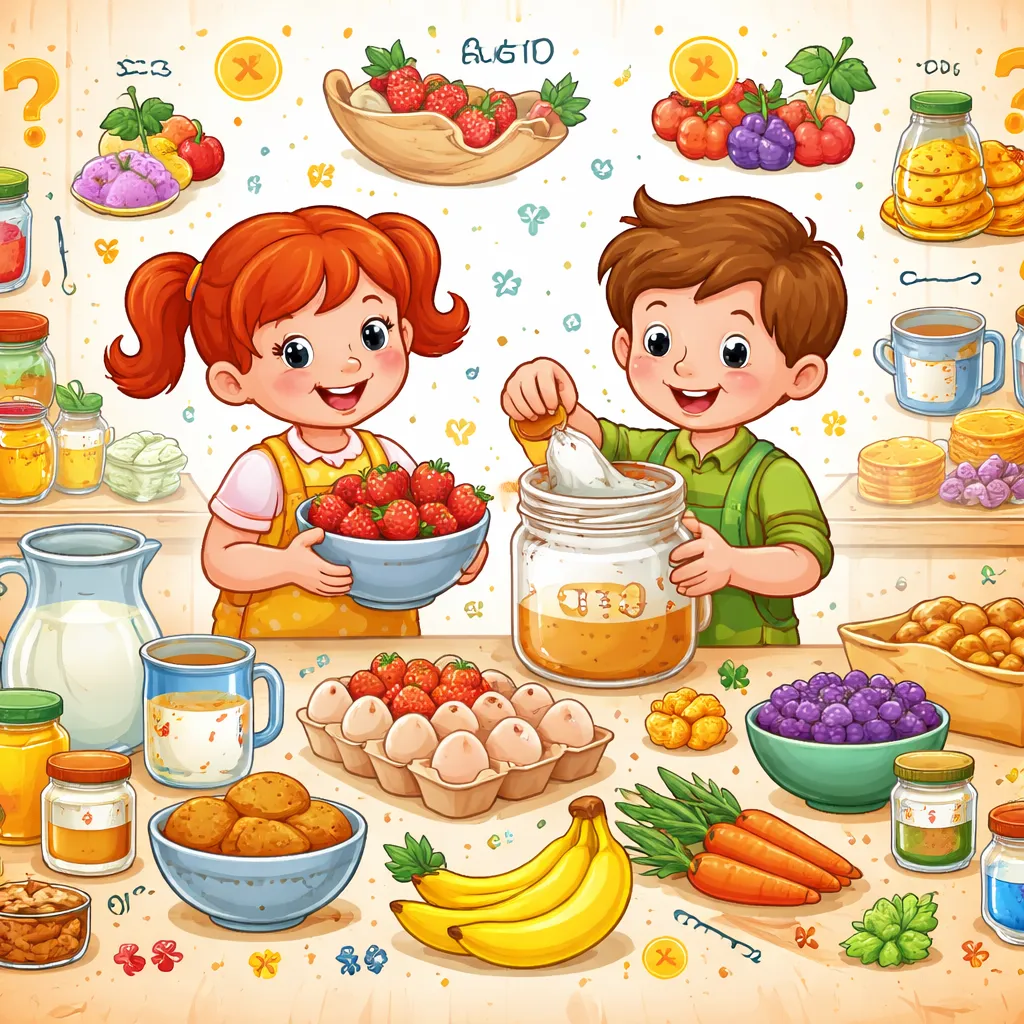

Hello, little chef! Do you like to help in the kitchen? We use cups and spoons to measure. A cup of flour. A spoon of sugar. In language, we have measuring words too. They are called quantifiers. Words like 'some', 'many', 'a few', 'a little'. They tell us 'how much' or 'how many'. Today, we are kitchen helpers! We will learn eighty must-master quantifiers. Our guide is Quincy the Quantifier Chef. He has special word-measuring cups. He will show us how to measure words at home, the playground, school, and in the garden. Let's start cooking with words!
What Are Quantifiers? Think of quantifiers as your word measuring cups. You cannot count 'water' with 1, 2, 3. You say 'some water' or 'a little water'. You can count 'cookies' with 1, 2, 3. You say 'a few cookies' or 'many cookies'. Quantifiers measure nouns. They answer 'how much?' for stuff you cannot count. They answer 'how many?' for stuff you can count. "Quincy's recipe book has eighty must-master quantifiers for you to learn."
Why Are These Measuring Words So Useful? These words make your talking exact and clear. They help your ears listen. You know if someone wants a lot or a little. "Can I have some water?" They help your mouth speak. You can ask for the right amount. "I want a few grapes, please." They help your eyes read. You will understand stories better. "He had many friends." They help your hand write. You can describe things perfectly. Using quantifiers makes you a precise speaker.
What Are the Measuring Cup Sizes? Let's look at Quincy's measuring cup set. He has different sizes for different jobs.
For things you can count (like apples, toys, kids): Use 'many', 'a few', 'several', 'a couple of'. "I have a few friends. I see many birds."
For things you cannot count (like water, sand, time): Use 'much', 'a little', 'a bit of'. "I have a little milk. I don't have much time."
For both! (like toys AND fun): Use 'some', 'any', 'a lot of', 'lots of', 'plenty of'. "I have some toys. I have a lot of fun."
Special small amounts: 'a few' (countable) is a small number. 'a little' (uncountable) is a small amount.
How Can You Pick the Right Measuring Cup? Picking is easy. Ask two simple questions.
First, ask: "Can I count this with 1, 2, 3?" If YES, it is countable. Use 'many', 'a few', 'several'. "I have many books."
If NO, it is uncountable. Use 'much', 'a little', 'a bit of'. "I need a little help."
For 'some' and 'a lot of', you can use them for both! "I want some apples (countable). I want some juice (uncountable)."
Listen to the noun. Does it have an 's' at the end? Like 'toys'? Then it's often countable. No 's'? Like 'rice'? Often uncountable.
Quincy shows us. "I have (many/much) toys." Can you count toys? Yes! 1 toy, 2 toys. So use 'many'. "I have many toys." "I have (many/much) soup." Can you count soup? No! So use 'much'. "I don't have much soup."
What Is the Measuring Formula? The formula is simple. Just put the measuring word before the noun.
For countable nouns (C): Quantifier + C (often plural with 's'). "Many apples. A few friends. Several cars."
For uncountable nouns (U): Quantifier + U (no 's'). "Much water. A little sugar. A bit of time."
For both (B): Quantifier + B. "Some cookies. Some milk. A lot of games. A lot of fun."
Let's Fix Some Measuring Mistakes. Sometimes we use the wrong cup. Let's fix that.
Using 'many' for uncountable things. "I have many milk." Milk is uncountable. Say "I have a lot of milk" or "I have some milk."
Using 'much' for countable things. "I have much toys." Toys are countable. Say "I have many toys."
Forgetting the 's' with 'a few'. "I have a few book." 'A few' needs a plural noun. "I have a few books."
Using 'a little' for countable things. "I have a little grape." A grape is one thing. For a small number, say "I have a few grapes."
Can You Be a Measuring Chef? You are a great kitchen helper! Let's play "Pick the Cup!" I have a noun: "juice." Can you count juice? No. Pick a word. Do you want a small amount? "I want a little juice." Good! Noun: "pencils." Can you count pencils? Yes. Do you have a small number? "I have a few pencils." Perfect! Harder task. Look at your toys. Say: "I have many toys." (Countable). Now look at your play dough. Say: "I have some play dough." (Uncountable).
Quincy's Kitchen: 80 Must-Master Quantifier Recipes. Ready to measure? Here are eighty quantifier examples. Chef Quincy uses them all. They are grouped by where you use them. Each is a perfect recipe!
At Home with Quantifiers (20). I have some toys. Can I have a little water? We need a lot of eggs. I ate a few cookies. There isn't much milk. I have plenty of books. She has many friends. He has a bit of time. I want a couple of grapes. There is some juice. I have several pencils. There isn't much sugar. I need a little help. We have lots of love. I have many ideas. He has a few questions. There is some noise. I have plenty of space. She has a lot of energy. I have a bit of paper.
At the Playground with Quantifiers (20). I see many children. There are several swings. We have lots of fun. I have a few friends here. There isn't much time left. I need a little push. She has plenty of energy. I saw many birds. He has a bit of sand. We need some balls. I have several turns. There aren't many slides. I want a little rest. They have lots of games. I have a few jokes. There is some laughter. He has plenty of strength. I have many memories. She has a lot of courage. I need a bit of luck.
At School with Quantifiers (20). I have many crayons. She needs a little quiet. We have some homework. I answered a few questions. There isn't much chalk. I have plenty of paper. He has several books. I need a bit of glue. We have lots of work. I have many teachers. She has a little time. I need some help. He has a few mistakes. There is a lot of noise. I have plenty of ideas. She has much knowledge. I need a couple of pens. There are many students. I have a little doubt. We have some tests.
In Nature with Quantifiers (20). I see many flowers. There is a little wind. We have some rain. I ate a few berries. There isn't much snow. I have plenty of air. He saw several bugs. I need a bit of sun. We have lots of trees. I see many stars. She has a little fear. I need some water. He has a few seeds. There is a lot of grass. I have plenty of time. She has much curiosity. I need a couple of rocks. There are many clouds. I have a little hope. We have some sunshine.
You Are Now a Word-Measuring Pro! You did it! You are now a quantifier expert. You know quantifiers are like measuring cups for words. You know to ask "Can I count it?" to choose 'many/a few' or 'much/a little'. You know 'some' and 'a lot of' work for both. Quincy the Quantifier Chef gives you a chef's hat. Your language is now perfectly measured. You have practiced eighty must-master quantifiers.
Here is what you can learn from our kitchen. You will know what quantifiers are. You can tell the difference between 'many' for countable things and 'much' for uncountable things. You can use 'a few' and 'a little' correctly. You can use 'some', 'any', and 'a lot of' in sentences. You have seen eighty clear examples.
Now, let's do some life practice! Your mission is today. Be a kitchen helper with words. At your next meal, describe your food with quantifiers. Say: "I want some rice. I want a few carrots. I have a little soup. I have a lot of milk." Great measuring! Keep using your word cups every day.