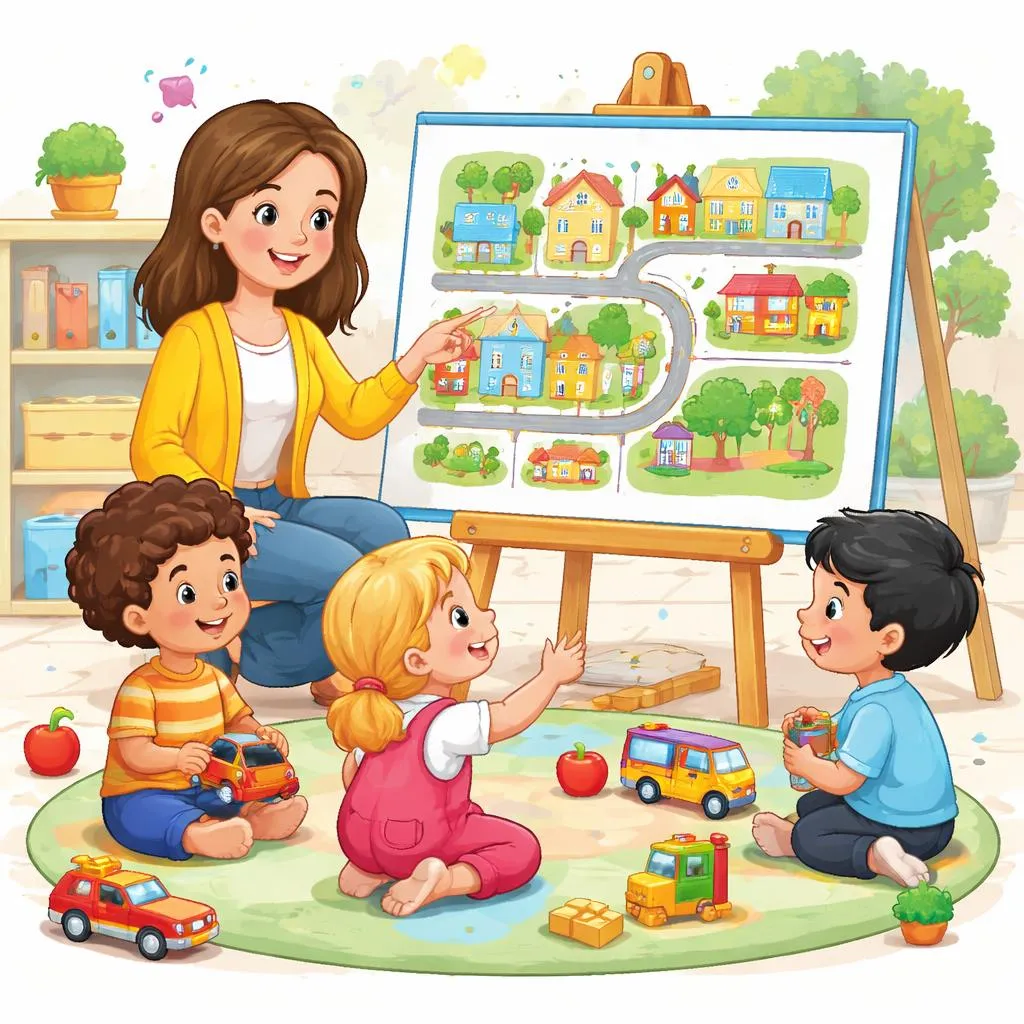
What is places town? Places town refers to common locations in a town for early English learning.It’s a core vocabulary topic for young language learners.Links words to real-life spaces children recognize or visit. Covers everyday spots that build practical English skills.Connects vocabulary to daily routines and community life.Lays a foundation for talking about where people go and what they do. Teaches location words in a clear, relatable context.Uses simple terms that match a child’s understanding of the world.Makes English useful for real conversations and descriptions. Meaning and explanation Each place in a town has a clear, simple meaning for young learners.Teach words with direct, concrete definitions and visual cues.Avoid complex language—stick to what children can experience. A town is a small community with homes and shared places.Places are the specific locations within that community.Each place has a purpose that kids can easily grasp. Link each place word to an action or function.For example, a park is for playing, a store is for buying things.This connection helps memory and understanding of word meaning. Places town vocabulary builds spatial and social awareness.Learners start to map the world with English words.Each new word adds to their ability to describe their surroundings. Categories or lists Organize places town vocabulary into simple, logical categories.Grouping words helps young learners remember and recall them.Stick to two main categories for early lessons to avoid overload. Community & Play Places Park – a green space for playing and walkingPlayground – an area with swings and slides for kidsZoo – a place with many different animals to seeGarden – a space with plants, flowers and trees Daily Errands & Services Places Store – a place to buy food, toys and suppliesCafé – a place to get drinks and small snacksLibrary – a place to borrow books and readClinic – a place to go for small health checks Home & Neighbourhood Places House – a place where a family livesStreet – the road with houses and buildingsSquare – an open space in the middle of a townBus stop – a place to wait for a bus to travel All words use short, simple spellings and sounds.Each category has a clear theme for easy association.Add one category at a time as learners build confidence. Daily life examples Use daily life examples to make places town vocabulary real.Connect each word to moments kids experience at home or in the community.Examples turn abstract words into concrete, memorable ideas. Talk about going to the park with family on weekends.Describe swinging on the playground after school.Mention visiting the store to buy fruit or a new toy. Talk about sitting in a café with a parent for a juice.Explain borrowing a picture book from the library.Reference walking down the street to a friend’s house. Describe seeing animals at the zoo on a trip.Talk about watering plants in a garden at home.Mention waiting at the bus stop to go to the town center. Use simple sentences to link place and action.Say, “We play at the park.” or “We buy milk at the store.”These examples model how to use words in real English. Printable flashcards Printable flashcards are a key tool for teaching places town.They combine visual and verbal learning for young learners.Make flashcards simple, bright and easy to recognize. Create one flashcard per place word with a clear image.Use bold, large text for the word—no extra words or details.Laminate flashcards for repeated use in lessons and play. Include the core places town list: park, store, library, café, zoo, street.Add simple, colorful illustrations—no busy backgrounds.Match the image exactly to the word for no confusion. Use flashcards for quick review at the start or end of lessons.Hold up a card and say the word—have learners repeat it.Progress to holding up the card and asking learners to name it. Create double-sided flashcards: word on one side, image on the other.Use these for independent practice or small group games.Flashcards work for classroom, homeschool and home practice. Add simple action words on the back for extension: park – play, store – buy.This builds early sentence structure with places town vocabulary.Flashcards grow with learners as their skills develop. Learning activities or games Learning activities turn places town vocabulary into active play.Each activity builds speaking, listening and recognition skills.Keep activities short, energetic and focused on fun. Place Sorting Game Lay out pictures of different town places and category cards.Category cards: “Play Places” and “Errand Places”.Have learners sort the place cards into the correct categories. Town Walk Role-Play Set up a mini town in the classroom with simple props.Use a mat for the park, a box for the store, a book for the library.Learners walk around, stop at a place and say the word aloud. Picture Match Show a flashcard of a place and hold up multiple small images.Ask learners to point to the image that matches the place word.Progress to saying the word and having learners find the flashcard. Sentence Build Use place words and simple action words on separate cards.Have learners pick one place and one action card to make a sentence.Model sentences first: “Go to the park.” “Play at the playground.” Place Hunt Hide place flashcards around the classroom or play area.Have learners hunt for the cards and bring them back to the group.When a card is found, the learner says the place word aloud. Town Map Draw Give learners a simple blank map of a town.Call out place words and have learners draw them on the map.Use simple shapes: a circle for the park, a square for the store. All activities use repetition without boredom.They build confidence by letting learners use words in action.Adjust the difficulty based on the learner’s current skill level. Incorporate movement into all places town activities.Young learners remember words better when they move and act.Stand up to say “park” and jump—sit to say “library” and read a book. Use turn-taking in group activities to build social skills.Each learner gets a chance to speak and use the vocabulary.Praise all attempts to build confidence and engagement. Places town is a wonderful starting point for early English vocabulary.It connects language to the world kids know and experience every day.Each word builds a foundation for more complex English later on. Teaching places town with visuals, examples and play makes learning stick.Learners don’t just memorize words—they learn how to use them.This practical learning builds a love for English and confidence to speak. Incorporate places town into daily lessons with quick reviews and play.Point out town places when out and about—say the English word aloud.This bridges classroom learning and real-life use of English. As learners master the core places town list, add new words slowly.Extend to more specific places: bakery, bookstore, playground.Build on their success to keep learning fun and rewarding. Every time a learner names a town place in English, they grow their skills.They start to see English as a useful tool for describing their world.Places town vocabulary opens the door to talking about travel, routines and community—key topics for young English learners. Keep lessons focused on connection and play, not perfection.Celebrate every word a learner masters and every attempt to speak.Places town is more than just vocabulary—it’s the start of a lifelong love for learning English.
How to Teach Young Learners About Places Town in English Easily?
