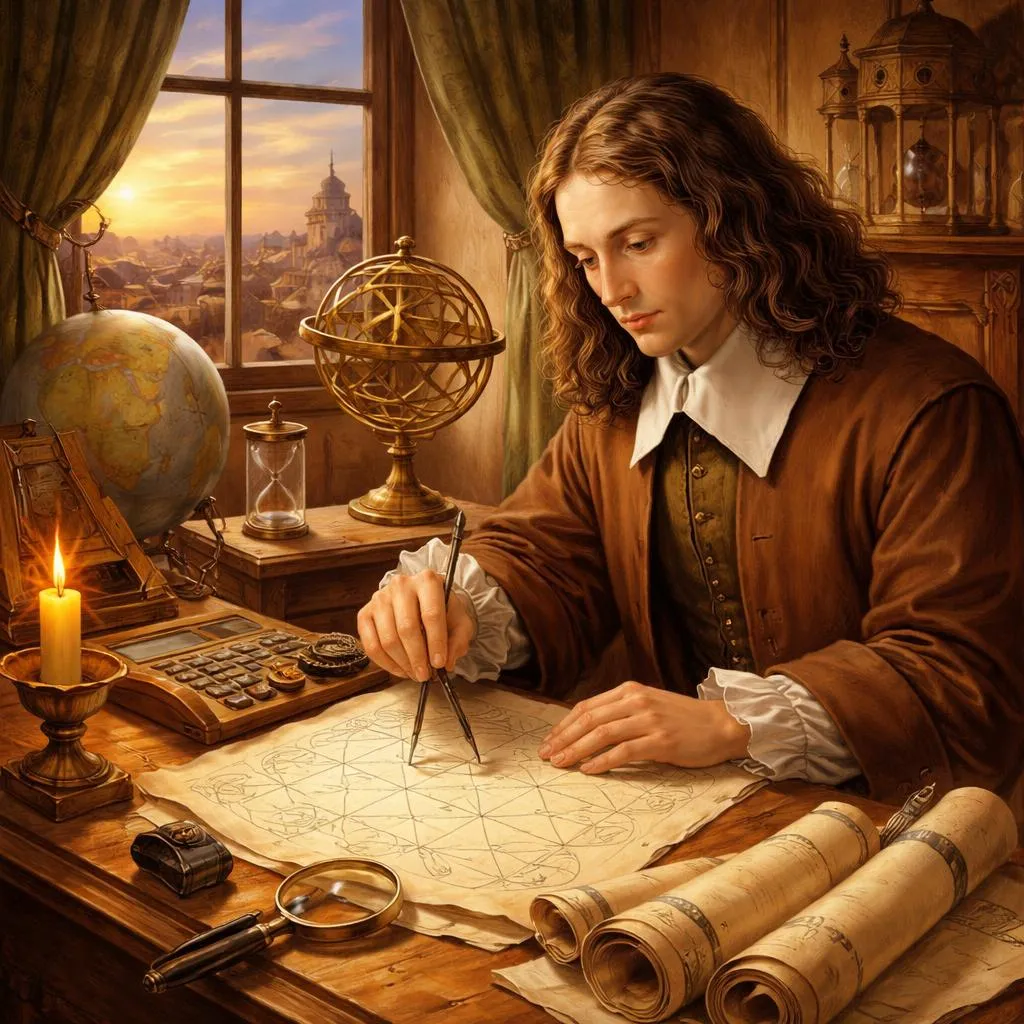

Among the contemporaries of Descartes none displayed greater natural genius than Pascal, but his mathematical reputation rests more on what he might have done than on what he actually effected, as during a considerable part of his life he deemed it his duty to devote his whole time to religious exercises.
Blaise Pascal was born at Clermont on June 19, 1623, and died at Paris on Aug. 19, 1662. His father, a local judge at Clermont, and himself of some scientific reputation, moved to Paris in 1631, partly to prosecute his own scientific studies, partly to carry on the education of his only son, who had already displayed exceptional ability. Pascal was kept at home in order to ensure his not being overworked, and with the same object it was directed that his education should be at first confined to the study of languages, and should not include any mathematics. This naturally excited the boy's curiosity, and one day, being then twelve years old, he asked in what geometry consisted. His tutor replied that it was the science of constructing exact figures and of determining the proportions between their different parts. Pascal, stimulated no doubt by the injunction against reading it, gave up his play-time to this new study, and in a few weeks had discovered for himself many properties of figures, and in particular the proposition that the sum of the angles of a triangle is equal to two right angles. I have read somewhere, but I cannot lay my hand on the authority, that his proof merely consisted in turning the angular points of a triangular piece of paper over so as to meet in the centre of the inscribed circle: a similar demonstration can be got by turning the angular points over so as to meet at the foot of the perpendicular drawn from the biggest angle to the opposite side. His father, struck by this display of ability, gave him a copy of Euclid's Elements , a book which Pascal read with avidity and soon mastered.
At the age of fourteen he was admitted to the weekly meetings of Roberval, Mersenne, Mydorge, and other French geometricians; from which, ultimately, the French Academy sprung. At sixteen Pascal wrote an essay on conic sections; and in 1641, at the age of eighteen, he constructed the first arithmetical machine, an instrument which, eight years later, he further improved. His correspondence with Fermat about this time shews that he was then turning his attention to analytical geometry and physics. He repeated Torricelli's experiments, by which the pressure of the atmosphere could be estimated as a weight, and he confirmed his theory of the cause of barometrical variations by obtaining at the same instant readings at different altitudes on the hill of Puy-de-Dôme.
In 1650, when in the midst of these researches, Pascal suddenly abandoned his favourite pursuits to study religion, or, as he says in his Pensées , "contemplate the greatness and the misery of man"; and about the same time he persuaded the younger of his two sisters to enter the Port Royal society.
In 1653 he had to administer his father's estate. He now took up his old life again, and made several experiments on the pressure exerted by gases and liquids; it was also about this period that he invented the arithmetical triangle, and together with Fermat created the calculus of probabilities. He was meditating marriage when an accident again turned the current of his thoughts to a religious life. He was driving a four-in-hand on November 23, 1654, when the horses ran away; the two leaders dashed over the parapet of the bridge at Neuilly, and Pascal was saved only by the traces breaking. Always somewhat of a mystic, he considered this a special summons to abandon the world. He wrote an account of the accident on a small piece of parchment, which for the rest of his life he wore next to his heart, to perpetually remind him of his covenant; and shortly moved to Port Royal, where he continued to live until his death in 1662. Constitutionally delicate, he had injured his health by his incessant study; from the age of seventeen or eighteen he suffered from insomnia and acute dyspepsia, and at the time of his death was physically worn out.
His famous Provincial Letters directed against the Jesuits, and his Pensées , were written towards the close of his life, and are the first example of that finished form which is characteristic of the best French literature. The only mathematical work that he produced after retiring to Port Royal was the essay on the cycloid in 1658. He was suffering from sleeplessness and toothache when the idea occurred to him, and to his surprise his teeth immediately ceased to ache. Regarding this as a divine intimation to proceed with the problem, he worked incessantly for eight days at it, and completed a tolerably full account of the geometry of the cycloid.
I now proceed to consider his mathematical works in rather greater detail.
His early essay on the geometry of conics, written in 1639, but not published till 1779, seems to have been founded on the teaching of Desargues. Two of the results are important as well as interesting. The first of these is the theorem known now as "Pascal's Theorem," namely, that if a hexagon be inscribed in a conic, the points of intersection of the opposite sides will lie in a straight line. The second, which is really due to Desargues, is that if a quadrilateral be inscribed in a conic, and a straight line be drawn cutting the sides taken in order in the points A , B , C , and D , and the conic in P and Q , then
PA . PC : PB . PD = QA . QC : QB . QD .
Pascal employed his arithmetical triangle in 1653, but no account of his method was printed till 1665. The triangle is constructed as in the figure below, each horizontal line being formed form the one above it by making every number in it equal to the sum of those above and to the left of it in the row immediately above it; ex. gr. the fourth number in the fourth line, namely, 20, is equal to 1 + 3 + 6 + 10.
The numbers in each line are what are now called figurate numbers. Those in the first line are called numbers of the first order; those in the second line, natural numbers or numbers of the second order; those in the third line, numbers of the third order, and so on. It is easily shewn that the mth number in the nth row is (m+n-2)! / (m-1)!(n-1)!
Pascal's arithmetical triangle, to any required order, is got by drawing a diagonal downwards from right to left as in the figure. The numbers in any diagonal give the coefficients of the expansion of a binomial; for example, the figures in the fifth diagonal, namely 1, 4, 6, 4, 1, are the coefficients of the expansion ( a + b ) 4 . Pascal used the triangle partly for this purpose, and partly to find the numbers of combinations of m things taken n at a time, which he stated, correctly, to be (n+1)(n+2)(n+3) ... m / (m-n)!
Perhaps as a mathematician Pascal is best known in connection with his correspondence with Fermat in 1654 in which he laid down the principles of the theory of probabilities. This correspondence arose from a problem proposed by a gamester, the Chevalier de Méré, to Pascal, who communicated it to Fermat. The problem was this. Two players of equal skill want to leave the table before finishing their game. Their scores and the number of points which constitute the game being given, it is desired to find in what proportion they should divide the stakes. Pascal and Fermat agreed on the answer, but gave different proofs. The following is a translation of Pascal's solution. That of Fermat is given later.
The following is my method for determining the share of each player when, for example, two players play a game of three points and each player has staked 32 pistoles.
Suppose that the first player has gained two points, and the second player one point; they have now to play for a point on this condition, that, if the first player gain, he takes all the money which is at stake, namely, 64 pistoles; while, if the second player gain, each player has two points, so that there are on terms of equality, and, if they leave off playing, each ought to take 32 pistoles. Thus if the first player gain, then 64 pistoles belong to him, and if he lose, then 32 pistoles belong to him. If therefore the players do not wish to play this game but to separate without playing it, the first player would say to the second, "I am certain of 32 pistoles even if I lose this game, and as for the other 32 pistoles perhaps I will have them and perhaps you will have them; the chances are equal. Let us then divide these 32 pistoles equally, and give me also the 32 pistoles of which I am certain." Thus the first player will have 48 pistoles and the second 16 pistoles.
Next, suppose that the first player has gained two points and the second player none, and that they are about to play for a point; the condition then is that, if the first player gain this point, he secures the game and takes the 64 pistoles, and, if the second player gain this point, then the players will be in the situation already examined, in which the first player is entitled to 48 pistoles and the second to 16 pistoles. Thus if they do not wish to play, the first player would say to the second, "If I gain the point I gain 64 pistoles; if I lose it, I am entitled to 48 pistoles. Give me then the 48 pistoles of which I am certain, and divide the other 16 equally, since our chances of gaining the point are equal." Thus the first player will have 56 pistoles and the second player 8 pistoles.
Finally, suppose that the first player has gained one point and the second player none. If they proceed to play for a point, the condition is that, if the first player gain it, the players will be in the situation first examined, in which the first player is entitled to 56 pistoles; if the first player lose the point, each player has then a point, and each is entitled to 32 pistoles. Thus, if they do not wish to play, the first player would say to the second, "Give me the 32 pistoles of which I am certain, and divide the remainder of the 56 pistoles equally, that is divide 24 pistoles equally." Thus the first player will have the sum of 32 and 12 pistoles, that is, 44 pistoles, and consequently the second will have 20 pistoles.
Pascal proceeds next to consider the similar problems when the game is won by whoever first obtains m + n points, and one player has m while the other has n points. The answer is obtained using the arithmetical triangle. The general solution (in which the skill of the players is unequal) is given in many modern text-books on algebra, and agrees with Pascal's result, though of course the notation of the latter is different and less convenient.
Pascal made an illegitimate use of the new theory in the seventh chapter of his Pensées . In effect, he puts his argument that, as the value of eternal happiness must be infinite, then, even if the probability of a religious life ensuring eternal happiness be very small, still the expectation (which is measured by the product of the two) must be of sufficient magnitude to make it worth while to be religious. The argument, if worth anything, would apply equally to any religion which promised eternal happiness to those who accepted its doctrines. If any conclusion may be drawn from the statement, it is the undersirability of applying mathematics to questions of morality of which some of the data are necessarily outside the range of an exact science. It is only fair to add that no one had more contempt than Pascal for those who changes their opinions according to the prospect of material benefit, and this isolated passage is at variance with the spirit of his writings.
The last mathematical work of Pascal was that on the cycloid in 1658. The cycloid is the curve traced out by a point on the circumference of a circular hoop which rolls along a straight line. Galileo, in 1630, had called attention to this curve, the shape of which is particularly graceful, and had suggested that the arches of bridges should be built in this form. Four years later, in 1634, Roberval found the area of the cycloid; Descartes thought little of this solution and defied him to find its tangents, the same challenge being also sent to Fermat who at once solved the problem. Several questions connected with the curve, and with the surface and volume generated by its revolution about its axis, base, or the tangent at its vertex, were then proposed by various mathematicians. These and some analogous question, as well as the positions of the centres of the mass of the solids formed, were solved by Pascal in 1658, and the results were issued as a challenge to the world, Wallis succeeded in solving all the questions except those connected with the centre of mass. Pascal's own solutions were effected by the method of indivisibles, and are similar to those which a modern mathematician would give by the aid of the integral calculus. He obtained by summation what are equivalent to the integrals of sin φ , sin 2 φ , and φ sin φ , one limit being either 0 or 1/2π. He also investigated the geometry of the Archimedean spiral. These researches, according to D'Alembert, form a connecting link between the geometry of Archimedes and the infinitesimal calculus of Newton.
Pengantar Blaise Pascal dan Warisannya
Blaise Pascal adalah seorang matematikawan, fisikawan, penemu, penulis, dan filsuf Prancis yang luar biasa yang hidup pada abad ke-17. Lahir pada tahun 1623, Pascal menunjukkan bakat luar biasa sejak usia muda, terutama dalam matematika dan sains. Terlepas dari janji awalnya dan kontribusi yang signifikan, sebagian besar hidupnya diabdikan untuk refleksi agama dan filsafat. Karyanya telah memberikan dampak yang langgeng di banyak bidang, termasuk geometri, teori probabilitas, dan bahkan sastra.
Latar Belakang dan Konteks Sejarah
Pascal hidup pada masa ketika sains dan agama sering kali berpotongan dan terkadang bertentangan. Abad ke-17 adalah periode penemuan ilmiah yang hebat, dengan tokoh-tokoh seperti Descartes dan Galileo menantang gagasan lama dan meletakkan dasar bagi sains modern. Pascal adalah bagian dari revolusi intelektual ini tetapi juga sangat terlibat dengan pemikiran agama, khususnya melalui hubungannya dengan gerakan Jansenis di Port Royal, sebuah komunitas keagamaan yang menekankan kesalehan dan moralitas yang ketat.
Ayahnya, seorang hakim dan ilmuwan, memainkan peran penting dalam memelihara pendidikan awal Pascal. Menariknya, Pascal awalnya dilarang mempelajari matematika, yang justru memicu rasa ingin tahunya dan membawanya untuk menemukan banyak kebenaran matematika sendiri. Pembelajaran mandiri di awal ini menjadi panggung bagi pencapaiannya di kemudian hari.
Kontribusi Utama Pascal
-
Matematika dan Geometri: Pascal membuat penemuan penting dalam geometri proyektif, termasuk Teorema Pascal tentang heksagon yang tertulis dalam irisan kerucut. Ia juga mengembangkan Segitiga Pascal yang terkenal, sebuah alat yang membantu menghitung kombinasi dan ekspansi binomial, yang masih diajarkan di sekolah hingga saat ini.
-
Teori Probabilitas: Bersama Pierre de Fermat, Pascal meletakkan dasar bagi teori probabilitas modern. Korespondensi mereka dimulai dengan masalah perjudian dan berkembang menjadi teori matematika formal yang membantu kita memahami peluang dan risiko—bidang yang penting untuk statistik, ekonomi, dan pengambilan keputusan.
-
Fisika dan Penemuan: Pascal melakukan eksperimen tentang tekanan atmosfer, mengkonfirmasi dan memperluas karya sebelumnya oleh Torricelli. Ia menemukan salah satu kalkulator mekanik pertama, langkah awal menuju komputasi modern.
-
Filsafat dan Sastra: "Pensées" (Pemikiran) Pascal adalah kumpulan refleksi tentang sifat manusia, agama, dan filsafat. Argumen "pertaruhan"-nya yang terkenal menggunakan probabilitas untuk bernalar tentang kepercayaan kepada Tuhan, yang menunjukkan perpaduan unik antara penalaran ilmiah dan spiritualitas.
Makna dan Signifikansi bagi Siswa
Hidup dan karya Pascal menawarkan pelajaran yang kaya bagi siswa dan pembaca muda:
-
Rasa Ingin Tahu dan Pembelajaran Mandiri: Pembangkangan awal Pascal terhadap batasan dan studinya yang termotivasi sendiri menunjukkan kekuatan rasa ingin tahu dan pembelajaran independen. Siswa dapat belajar bahwa terkadang mempertanyakan aturan dan mengeksplorasi sendiri mengarah pada penemuan-penemuan hebat.
-
Pemikiran Interdisipliner: Pascal menggabungkan matematika, sains, dan filsafat, menunjukkan bahwa pengetahuan saling terkait. Hal ini mendorong siswa untuk berpikiran terbuka dan melihat bagaimana berbagai mata pelajaran dapat menginformasikan dan memperkaya satu sama lain.
-
Menyeimbangkan Gairah dan Refleksi: Pergeseran Pascal dari sains ke perenungan agama mengingatkan kita akan pentingnya menyeimbangkan pengejaran intelektual dengan nilai-nilai pribadi dan refleksi.
-
Ketahanan dan Tujuan: Terlepas dari masalah kesehatan dan tantangan pribadi, Pascal terus bekerja dan berpikir mendalam tentang pertanyaan-pertanyaan penting. Kegigihannya menginspirasi siapa pun yang menghadapi kesulitan.
Penerapan dalam Kehidupan Sehari-hari dan Pembelajaran
-
Matematika dan Pemecahan Masalah: Memahami Segitiga Pascal dan probabilitas dapat meningkatkan keterampilan berpikir logis dan pengambilan keputusan siswa, yang berguna dalam permainan, studi, dan situasi kehidupan nyata yang melibatkan risiko.
-
Etika dan Pemikiran Kritis: Refleksi filosofis Pascal mendorong siswa untuk memikirkan pertanyaan-pertanyaan besar—tentang kebahagiaan, tujuan, dan kepercayaan—yang dapat membantu mereka mengembangkan nilai-nilai dan penalaran moral mereka sendiri.
-
Penyelidikan Ilmiah: Eksperimen Pascal menunjukkan pentingnya pengamatan, pengujian, dan rasa ingin tahu dalam sains, mendorong siswa untuk menjelajahi dan mempertanyakan dunia di sekitar mereka.
-
Apresiasi Sastra: Gaya penulisan Pascal yang jelas dan elegan dalam surat-surat dan "Pensées"-nya adalah contoh yang bagus tentang cara mengungkapkan ide-ide kompleks secara sederhana dan indah, sebuah keterampilan yang berharga dalam semua komunikasi.
Cara Mengembangkan Semangat Pascal
-
Tetap Penasaran: Seperti Pascal, jangan takut untuk menjelajahi topik baru, bahkan yang tampak sulit atau terlarang.
-
Berpikir Lintas Mata Pelajaran: Cobalah untuk menghubungkan ide-ide dari berbagai bidang—matematika, sains, sastra, filsafat—untuk mendapatkan pemahaman yang lebih dalam.
-
Renungkan Keyakinan Anda: Luangkan waktu untuk mempertimbangkan apa yang penting bagi Anda, seperti yang dilakukan Pascal di tahun-tahun terakhirnya.
-
Tetap Gigih: Tantangan dan kemunduran adalah bagian dari pembelajaran; teruslah berupaya mencapai tujuan Anda dengan dedikasi.
Kesimpulan
Kisah Blaise Pascal bukan hanya tentang matematika atau sains; ini tentang perjalanan pikiran muda melalui rasa ingin tahu, penemuan, iman, dan refleksi. Bagi siswa saat ini, hidupnya mengajarkan nilai gairah intelektual, pertanyaan moral, dan ketahanan. Dengan mempelajari Pascal, pelajar muda dapat mengembangkan keterampilan dan sikap yang membantu mereka berhasil secara akademis dan tumbuh sebagai individu yang bijaksana dan berpengetahuan luas.
