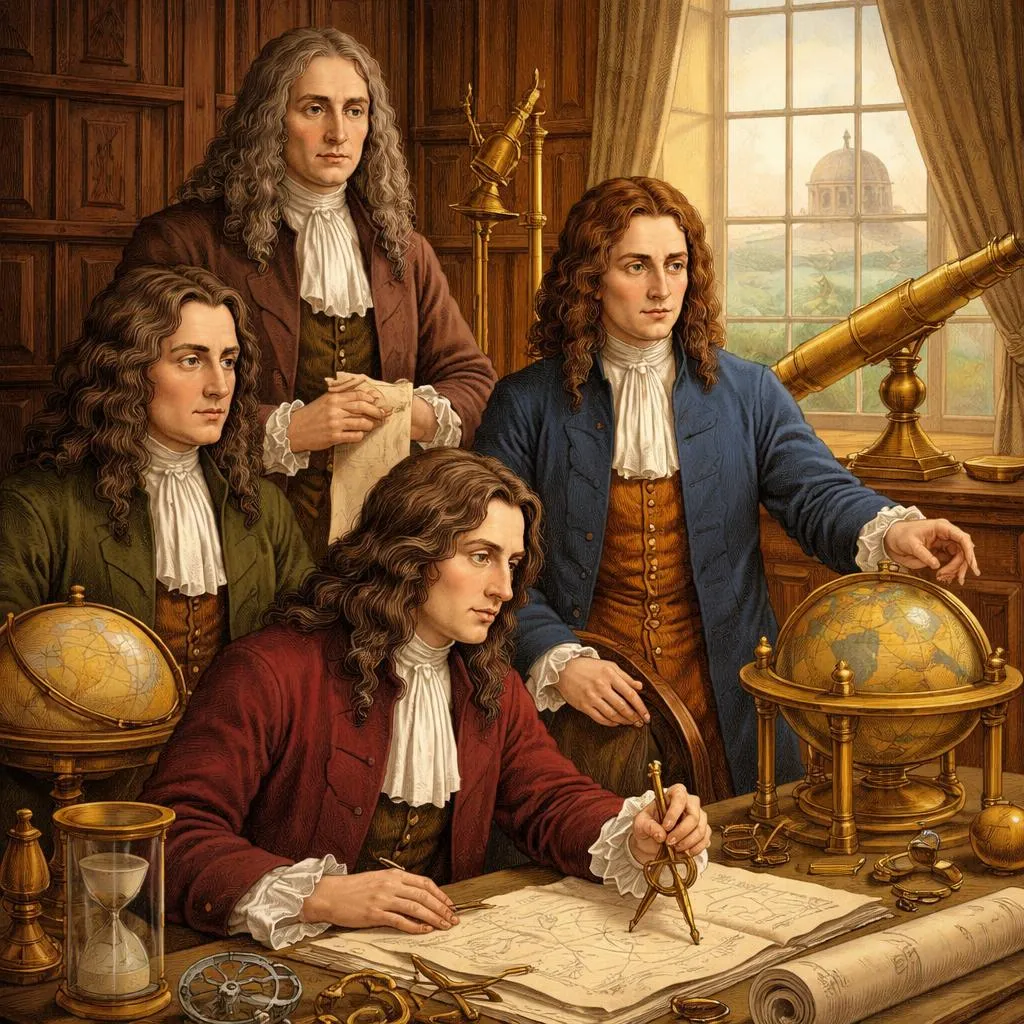

It was almost a matter of course that the English should at first have adopted the notation of Newton in the infinitesimal calculus in preference to that of Leibnitz and consequently the English school would in any case have developed on somewhat different lines to that on the continent, where a knowledge of the infinitesimal calculus was derived solely from Leibnitz and the Bernoullis. But this separation into two distinct schools became very marked owing to the action of Leibnitz and John Bernoulli, which was naturally resented by Newton's friends; and so for forty or fifty years, to the disadvantage of both sides, the quarrel raged. The leading members of the English school were Cotes, Demoivre, Ditton, David Gregory, Halley, Maclaurin, Simpson, and Taylor. I may, however, again remind my readers that as we approach modern times the number of capable mathematicians in Britain, France, Germany and Italy becomes very considerable, but that in a popular sketch like this book it is only the leading men whom I propose to mention.
To David Gregory, Halley and Ditton I need devote but few words.
David Gregory
David Gregory, the nephew of the James Gregory mentioned above, born at Aberdeen on June 24, 1661, and died at Maidenhead on Oct. 10, 1708, was appointed professor at Edinburgh in 1684, and in 1691 was on Newton's recommendation elected Savilian professor at Oxford. His chief works are one on geometry, issued in 1684; one on optics, published in 1695, which contains [p. 98] the earliest suggestion of the possibility of making an achromatic combinations of lenses; and one on the Newtonian geometry, physics, and astronomy, issued in 1702.
Halley
Edmund Halley, born in London in 1656, and died at Greenwich in 1742, was educated at St. Paul's School, London, and Queen's College, Oxford, in 1703 succeeded Wallis as Savilian professor, and subsequently in 1720 was appointed astronomer-royal in succession to Flamsteed, whose Historia Coelestis Britannica he edited; the first and imperfect edition was issued in 1712. Halley's name will be recollected for the generous manner in which he secured the immediate publication of Newton's Principia in 1687. Most of his original work was on astronomy and allied subjects, and lies outside the limits of this book; it may be, however, said that the work is of excellent quality, and both Lalande and Mairan speak of it in the highest terms. Halley conjecturally restored the eighth and lost book of the conics of Apollonius, and in 1710 brought out a magnificent edition of the whole work; he also edited the works of Serenus, those of Menelaus, and some of the minor works of Apollonius. He was in his turn succeeded at Greenwich as astronomer-royal by Bradley.
Ditton
Humphry Ditton was born at Salisbury on May 29, 1675, and died in London in 1715 at Christ's Hospital, where he was mathematical master. He does not seem to have paid much attention to mathematics until he came to London about 1705, and his early death was a distinct loss to English science. He published in 1706 a text book on fluxions; this and another similar work by William Jones, which was issued in 1711, occupied in England much the same place as l'Hospital's treatise did in France. In 1709 Ditton issued an algebra, and in 1712 a treatise on perspective. He also wrote numerous papers in the Philosophical Transactions . He was the earliest writer to attempt to explain the phenomenon of capillarity on mathematical principles; and he invented a method for finding the longditude, which has been since used on various occasions.
Cotes
Roger Cotes was born near Leicester on July 10, 1682, and died at Cambridge on June 5, 1716. He was educated at Trinity College, Cambridge, of which society he was a fellow, and in 1706 was elected to the newly-created Plumian chair of astronomy in the university of Cambridge. From 1709 to 1713 his time was mainly occupied in editing the second edition of the Principia . The remark of Newton that if only Cotes had lived "we might have known something" indicates the opinion of his abilities held by most of his contemporaries.
Cotes's writings were collected and published in 1722 under the titles Harmonia Mensurarum and Opera Miscellanea . His lectures on hydrostatics were published in 1738. A large part of the Harmonia Mensurarum is given up to the decomposition and integration of rational algebraical expressions. That part which deals with the theory of partial fractions was left unfinished, but was completed by de Moivre. Cotes's theorem in trigonometry, which depends on forming the quadratic factors of x n - 1, is well known. The proposition that "if from a fixed point O a line be drawn cutting a curve in Q 1 , Q 2 , ... , Q n , and a point P be taken on the line so that the reciprocal of OP is the arithmetic mean of the reciprocals of OQ 1 , OQ 2 , ... , OQ n , then the locus of P will be a straight line" is also due to Cotes. The title of the book was derived from the latter theorem. The Opera Miscellanea contains a paper on the method for determining the most probable result from a number of observations. This was the earliest attempt to frame a theory of errors. It also contains essays on Newton's Methodus Differentialis , on the construction of tables by the method of differences, on the descent of a body under gravity, on the cycloidal pendulum, and on projectiles.
de Moivre
Abraham de Moivre was born at Vitry on May 26, 1667, and died in London on November 27, 1754. His parents came to England when he was a boy, and his education and friends were alike English. His interest in the higher mathematics is said to have originated in his coming by chance across a copy of Newton's Principia . From the éloge on him delivered in 1754 before the French Academy it would seem that his work as a teacher of mathematics had led him to the house of the Earl of Devonshire at the instant when Newton, who had asked permission to present a copy of his work to the earl, was coming out. Taking up the book, and charmed by the far-reaching conclusions and the apparent simplicity of the reasoning, de Moivre thought nothing would be easier than to master the subject, but to his surprise found that to follow the argument overtaxed his powers. He, however, bought a copy, and as he had but little leisure he tore out the pages in order to carry one or two of them loose in his pocket so that he could study them in the intervals of his work as a teacher. Subsequently he joined the Royal Society, and became intimately connected with Newton, Halley, and other mathematicians of the English school. The manner of his death has a certain interest for psychologists. Shortly before it he declared that it was necessary for him to sleep some ten minutes or a quarter of an hour longer each day than the preceding one. The day after he had thus reached a total of something over twenty-three hours he slept up to the limit of twenty-four hours, and then died in his sleep.
He is best known for having, together with Lambert, created that part of trigonometry which deals with imaginary quantities. Two theorems on this part of the subject are still connected with his name, namely, that which asserts that sin nx + i cos nx is one of the values of (sin x + i cos x ) n , and that which gives the various quadratic factors of x 2 n - 2 px n + 1. His chief works, other than numerous papers in the Philosophical Transactions , were The Doctrine of Chances , published in 1718, and the Miscellanea Analytica , published in 1730. In the former the theory of recurring series was first given, and the theory of partial fractions which Cotes's premature death had left unfinished was completed, while the rule for finding the probability of a compound event was enunciated. The latter book, besides the trigonometrical propositions mentioned above, contains some theorems in astronomy, but they are treated as problems in analysis.
Stewart
Maclaurin was succeeded in his chair at Edinburgh by his pupil Matthew Stewart, born at Rothesay in 1717 and died at Edinburgh on January 23, 1785, a mathematician of considerable power, to whom I allude in passing, for his theorems on the problem of three bodies, and for his discussion, treated by transversals and involution, of the properties of the circle and straight line.
Latar Belakang dan Konteks Sejarah
Tulisan ini memberikan sekilas pandang yang menarik ke dalam perkembangan matematika dan astronomi di Inggris selama akhir abad ke-17 dan awal abad ke-18. Ia menjelaskan persaingan antara sekolah kalkulus Inggris dan Kontinental, dengan fokus pada pengikut Isaac Newton dan Gottfried Wilhelm Leibniz. Persaingan ini membentuk arah pemikiran matematika selama beberapa dekade. Tokoh-tokoh yang disebutkan—David Gregory, Edmund Halley, Humphry Ditton, Roger Cotes, Abraham de Moivre, dan Matthew Stewart—adalah kontributor utama bagi kemajuan ilmu pengetahuan dan matematika selama periode ini.
Tentang Penulis dan Ahli Matematika
- Isaac Newton (1643–1727): Meskipun tidak dijelaskan secara rinci di sini, karya Newton meletakkan dasar bagi sebagian besar kalkulus dan fisika yang dibahas. "Principia Mathematica"-nya merevolusi pemahaman tentang gerak dan gravitasi.
- David Gregory (1661–1708): Seorang matematikawan dan astronom yang berkontribusi pada geometri dan optik, termasuk gagasan awal tentang lensa akromatik.
- Edmund Halley (1656–1742): Terkenal karena Komet Halley, ia juga berperan penting dalam menerbitkan karya Newton dan memberikan kontribusi signifikan pada astronomi.
- Humphry Ditton (1675–1715): Dikenal karena buku teksnya tentang fluksion (kalkulus) dan aljabar, dan untuk karya awal tentang kapilaritas dan perhitungan garis bujur.
- Roger Cotes (1682–1716): Editor edisi kedua Principia Newton, dikenal karena teorema penting dalam trigonometri dan karya awal tentang teori kesalahan.
- Abraham de Moivre (1667–1754): Pelopor dalam teori probabilitas dan trigonometri yang melibatkan bilangan imajiner, karyanya meletakkan dasar bagi statistik.
- Matthew Stewart (1717–1785): Dikenal karena karyanya tentang masalah tiga benda dan sifat geometris.
Interpretasi dan Signifikansi Rinci
Kumpulan biografi dan pencapaian ini menyoroti sifat kolaboratif dan terkadang kompetitif dari kemajuan ilmiah. Preferensi sekolah Inggris terhadap notasi Newton memengaruhi arah kalkulus di Inggris, sementara matematikawan Kontinental mengikuti pendekatan Leibniz. Perselisihan antara sekolah-sekolah ini memperlambat kemajuan tetapi juga mempertajam ketelitian matematika.
Karya-karya yang disebutkan—mulai dari geometri dan optik hingga astronomi dan probabilitas—menunjukkan betapa saling berhubungan bidang-bidang ini. Misalnya, upaya Halley memastikan ide-ide revolusioner Newton menjangkau khalayak yang lebih luas, sementara teori probabilitas de Moivre telah menjadi fundamental bagi statistik dan analisis risiko saat ini.
Pelajaran dan Wawasan untuk Siswa
- Ketekunan dan Rasa Ingin Tahu: Banyak dari ahli matematika ini menghadapi tantangan, mulai dari perselisihan intelektual hingga kesulitan pribadi. Ketekunan mereka dalam mempelajari masalah kompleks mengajarkan siswa nilai dedikasi.
- Pembelajaran Interdisipliner: Perpaduan geometri, fisika, astronomi, dan probabilitas menggambarkan pentingnya menghubungkan berbagai bidang untuk memecahkan masalah.
- Kolaborasi dan Rasa Hormat: Terlepas dari persaingan, para sarjana ini sering kali membangun karya satu sama lain. Ini menunjukkan pentingnya menghormati kontribusi orang lain dan bekerja sama.
- Inovasi dan Berpikir Kritis: Pendekatan de Moivre terhadap bilangan imajiner dan probabilitas menunjukkan bagaimana pemikiran inovatif dapat membuka bidang pengetahuan baru.
- Penerapan Praktis: Dari meningkatkan navigasi dengan menghitung garis bujur hingga memahami kapilaritas, penemuan-penemuan ini memiliki dampak dunia nyata, mendorong siswa untuk melihat relevansi matematika dan sains.
Menerapkan Pelajaran Ini dalam Kehidupan Sehari-hari
- Dalam Pembelajaran: Tiru rasa ingin tahu dan disiplin dari para ahli matematika ini dengan menangani mata pelajaran yang menantang selangkah demi selangkah dan berusaha untuk memahami aplikasi dunia nyata mereka.
- Dalam Pengaturan Sosial: Hargai sudut pandang yang beragam dan berkolaborasi secara hormat, menyadari bahwa kemajuan sering kali datang dari upaya bersama.
- Dalam Pemecahan Masalah: Gunakan pendekatan interdisipliner—gabungkan pengetahuan dari berbagai bidang untuk menemukan solusi kreatif.
- Dalam Pertumbuhan Pribadi: Kembangkan kesabaran dan ketekunan, mengetahui bahwa penguasaan membutuhkan waktu dan usaha.
Mengembangkan Sifat Positif dari Kisah-Kisah Ini
Siswa dapat belajar untuk menghargai pembelajaran seumur hidup, menerima tantangan, dan mempertahankan kerendahan hati intelektual. Kisah-kisah tersebut mendorong untuk menerima ide-ide baru, bahkan ketika sulit, dan menyoroti pentingnya berkontribusi pada komunitas pengetahuan yang lebih besar.
Dengan mempelajari tokoh-tokoh sejarah ini dan karya mereka, siswa tidak hanya mendapatkan pengetahuan matematika tetapi juga inspirasi untuk menempuh jalan mereka sendiri dalam sains, teknologi, teknik, dan matematika (STEM), membina pola pikir yang menghargai rasa ingin tahu, kolaborasi, dan ketekunan.
