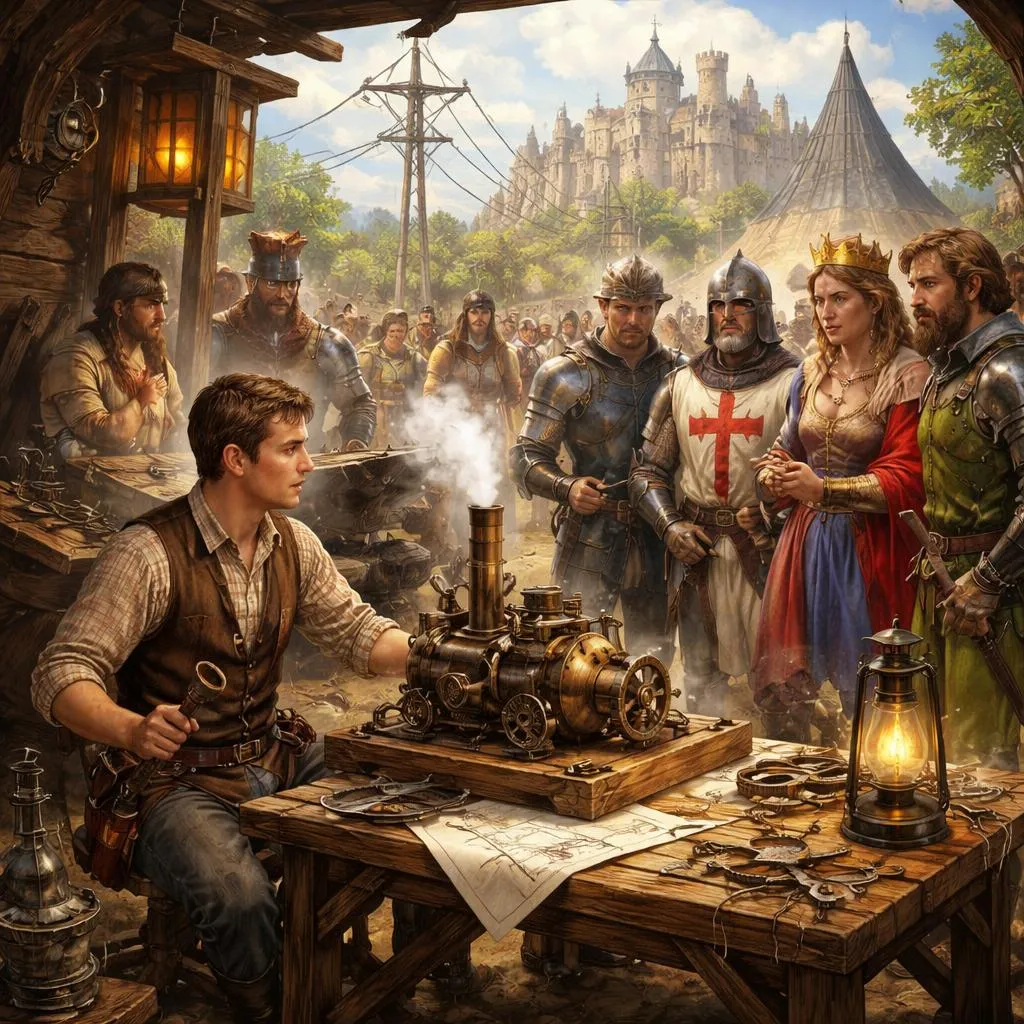

The Round Table soon heard of the challenge, and of course it was a good deal discussed, for such things interested the boys. The king thought I ought now to set forth in quest of adventures, so that I might gain renown and be the more worthy to meet Sir Sagramor when the several years should have rolled away. I excused myself for the present; I said it would take me three or four years yet to get things well fixed up and going smoothly; then I should be ready; all the chances were that at the end of that time Sir Sagramor would still be out grailing, so no valuable time would be lost by the postponement; I should then have been in office six or seven years, and I believed my system and machinery would be so well developed that I could take a holiday without its working any harm.
I was pretty well satisfied with what I had already accomplished. In various quiet nooks and corners I had the beginnings of all sorts of industries under way—nuclei of future vast factories, the iron and steel missionaries of my future civilization. In these were gathered together the brightest young minds I could find, and I kept agents out raking the country for more, all the time. I was training a crowd of ignorant folk into experts—experts in every sort of handiwork and scientific calling. These nurseries of mine went smoothly and privately along undisturbed in their obscure country retreats, for nobody was allowed to come into their precincts without a special permit—for I was afraid of the Church.
I had started a teacher-factory and a lot of Sunday-schools the first thing; as a result, I now had an admirable system of graded schools in full blast in those places, and also a complete variety of Protestant congregations all in a prosperous and growing condition. Everybody could be any kind of a Christian he wanted to; there was perfect freedom in that matter. But I confined public religious teaching to the churches and the Sunday-schools, permitting nothing of it in my other educational buildings. I could have given my own sect the preference and made everybody a Presbyterian without any trouble, but that would have been to affront a law of human nature: spiritual wants and instincts are as various in the human family as are physical appetites, complexions, and features, and a man is only at his best, morally, when he is equipped with the religious garment whose color and shape and size most nicely accommodate themselves to the spiritual complexion, angularities, and stature of the individual who wears it; and, besides, I was afraid of a united Church; it makes a mighty power, the mightiest conceivable, and then when it by and by gets into selfish hands, as it is always bound to do, it means death to human liberty and paralysis to human thought.
All mines were royal property, and there were a good many of them. They had formerly been worked as savages always work mines—holes grubbed in the earth and the mineral brought up in sacks of hide by hand, at the rate of a ton a day; but I had begun to put the mining on a scientific basis as early as I could.
Yes, I had made pretty handsome progress when Sir Sagramor’s challenge struck me.
Four years rolled by—and then! Well, you would never imagine it in the world. Unlimited power is the ideal thing when it is in safe hands. The despotism of heaven is the one absolutely perfect government. An earthly despotism would be the absolutely perfect earthly government, if the conditions were the same, namely, the despot the perfectest individual of the human race, and his lease of life perpetual. But as a perishable perfect man must die, and leave his despotism in the hands of an imperfect successor, an earthly despotism is not merely a bad form of government, it is the worst form that is possible.
My works showed what a despot could do with the resources of a kingdom at his command. Unsuspected by this dark land, I had the civilization of the nineteenth century booming under its very nose! It was fenced away from the public view, but there it was, a gigantic and unassailable fact—and to be heard from, yet, if I lived and had luck. There it was, as sure a fact and as substantial a fact as any serene volcano, standing innocent with its smokeless summit in the blue sky and giving no sign of the rising hell in its bowels. My schools and churches were children four years before; they were grown-up now; my shops of that day were vast factories now; where I had a dozen trained men then, I had a thousand now; where I had one brilliant expert then, I had fifty now. I stood with my hand on the cock, so to speak, ready to turn it on and flood the midnight world with light at any moment. But I was not going to do the thing in that sudden way. It was not my policy. The people could not have stood it; and, moreover, I should have had the Established Roman Catholic Church on my back in a minute.
No, I had been going cautiously all the while. I had had confidential agents trickling through the country some time, whose office was to undermine knighthood by imperceptible degrees, and to gnaw a little at this and that and the other superstition, and so prepare the way gradually for a better order of things. I was turning on my light one-candle-power at a time, and meant to continue to do so.
I had scattered some branch schools secretly about the kingdom, and they were doing very well. I meant to work this racket more and more, as time wore on, if nothing occurred to frighten me. One of my deepest secrets was my West Point—my military academy. I kept that most jealously out of sight; and I did the same with my naval academy which I had established at a remote seaport. Both were prospering to my satisfaction.
Clarence was twenty-two now, and was my head executive, my right hand. He was a darling; he was equal to anything; there wasn’t anything he couldn’t turn his hand to. Of late I had been training him for journalism, for the time seemed about right for a start in the newspaper line; nothing big, but just a small weekly for experimental circulation in my civilization-nurseries. He took to it like a duck; there was an editor concealed in him, sure. Already he had doubled himself in one way; he talked sixth century and wrote nineteenth. His journalistic style was climbing, steadily; it was already up to the back settlement Alabama mark, and couldn’t be told from the editorial output of that region either by matter or flavor.
We had another large departure on hand, too. This was a telegraph and a telephone; our first venture in this line. These wires were for private service only, as yet, and must be kept private until a riper day should come. We had a gang of men on the road, working mainly by night. They were stringing ground wires; we were afraid to put up poles, for they would attract too much inquiry. Ground wires were good enough, in both instances, for my wires were protected by an insulation of my own invention which was perfect. My men had orders to strike across country, avoiding roads, and establishing connection with any considerable towns whose lights betrayed their presence, and leaving experts in charge. Nobody could tell you how to find any place in the kingdom, for nobody ever went intentionally to any place, but only struck it by accident in his wanderings, and then generally left it without thinking to inquire what its name was. At one time and another we had sent out topographical expeditions to survey and map the kingdom, but the priests had always interfered and raised trouble. So we had given the thing up, for the present; it would be poor wisdom to antagonize the Church.
As for the general condition of the country, it was as it had been when I arrived in it, to all intents and purposes. I had made changes, but they were necessarily slight, and they were not noticeable. Thus far, I had not even meddled with taxation, outside of the taxes which provided the royal revenues. I had systematized those, and put the service on an effective and righteous basis. As a result, these revenues were already quadrupled, and yet the burden was so much more equably distributed than before, that all the kingdom felt a sense of relief, and the praises of my administration were hearty and general.
Personally, I struck an interruption, now, but I did not mind it, it could not have happened at a better time. Earlier it could have annoyed me, but now everything was in good hands and swimming right along. The king had reminded me several times, of late, that the postponement I had asked for, four years before, had about run out now. It was a hint that I ought to be starting out to seek adventures and get up a reputation of a size to make me worthy of the honor of breaking a lance with Sir Sagramor, who was still out grailing, but was being hunted for by various relief expeditions, and might be found any year, now. So you see I was expecting this interruption; it did not take me by surprise.
Latar Belakang dan Pengantar Penulis
Kutipan ini berasal dari "Seorang Yankee Connecticut di Pengadilan Raja Arthur," sebuah novel klasik yang ditulis oleh Mark Twain, salah satu penulis terbesar Amerika yang dikenal karena kecerdasan dan komentar sosialnya yang tajam. Diterbitkan pada tahun 1889, novel ini menggabungkan petualangan, fantasi, dan satire. Twain menggunakan cerita ini untuk mengeksplorasi tema kemajuan, teknologi, dan benturan antara nilai-nilai modern dan abad pertengahan.
Novel ini menceritakan kisah seorang insinyur Amerika abad ke-19 yang, melalui kecelakaan misterius, mendapati dirinya terangkut kembali ke zaman Raja Arthur dan Ksatria Meja Bundar. Dengan menggunakan pengetahuannya tentang sains dan teknologi, ia berusaha memodernisasi masyarakat abad pertengahan, sering kali berbenturan dengan Gereja yang mapan dan sistem feodal.
Interpretasi dan Signifikansi Terperinci
Dalam penggalan ini, narator menggambarkan usahanya untuk membawa kemajuan dan pencerahan ke kerajaan yang terbelakang. Ia secara diam-diam telah membangun sekolah, pabrik, dan bahkan akademi militer, melatih kaum muda dan menyebarkan pengetahuan. Tujuannya adalah untuk mempersiapkan masyarakat untuk masa depan yang lebih baik, tetapi ia harus bertindak hati-hati untuk menghindari memprovokasi Gereja yang kuat dan tradisi yang mengakar.
Kisah ini menyoroti ketegangan antara inovasi dan tradisi, kebebasan dan kendali, serta bahaya kekuasaan absolut—bahkan ketika dijalankan oleh seorang tiran yang bermaksud baik. Refleksi narator tentang tirani mengungkapkan skeptisisme Twain tentang otoritas yang terkonsentrasi, menekankan bahwa bahkan penguasa terbaik adalah fana dan penerus mereka tidak sempurna.
Pelajaran dan Wawasan untuk Siswa
-
Nilai Pendidikan dan Pengetahuan: Dedikasi narator untuk menciptakan sekolah dan melatih para ahli menunjukkan bagaimana pendidikan adalah fondasi untuk kemajuan. Siswa dapat belajar bahwa pembelajaran dan rasa ingin tahu yang berkelanjutan sangat penting untuk pertumbuhan pribadi dan peningkatan masyarakat.
-
Keberanian untuk Menantang Tradisi: Kisah ini mendorong pembaca muda untuk mempertanyakan keyakinan dan sistem yang ketinggalan zaman, terutama ketika mereka menghambat kemajuan atau kebebasan. Ini mengajarkan pentingnya berpikir kritis dan membela apa yang benar, bahkan ketika sulit.
-
Kesabaran dan Perencanaan Strategis: Narator tidak terburu-buru melakukan reformasinya tetapi bekerja dengan hati-hati dan diam-diam, memahami bahwa perubahan membutuhkan waktu. Ini adalah pelajaran yang berharga dalam ketekunan dan pentingnya tindakan yang bijaksana.
-
Menghormati Keanekaragaman: Dengan mengizinkan kebebasan beragama dan menghindari memaksakan keyakinannya sendiri, narator menghormati perbedaan individu. Ini mempromosikan toleransi dan pengertian—kualitas kunci untuk hidup berdampingan secara damai.
-
Tanggung Jawab Kekuasaan: Penggalan ini memperingatkan tentang bahaya kekuasaan absolut dan kebutuhan bagi para pemimpin untuk bersikap adil dan bijaksana. Siswa dapat merenungkan pentingnya keadilan, kerendahan hati, dan akuntabilitas dalam peran kepemimpinan.
Menerapkan Pelajaran Ini dalam Kehidupan Sehari-hari
-
Dalam Belajar: Rangkul pendidikan sebagai perjalanan seumur hidup. Sama seperti narator membangun sekolah dan melatih para ahli, siswa harus mencari pengetahuan secara aktif, mengajukan pertanyaan, dan mengembangkan keterampilan baru.
-
Dalam Interaksi Sosial: Hormati keyakinan dan pendapat orang lain, sama seperti narator mengizinkan kebebasan beragama. Ini membantu membangun persahabatan dan komunitas yang harmonis.
-
Dalam Menghadapi Tantangan: Bersabarlah dan rencanakan dengan hati-hati saat mengerjakan tujuan. Perubahan seringkali membutuhkan waktu dan upaya yang stabil, jadi ketekunan adalah kunci.
-
Dalam Kepemimpinan dan Tanggung Jawab: Baik dalam kelompok sekolah atau di rumah, praktikkan keadilan dan dengarkan orang lain. Pahami bahwa kepemimpinan adalah tentang melayani dan membantu, bukan mengendalikan.
Mengembangkan Sifat Positif dari Cerita
-
Inovasi: Dorong kreativitas dan pemecahan masalah dengan memikirkan cara-cara baru untuk meningkatkan lingkungan Anda atau membantu orang lain.
-
Keberanian: Bela nilai-nilai Anda dan bersedia untuk menantang aturan atau gagasan yang tidak adil secara hormat.
-
Toleransi: Hargai keanekaragaman dan belajar dari orang-orang dengan latar belakang dan perspektif yang berbeda.
-
Kebijaksanaan: Buat keputusan yang bijaksana dan pertimbangkan konsekuensi dari tindakan Anda.
Dengan terlibat dalam cerita ini, siswa tidak hanya dapat menikmati petualangan yang menarik tetapi juga mendapatkan wawasan berharga tentang sejarah, etika, dan pengembangan pribadi. Novel Mark Twain tetap menjadi panduan abadi untuk memahami kompleksitas kemajuan dan sifat manusia.
