
“Well, how do you like them?” said Marilla.
Anne was standing in the gable room, looking solemnly at three new dresses spread out on the bed. One was of snuffy colored gingham which Marilla had been tempted to buy from a peddler the preceding summer because it looked so serviceable; one was of black-and-white checkered sateen which she had picked up at a bargain counter in the winter; and one was a stiff print of an ugly blue shade which she had purchased that week at a Carmody store.
She had made them up herself, and they were all made alike—plain skirts fulled tightly to plain waists, with sleeves as plain as waist and skirt and tight as sleeves could be.
“I’ll imagine that I like them,” said Anne soberly.
“I don’t want you to imagine it,” said Marilla, offended. “Oh, I can see you don’t like the dresses! What is the matter with them? Aren’t they neat and clean and new?”
“Yes.”
“Then why don’t you like them?”
“They’re—they’re not—pretty,” said Anne reluctantly.
“Pretty!” Marilla sniffed. “I didn’t trouble my head about getting pretty dresses for you. I don’t believe in pampering vanity, Anne, I’ll tell you that right off. Those dresses are good, sensible, serviceable dresses, without any frills or furbelows about them, and they’re all you’ll get this summer. The brown gingham and the blue print will do you for school when you begin to go. The sateen is for church and Sunday school. I’ll expect you to keep them neat and clean and not to tear them. I should think you’d be grateful to get most anything after those skimpy wincey things you’ve been wearing.”
“Oh, I AM grateful,” protested Anne. “But I’d be ever so much gratefuller if—if you’d made just one of them with puffed sleeves. Puffed sleeves are so fashionable now. It would give me such a thrill, Marilla, just to wear a dress with puffed sleeves.”
“Well, you’ll have to do without your thrill. I hadn’t any material to waste on puffed sleeves. I think they are ridiculous-looking things anyhow. I prefer the plain, sensible ones.”
“But I’d rather look ridiculous when everybody else does than plain and sensible all by myself,” persisted Anne mournfully.
“Trust you for that! Well, hang those dresses carefully up in your closet, and then sit down and learn the Sunday school lesson. I got a quarterly from Mr. Bell for you and you’ll go to Sunday school tomorrow,” said Marilla, disappearing downstairs in high dudgeon.
Anne clasped her hands and looked at the dresses.
“I did hope there would be a white one with puffed sleeves,” she whispered disconsolately. “I prayed for one, but I didn’t much expect it on that account. I didn’t suppose God would have time to bother about a little orphan girl’s dress. I knew I’d just have to depend on Marilla for it. Well, fortunately I can imagine that one of them is of snow-white muslin with lovely lace frills and three-puffed sleeves.”
The next morning warnings of a sick headache prevented Marilla from going to Sunday-school with Anne.
“You’ll have to go down and call for Mrs. Lynde, Anne.” she said. “She’ll see that you get into the right class. Now, mind you behave yourself properly. Stay to preaching afterwards and ask Mrs. Lynde to show you our pew. Here’s a cent for collection. Don’t stare at people and don’t fidget. I shall expect you to tell me the text when you come home.”
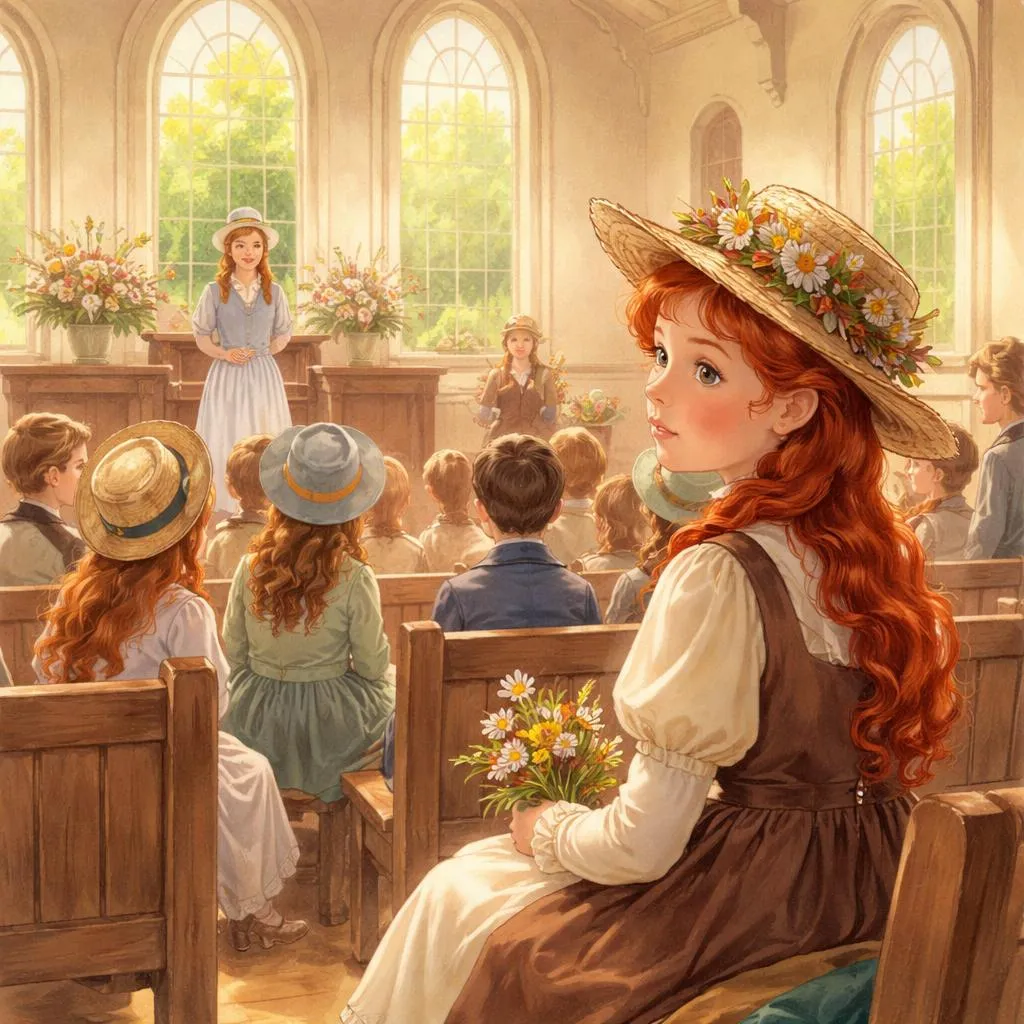
Anne started off irreproachable, arrayed in the stiff black-and-white sateen, which, while decent as regards length and certainly not open to the charge of skimpiness, contrived to emphasize every corner and angle of her thin figure. Her hat was a little, flat, glossy, new sailor, the extreme plainness of which had likewise much disappointed Anne, who had permitted herself secret visions of ribbon and flowers. The latter, however, were supplied before Anne reached the main road, for being confronted halfway down the lane with a golden frenzy of wind-stirred buttercups and a glory of wild roses, Anne promptly and liberally garlanded her hat with a heavy wreath of them. Whatever other people might have thought of the result it satisfied Anne, and she tripped gaily down the road, holding her ruddy head with its decoration of pink and yellow very proudly.
When she had reached Mrs. Lynde’s house she found that lady gone. Nothing daunted, Anne proceeded onward to the church alone. In the porch she found a crowd of little girls, all more or less gaily attired in whites and blues and pinks, and all staring with curious eyes at this stranger in their midst, with her extraordinary head adornment. Avonlea little girls had already heard queer stories about Anne. Mrs. Lynde said she had an awful temper; Jerry Buote, the hired boy at Green Gables, said she talked all the time to herself or to the trees and flowers like a crazy girl. They looked at her and whispered to each other behind their quarterlies. Nobody made any friendly advances, then or later on when the opening exercises were over and Anne found herself in Miss Rogerson’s class.
Miss Rogerson was a middle-aged lady who had taught a Sunday-school class for twenty years. Her method of teaching was to ask the printed questions from the quarterly and look sternly over its edge at the particular little girl she thought ought to answer the question. She looked very often at Anne, and Anne, thanks to Marilla’s drilling, answered promptly; but it may be questioned if she understood very much about either question or answer.
She did not think she liked Miss Rogerson, and she felt very miserable; every other little girl in the class had puffed sleeves. Anne felt that life was really not worth living without puffed sleeves.
“Well, how did you like Sunday school?” Marilla wanted to know when Anne came home. Her wreath having faded, Anne had discarded it in the lane, so Marilla was spared the knowledge of that for a time.
“I didn’t like it a bit. It was horrid.”
“Anne Shirley!” said Marilla rebukingly.
Anne sat down on the rocker with a long sigh, kissed one of Bonny’s leaves, and waved her hand to a blossoming fuchsia.
“They might have been lonesome while I was away,” she explained. “And now about the Sunday school. I behaved well, just as you told me. Mrs. Lynde was gone, but I went right on myself. I went into the church, with a lot of other little girls, and I sat in the corner of a pew by the window while the opening exercises went on. Mr. Bell made an awfully long prayer. I would have been dreadfully tired before he got through if I hadn’t been sitting by that window. But it looked right out on the Lake of Shining Waters, so I just gazed at that and imagined all sorts of splendid things.”
“You shouldn’t have done anything of the sort. You should have listened to Mr. Bell.”
“But he wasn’t talking to me,” protested Anne. “He was talking to God and he didn’t seem to be very much inter-ested in it, either. I think he thought God was too far off though. There was a long row of white birches hanging over the lake and the sunshine fell down through them, ‘way, ‘way down, deep into the water. Oh, Marilla, it was like a beautiful dream! It gave me a thrill and I just said, ‘Thank you for it, God,’ two or three times.”
“Not out loud, I hope,” said Marilla anxiously.
“Oh, no, just under my breath. Well, Mr. Bell did get through at last and they told me to go into the classroom with Miss Rogerson’s class. There were nine other girls in it. They all had puffed sleeves. I tried to imagine mine were puffed, too, but I couldn’t. Why couldn’t I? It was as easy as could be to imagine they were puffed when I was alone in the east gable, but it was awfully hard there among the others who had really truly puffs.”
“You shouldn’t have been thinking about your sleeves in Sunday school. You should have been attending to the lesson. I hope you knew it.”
“Oh, yes; and I answered a lot of questions. Miss Rogerson asked ever so many. I don’t think it was fair for her to do all the asking. There were lots I wanted to ask her, but I didn’t like to because I didn’t think she was a kindred spirit. Then all the other little girls recited a paraphrase. She asked me if I knew any. I told her I didn’t, but I could recite, ‘The Dog at His Master’s Grave’ if she liked. That’s in the Third Royal Reader. It isn’t a really truly religious piece of poetry, but it’s so sad and melancholy that it might as well be. She said it wouldn’t do and she told me to learn the nineteenth paraphrase for next Sunday. I read it over in church afterwards and it’s splendid. There are two lines in particular that just thrill me.
"'Quick as the slaughtered squadrons fell In Midian's evil day.'"
“I don’t know what ‘squadrons’ means nor ‘Midian,’ either, but it sounds SO tragical. I can hardly wait until next Sunday to recite it. I’ll practice it all the week. After Sunday school I asked Miss Rogerson—because Mrs. Lynde was too far away—to show me your pew. I sat just as still as I could and the text was Revelations, third chapter, second and third verses. It was a very long text. If I was a minister I’d pick the short, snappy ones. The sermon was awfully long, too. I suppose the minister had to match it to the text. I didn’t think he was a bit interesting. The trouble with him seems to be that he hasn’t enough imagination. I didn’t listen to him very much. I just let my thoughts run and I thought of the most surprising things.”
Marilla felt helplessly that all this should be sternly reproved, but she was hampered by the undeniable fact that some of the things Anne had said, especially about the minister’s sermons and Mr. Bell’s prayers, were what she herself had really thought deep down in her heart for years, but had never given expression to. It almost seemed to her that those secret, unuttered, critical thoughts had suddenly taken visible and accusing shape and form in the person of this outspoken morsel of neglected humanity.
Latar Belakang dan Pengantar Penulis
Kutipan ini dari Anne of Green Gables, sebuah novel klasik yang ditulis oleh penulis Kanada Lucy Maud Montgomery pada tahun 1908. Kisah ini mengikuti Anne Shirley, seorang gadis yatim piatu yang imajinatif dan bersemangat yang secara keliru dikirim untuk tinggal bersama Marilla dan Matthew Cuthbert, seorang saudara laki-laki dan perempuan yang bermaksud mengadopsi seorang anak laki-laki untuk membantu mereka di pertanian mereka di Avonlea, Pulau Prince Edward. Novel ini dirayakan karena deskripsinya yang jelas tentang kehidupan pedesaan, dunia batin Anne yang kaya, dan tema-tema tentang rasa memiliki, identitas, dan pertumbuhan pribadi.
Lucy Maud Montgomery sendiri lahir pada tahun 1874 di Pulau Prince Edward. Pengalamannya tumbuh di lingkungan pedesaan sangat memengaruhi tulisannya. Dia menulis dengan kehangatan dan humor tentang suka dan duka masa kecil dan keindahan alam, merebut hati para pembaca di seluruh dunia.
Interpretasi dan Signifikansi yang Detail
Pesanan ini menyoroti kerinduan Anne akan keindahan dan individualitas di tengah kesederhanaan dan kepraktisan yang dipaksakan oleh Marilla, yang mewakili pandangan dunia yang lebih konservatif dan pragmatis. Keinginan Anne akan lengan baju yang mengembang—detail yang modis dan agak sepele—melambangkan kerinduannya akan ekspresi diri dan sentuhan keajaiban dalam hidupnya. Penolakan Marilla mencerminkan realitas ekonomi dan harapan sosial pada saat itu, menekankan tugas, kesopanan, dan kegunaan daripada kesombongan.
Semangat imajinatif Anne bersinar saat dia secara mental mengubah gaun polosnya menjadi pakaian yang indah, menunjukkan ketahanan dan kreativitasnya. Pengalamannya di sekolah Minggu lebih lanjut menggarisbawahi status orang luar—dia berbeda, disalahpahami, dan rindu untuk menyesuaikan diri, namun dia tetap setia pada dirinya sendiri. Refleksinya selama khotbah mengungkapkan pikiran yang bijaksana dan sensitif yang menemukan keajaiban bahkan ketika agama formal tampak membosankan atau jauh.
Adegan ini juga mengeksplorasi tema kesepian, penerimaan, dan ketegangan antara konformitas dan individualitas. Imajinasi Anne yang jelas dan kedalaman emosionalnya kontras dengan norma-norma sosial yang kaku di sekitarnya, menjadikannya simbol abadi harapan masa muda dan kekuatan imajinasi.
Pelajaran dan Wawasan untuk Siswa
-
Rangkul Individualitas Anda: Kisah Anne mendorong pembaca muda untuk menghargai kualitas dan impian unik mereka, bahkan ketika mereka tidak sesuai dengan harapan orang lain. Penting untuk tetap setia pada diri sendiri dan menemukan kegembiraan dalam imajinasi dan kreativitas.
-
Ketahanan dalam Kesulitan: Terlepas dari kekecewaan dan tantangannya, Anne tetap berharap dan banyak akal. Ini mengajarkan siswa nilai ketekunan dan berpikir positif saat menghadapi kesulitan.
-
Apresiasi Kesederhanaan dan Kepraktisan: Perspektif Marilla mengingatkan kita bahwa hidup seringkali membutuhkan kepraktisan dan tanggung jawab. Menyeimbangkan impian dengan tuntutan dunia nyata adalah keterampilan hidup yang penting.
-
Empati dan Pemahaman: Kisah ini mengundang pembaca untuk melihat melampaui penampilan dan penilaian. Teman sekelas Anne berbisik tentang dia, tetapi dunia batinnya kaya dan kompleks. Ini mendorong kebaikan dan keterbukaan pikiran terhadap orang lain yang tampak berbeda.
-
Menemukan Keindahan dalam Kehidupan Sehari-hari: Kemampuan Anne untuk menemukan keajaiban di dunia alam dan bahkan dalam khotbah yang panjang menunjukkan pentingnya kesadaran dan menghargai momen-momen kecil keindahan.
Aplikasi dalam Kehidupan Sehari-hari
-
Di Sekolah: Siswa dapat belajar dari rasa ingin tahu dan keinginan Anne untuk menjawab pertanyaan, bahkan ketika dia tidak sepenuhnya mengerti. Ini menunjukkan pentingnya partisipasi dan kemauan untuk belajar, yang dapat meningkatkan kepercayaan diri dan pengetahuan.
-
Dalam Situasi Sosial: Pengalaman Anne merasa seperti orang luar mengingatkan siswa untuk inklusif dan menyambut teman sekelas baru atau berbeda. Mempraktikkan empati dan persahabatan dapat menciptakan lingkungan yang mendukung.
-
Dalam Pertumbuhan Pribadi: Seperti Anne, siswa dapat mengembangkan imajinasi dan kreativitas mereka melalui membaca, menulis, atau seni. Ini memupuk kecerdasan emosional dan keterampilan memecahkan masalah.
-
Dalam Kehidupan Keluarga: Dinamika antara Anne dan Marilla menyoroti pentingnya komunikasi dan kompromi dalam hubungan. Memahami perspektif yang berbeda dapat membantu menyelesaikan konflik.
Mengembangkan Sifat Positif dari Cerita
-
Imajinasi dan Kreativitas: Dorong siswa untuk menggunakan imajinasi mereka tidak hanya untuk bersenang-senang tetapi juga sebagai alat untuk memecahkan masalah dan ekspresi emosional.
-
Rasa Syukur dan Kepuasan: Rasa syukur Anne atas gaunnya, meskipun polos, mengajarkan penghargaan atas apa yang dimiliki seseorang.
-
Keberanian dan Kepercayaan Diri: Keinginan Anne untuk menjadi dirinya sendiri, bahkan ketika orang lain menghakiminya, menginspirasi siswa untuk mengembangkan kepercayaan diri dan membela nilai-nilai mereka.
-
Hormat kepada Orang Lain: Perhatian Marilla terhadap Anne, meskipun ketat, menunjukkan bentuk cinta dan tanggung jawab. Siswa dapat belajar untuk menghormati otoritas dan menghargai mereka yang peduli pada mereka.
Kesimpulan
Anne of Green Gables lebih dari sekadar cerita anak-anak; itu adalah eksplorasi yang kaya akan emosi manusia, nilai-nilai sosial, dan kekuatan transformatif imajinasi. Melalui petualangan dan tantangan Anne, siswa dapat mempelajari pelajaran berharga tentang identitas, ketahanan, kebaikan, dan keindahan momen-momen sederhana dalam hidup. Dengan merenungkan pengalaman Anne, pembaca muda didorong untuk merangkul keunikan mereka, menghadapi kesulitan hidup dengan harapan, dan mengembangkan empati dan kreativitas dalam kehidupan mereka sendiri.
