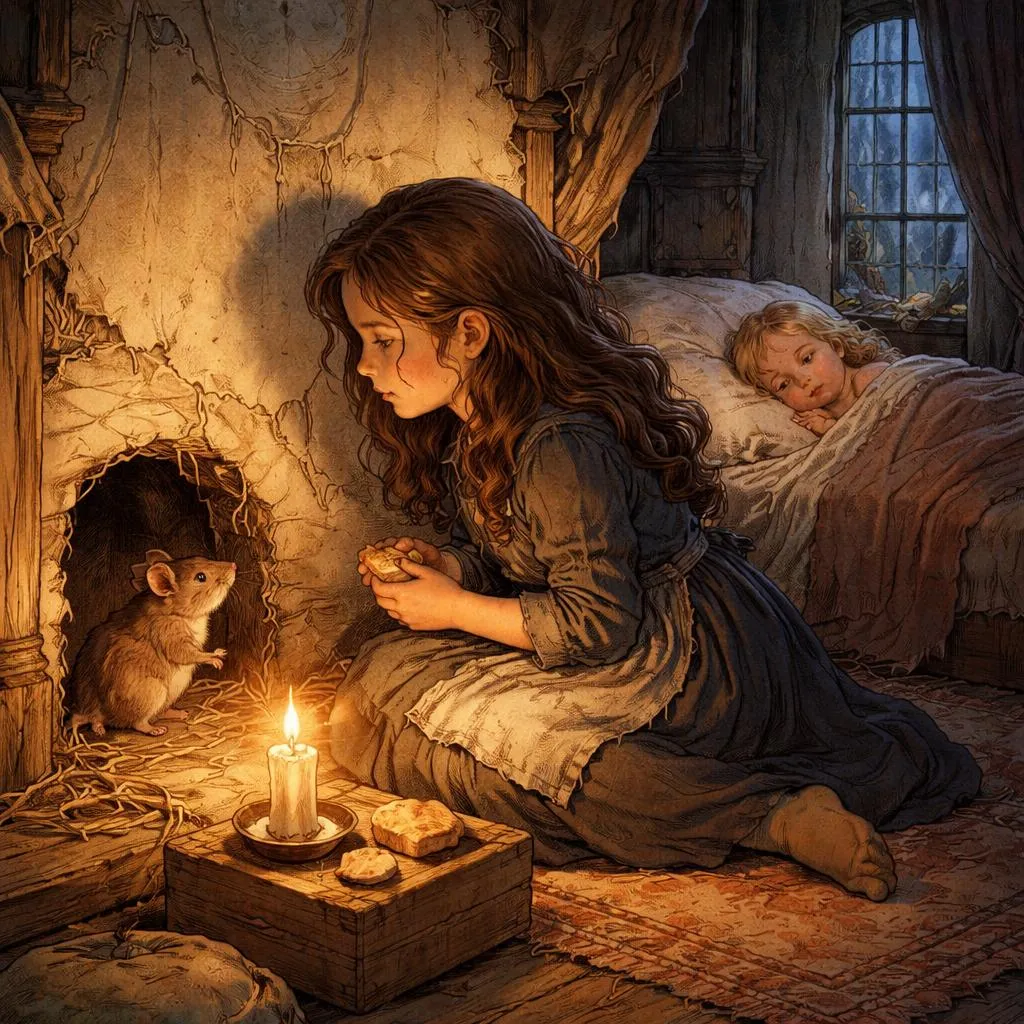

On this very afternoon, while Sara was out, a strange thing happened in the attic. Only Melchisedec saw and heard it; and he was so much alarmed and mystified that he scuttled back to his hole and hid there, and really quaked and trembled as he peeped out furtively and with great caution to watch what was going on.
The attic had been very still all the day after Sara had left it in the early morning. The stillness had only been broken by the pattering of the rain upon the slates and the skylight. Melchisedec had, in fact, found it rather dull; and when the rain ceased to patter and perfect silence reigned, he decided to come out and reconnoiter, though experience taught him that Sara would not return for some time. He had been rambling and sniffing about, and had just found a totally unexpected and unexplained crumb left from his last meal, when his attention was attracted by a sound on the roof. He stopped to listen with a palpitating heart. The sound suggested that something was moving on the roof. It was approaching the skylight; it reached the skylight. The skylight was being mysteriously opened. A dark face peered into the attic; then another face appeared behind it, and both looked in with signs of caution and interest. Two men were outside on the roof, and were making silent preparations to enter through the skylight itself. One was Ram Dass and the other was a young man who was the Indian gentleman’s secretary; but of course Melchisedec did not know this. He only knew that the men were invading the silence and privacy of the attic; and as the one with the dark face let himself down through the aperture with such lightness and dexterity that he did not make the slightest sound, Melchisedec turned tail and fled precipitately back to his hole. He was frightened to death. He had ceased to be timid with Sara, and knew she would never throw anything but crumbs, and would never make any sound other than the soft, low, coaxing whistling; but strange men were dangerous things to remain near. He lay close and flat near the entrance of his home, just managing to peep through the crack with a bright, alarmed eye. How much he understood of the talk he heard I am not in the least able to say; but, even if he had understood it all, he would probably have remained greatly mystified.
The secretary, who was light and young, slipped through the skylight as noiselessly as Ram Dass had done; and he caught a last glimpse of Melchisedec’s vanishing tail.
“Was that a rat?” he asked Ram Dass in a whisper.
“Yes; a rat, Sahib,” answered Ram Dass, also whispering. “There are many in the walls.”
“Ugh!” exclaimed the young man. “It is a wonder the child is not terrified of them.”
Ram Dass made a gesture with his hands. He also smiled respectfully. He was in this place as the intimate exponent of Sara, though she had only spoken to him once.
“The child is the little friend of all things, Sahib,” he answered. “She is not as other children. I see her when she does not see me. I slip across the slates and look at her many nights to see that she is safe. I watch her from my window when she does not know I am near. She stands on the table there and looks out at the sky as if it spoke to her. The sparrows come at her call. The rat she has fed and tamed in her loneliness. The poor slave of the house comes to her for comfort. There is a little child who comes to her in secret; there is one older who worships her and would listen to her forever if she might. This I have seen when I have crept across the roof. By the mistress of the house—who is an evil woman—she is treated like a pariah; but she has the bearing of a child who is of the blood of kings!”
“You seem to know a great deal about her,” the secretary said.
“All her life each day I know,” answered Ram Dass. “Her going out I know, and her coming in; her sadness and her poor joys; her coldness and her hunger. I know when she is alone until midnight, learning from her books; I know when her secret friends steal to her and she is happier—as children can be, even in the midst of poverty—because they come and she may laugh and talk with them in whispers. If she were ill I should know, and I would come and serve her if it might be done.”
“You are sure no one comes near this place but herself, and that she will not return and surprise us. She would be frightened if she found us here, and the Sahib Carrisford’s plan would be spoiled.”
Ram Dass crossed noiselessly to the door and stood close to it.
“None mount here but herself, Sahib,” he said. “She has gone out with her basket and may be gone for hours. If I stand here I can hear any step before it reaches the last flight of the stairs.”
The secretary took a pencil and a tablet from his breast pocket.
“Keep your ears open,” he said; and he began to walk slowly and softly round the miserable little room, making rapid notes on his tablet as he looked at things.
First he went to the narrow bed. He pressed his hand upon the mattress and uttered an exclamation.
“As hard as a stone,” he said. “That will have to be altered some day when she is out. A special journey can be made to bring it across. It cannot be done tonight.” He lifted the covering and examined the one thin pillow.
“Coverlet dingy and worn, blanket thin, sheets patched and ragged,” he said. “What a bed for a child to sleep in—and in a house which calls itself respectable! There has not been a fire in that grate for many a day,” glancing at the rusty fireplace.
“Never since I have seen it,” said Ram Dass. “The mistress of the house is not one who remembers that another than herself may be cold.”
The secretary was writing quickly on his tablet. He looked up from it as he tore off a leaf and slipped it into his breast pocket.
“It is a strange way of doing the thing,” he said. “Who planned it?”
Ram Dass made a modestly apologetic obeisance.
“It is true that the first thought was mine, Sahib,” he said; “though it was naught but a fancy. I am fond of this child; we are both lonely. It is her way to relate her visions to her secret friends. Being sad one night, I lay close to the open skylight and listened. The vision she related told what this miserable room might be if it had comforts in it. She seemed to see it as she talked, and she grew cheered and warmed as she spoke. Then she came to this fancy; and the next day, the Sahib being ill and wretched, I told him of the thing to amuse him. It seemed then but a dream, but it pleased the Sahib. To hear of the child’s doings gave him entertainment. He became interested in her and asked questions. At last he began to please himself with the thought of making her visions real things.”
“You think that it can be done while she sleeps? Suppose she awakened,” suggested the secretary; and it was evident that whatsoever the plan referred to was, it had caught and pleased his fancy as well as the Sahib Carrisford’s.
“I can move as if my feet were of velvet,” Ram Dass replied; “and children sleep soundly—even the unhappy ones. I could have entered this room in the night many times, and without causing her to turn upon her pillow. If the other bearer passes to me the things through the window, I can do all and she will not stir. When she awakens she will think a magician has been here.”
He smiled as if his heart warmed under his white robe, and the secretary smiled back at him.
“It will be like a story from the Arabian Nights,” he said. “Only an Oriental could have planned it. It does not belong to London fogs.”
They did not remain very long, to the great relief of Melchisedec, who, as he probably did not comprehend their conversation, felt their movements and whispers ominous. The young secretary seemed interested in everything. He wrote down things about the floor, the fireplace, the broken footstool, the old table, the walls—which last he touched with his hand again and again, seeming much pleased when he found that a number of old nails had been driven in various places.
“You can hang things on them,” he said.
Ram Dass smiled mysteriously.
“Yesterday, when she was out,” he said, “I entered, bringing with me small, sharp nails which can be pressed into the wall without blows from a hammer. I placed many in the plaster where I may need them. They are ready.”
The Indian gentleman’s secretary stood still and looked round him as he thrust his tablets back into his pocket.
“I think I have made notes enough; we can go now,” he said. “The Sahib Carrisford has a warm heart. It is a thousand pities that he has not found the lost child.”
“If he should find her his strength would be restored to him,” said Ram Dass. “His God may lead her to him yet.”
Then they slipped through the skylight as noiselessly as they had entered it. And, after he was quite sure they had gone, Melchisedec was greatly relieved, and in the course of a few minutes felt it safe to emerge from his hole again and scuffle about in the hope that even such alarming human beings as these might have chanced to carry crumbs in their pockets and drop one or two.
Pengantar Latar Belakang dan Penulis
Kutipan ini berasal dari "Seorang Putri Kecil," sebuah novel anak-anak klasik yang ditulis oleh Frances Hodgson Burnett, pertama kali diterbitkan pada tahun 1905. Burnett adalah seorang penulis Inggris-Amerika yang dikenal karena cerita-ceritanya yang abadi yang sering kali mengeksplorasi tema kebaikan, ketahanan, dan imajinasi. "Seorang Putri Kecil" menceritakan kisah Sara Crewe, seorang gadis kaya dan imajinatif yang, setelah kehilangan kekayaannya, terpaksa hidup sebagai pelayan di sebuah sekolah asrama tetapi tetap mempertahankan martabat dan kebaikannya selama kesulitan yang dialaminya.
Interpretasi Detail Cerita
Dalam kutipan ini, narasi dilihat melalui mata Melchisedec, seekor tikus kecil yang tinggal di loteng tempat Sara tinggal. Adegan tersebut mengungkapkan kunjungan rahasia oleh dua pria, Ram Dass dan sekretaris mudanya, yang diam-diam memeriksa kamar loteng Sara saat dia pergi. Ram Dass adalah pelayan dan pelindung setia Sara, diam-diam mengawasinya dari bayang-bayang. Para pria berencana untuk memperbaiki kondisi kehidupan Sara yang suram, terinspirasi oleh impian dan visinya tentang kehidupan yang lebih baik. Perawatan dan rasa hormat rahasia yang mereka tunjukkan kepada Sara sangat kontras dengan kekejaman yang dia hadapi dari nyonya rumah.
Kutipan ini menyoroti tema kebaikan, perlindungan, dan harapan. Terlepas dari keadaan Sara yang sulit, dia tidak sendirian; teman-teman yang tak terlihat mengawasinya, dan ada rencana untuk memberikan kenyamanan dan kegembiraan kepadanya. Tikus Melchisedec melambangkan pengamat diam yang memperhatikan dan peduli terhadap mereka yang rentan, bahkan ketika orang lain mengabaikannya.
Pelajaran dan Wawasan untuk Siswa
-
Ketahanan dan Kebaikan: Karakter Sara mengajari kita untuk tetap baik dan penuh harapan bahkan dalam kesulitan. Dia berteman dengan hewan dan manusia, menunjukkan kasih sayang yang melampaui kesulitannya sendiri.
-
Kekuatan Imajinasi: Visi Sara tentang kamar dan kehidupan yang lebih baik menginspirasi orang lain untuk bertindak. Ini mengingatkan siswa bahwa imajinasi dan impian dapat memotivasi perubahan nyata.
-
Empati dan Perlindungan: Peran Ram Dass menggambarkan pentingnya menjaga orang lain, terutama mereka yang rentan. Siswa dapat belajar untuk menjadi teman yang penuh perhatian dan suportif.
-
Keberanian dalam Menghadapi Ketakutan: Bahkan Melchisedec, meskipun ketakutan, terus mengamati dan berharap. Ini mendorong pembaca muda untuk menghadapi ketakutan mereka dengan keberanian dan rasa ingin tahu.
Menerapkan Pelajaran Ini dalam Kehidupan Sehari-hari
- Dalam Belajar: Seperti Sara, siswa dapat mengembangkan rasa ingin tahu dan kecintaan pada buku, menggunakan imajinasi untuk menjelajahi ide dan kemungkinan baru.
- Dalam Hubungan: Menunjukkan kebaikan dan empati kepada teman sekelas dan teman, terutama mereka yang mungkin kesepian atau berjuang, dapat membuat perbedaan besar.
- Dalam Tantangan: Ketika menghadapi kesulitan, siswa dapat mengingat contoh Sara untuk tetap berharap dan tangguh, memahami bahwa masa-masa sulit dapat diatasi.
- Dalam Kreativitas: Mendorong pemikiran kreatif dan bermimpi dapat mengarah pada solusi inovatif dan pertumbuhan pribadi.
Mengembangkan Sifat Positif dari Cerita
- Kasih Sayang: Latih tindakan kebaikan kecil setiap hari, seperti membantu teman sebaya atau merawat hewan.
- Pengamatan: Seperti Melchisedec, belajarlah untuk mengamati sekeliling Anda dengan cermat dan memahami perasaan orang lain.
- Harapan: Pertahankan pandangan positif bahkan ketika situasi tampak suram, percaya bahwa perubahan itu mungkin.
- Tanggung Jawab: Jadilah pelindung dan pendukung di komunitas Anda, membela mereka yang membutuhkan bantuan.
Kesimpulan
"Seorang Putri Kecil" lebih dari sekadar cerita tentang kesulitan; itu adalah perayaan kekuatan batin, kebaikan, dan keajaiban harapan. Siswa yang membaca cerita ini dapat memperoleh pelajaran berharga tentang empati, keberanian, dan pentingnya memelihara impian. Dengan menerapkan pelajaran ini, mereka dapat tumbuh menjadi individu yang bijaksana, tangguh yang berkontribusi secara positif pada komunitas dan hubungan mereka.
