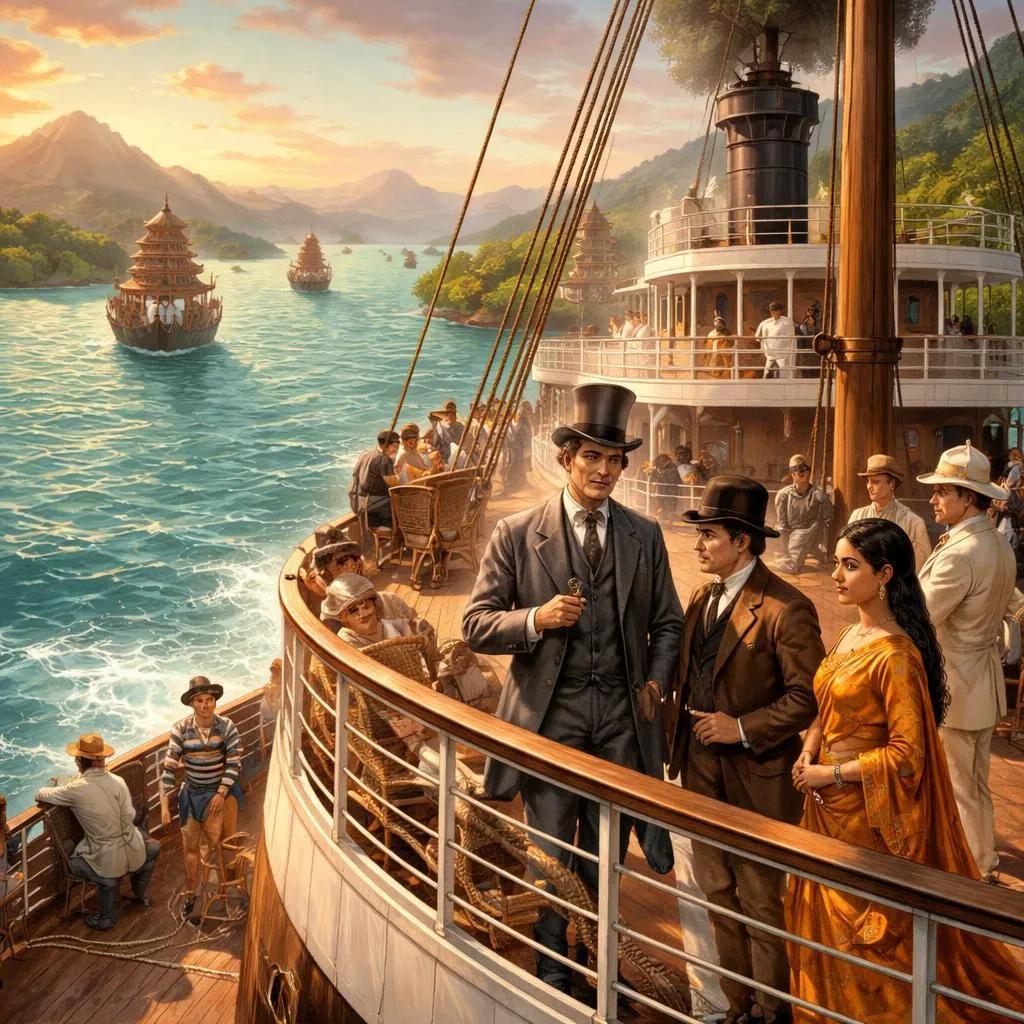

The detective and Passepartout met often on deck after this interview, though Fix was reserved, and did not attempt to induce his companion to divulge any more facts concerning Mr. Fogg. He caught a glimpse of that mysterious gentleman once or twice; but Mr. Fogg usually confined himself to the cabin, where he kept Aouda company, or, according to his inveterate habit, took a hand at whist.
Passepartout began very seriously to conjecture what strange chance kept Fix still on the route that his master was pursuing. It was really worth considering why this certainly very amiable and complacent person, whom he had first met at Suez, had then encountered on board the Mongolia, who disembarked at Bombay, which he announced as his destination, and now turned up so unexpectedly on the Rangoon, was following Mr. Fogg's tracks step by step. What was Fix's object? Passepartout was ready to wager his Indian shoes—which he religiously preserved—that Fix would also leave Hong Kong at the same time with them, and probably on the same steamer.
Passepartout might have cudgelled his brain for a century without hitting upon the real object which the detective had in view. He never could have imagined that Phileas Fogg was being tracked as a robber around the globe. But, as it is in human nature to attempt the solution of every mystery, Passepartout suddenly discovered an explanation of Fix's movements, which was in truth far from unreasonable. Fix, he thought, could only be an agent of Mr. Fogg's friends at the Reform Club, sent to follow him up, and to ascertain that he really went round the world as had been agreed upon.
"It's clear!" repeated the worthy servant to himself, proud of his shrewdness. "He's a spy sent to keep us in view! That isn't quite the thing, either, to be spying Mr. Fogg, who is so honourable a man! Ah, gentlemen of the Reform, this shall cost you dear!"
Passepartout, enchanted with his discovery, resolved to say nothing to his master, lest he should be justly offended at this mistrust on the part of his adversaries. But he determined to chaff Fix, when he had the chance, with mysterious allusions, which, however, need not betray his real suspicions.
During the afternoon of Wednesday, 30th October, the Rangoon entered the Strait of Malacca, which separates the peninsula of that name from Sumatra. The mountainous and craggy islets intercepted the beauties of this noble island from the view of the travellers. The Rangoon weighed anchor at Singapore the next day at four a.m., to receive coal, having gained half a day on the prescribed time of her arrival. Phileas Fogg noted this gain in his journal, and then, accompanied by Aouda, who betrayed a desire for a walk on shore, disembarked.
Fix, who suspected Mr. Fogg's every movement, followed them cautiously, without being himself perceived; while Passepartout, laughing in his sleeve at Fix's manoeuvres, went about his usual errands.
The island of Singapore is not imposing in aspect, for there are no mountains; yet its appearance is not without attractions. It is a park checkered by pleasant highways and avenues. A handsome carriage, drawn by a sleek pair of New Holland horses, carried Phileas Fogg and Aouda into the midst of rows of palms with brilliant foliage, and of clove–trees, whereof the cloves form the heart of a half–open flower. Pepper plants replaced the prickly hedges of European fields; sago–bushes, large ferns with gorgeous branches, varied the aspect of this tropical clime; while nutmeg–trees in full foliage filled the air with a penetrating perfume. Agile and grinning bands of monkeys skipped about in the trees, nor were tigers wanting in the jungles.
After a drive of two hours through the country, Aouda and Mr. Fogg returned to the town, which is a vast collection of heavy–looking, irregular houses, surrounded by charming gardens rich in tropical fruits and plants; and at ten o'clock they re–embarked, closely followed by the detective, who had kept them constantly in sight.
Passepartout, who had been purchasing several dozen mangoes—a fruit as large as good–sized apples, of a dark–brown colour outside and a bright red within, and whose white pulp, melting in the mouth, affords gourmands a delicious sensation—was waiting for them on deck. He was only too glad to offer some mangoes to Aouda, who thanked him very gracefully for them.
At eleven o'clock the Rangoon rode out of Singapore harbour, and in a few hours the high mountains of Malacca, with their forests, inhabited by the most beautifully–furred tigers in the world, were lost to view. Singapore is distant some thirteen hundred miles from the island of Hong Kong, which is a little English colony near the Chinese coast. Phileas Fogg hoped to accomplish the journey in six days, so as to be in time for the steamer which would leave on the 6th of November for Yokohama, the principal Japanese port.
The Rangoon had a large quota of passengers, many of whom disembarked at Singapore, among them a number of Indians, Ceylonese, Chinamen, Malays, and Portuguese, mostly second–class travellers.
The weather, which had hitherto been fine, changed with the last quarter of the moon. The sea rolled heavily, and the wind at intervals rose almost to a storm, but happily blew from the south–west, and thus aided the steamer's progress. The captain as often as possible put up his sails, and under the double action of steam and sail the vessel made rapid progress along the coasts of Anam and Cochin China. Owing to the defective construction of the Rangoon, however, unusual precautions became necessary in unfavourable weather; but the loss of time which resulted from this cause, while it nearly drove Passepartout out of his senses, did not seem to affect his master in the least. Passepartout blamed the captain, the engineer, and the crew, and consigned all who were connected with the ship to the land where the pepper grows. Perhaps the thought of the gas, which was remorselessly burning at his expense in Saville Row, had something to do with his hot impatience.
"You are in a great hurry, then," said Fix to him one day, "to reach Hong Kong?"
"A very great hurry!"
"Mr. Fogg, I suppose, is anxious to catch the steamer for Yokohama?"
"Terribly anxious."
"You believe in this journey around the world, then?"
"Absolutely. Don't you, Mr. Fix?"
"I? I don't believe a word of it."
"You're a sly dog!" said Passepartout, winking at him.
This expression rather disturbed Fix, without his knowing why. Had the Frenchman guessed his real purpose? He knew not what to think. But how could Passepartout have discovered that he was a detective? Yet, in speaking as he did, the man evidently meant more than he expressed.
Passepartout went still further the next day; he could not hold his tongue.
"Mr. Fix," said he, in a bantering tone, "shall we be so unfortunate as to lose you when we get to Hong Kong?"
"Why," responded Fix, a little embarrassed, "I don't know; perhaps—"
"Ah, if you would only go on with us! An agent of the Peninsular Company, you know, can't stop on the way! You were only going to Bombay, and here you are in China. America is not far off, and from America to Europe is only a step."
Fix looked intently at his companion, whose countenance was as serene as possible, and laughed with him. But Passepartout persisted in chaffing him by asking him if he made much by his present occupation.
"Yes, and no," returned Fix; "there is good and bad luck in such things. But you must understand that I don't travel at my own expense."
"Oh, I am quite sure of that!" cried Passepartout, laughing heartily.
Fix, fairly puzzled, descended to his cabin and gave himself up to his reflections. He was evidently suspected; somehow or other the Frenchman had found out that he was a detective. But had he told his master? What part was he playing in all this: was he an accomplice or not? Was the game, then, up? Fix spent several hours turning these things over in his mind, sometimes thinking that all was lost, then persuading himself that Fogg was ignorant of his presence, and then undecided what course it was best to take.
Nevertheless, he preserved his coolness of mind, and at last resolved to deal plainly with Passepartout. If he did not find it practicable to arrest Fogg at Hong Kong, and if Fogg made preparations to leave that last foothold of English territory, he, Fix, would tell Passepartout all. Either the servant was the accomplice of his master, and in this case the master knew of his operations, and he should fail; or else the servant knew nothing about the robbery, and then his interest would be to abandon the robber.
Such was the situation between Fix and Passepartout. Meanwhile Phileas Fogg moved about above them in the most majestic and unconscious indifference. He was passing methodically in his orbit around the world, regardless of the lesser stars which gravitated around him. Yet there was near by what the astronomers would call a disturbing star, which might have produced an agitation in this gentleman's heart. But no! the charms of Aouda failed to act, to Passepartout's great surprise; and the disturbances, if they existed, would have been more difficult to calculate than those of Uranus which led to the discovery of Neptune.
It was every day an increasing wonder to Passepartout, who read in Aouda's eyes the depths of her gratitude to his master. Phileas Fogg, though brave and gallant, must be, he thought, quite heartless. As to the sentiment which this journey might have awakened in him, there was clearly no trace of such a thing; while poor Passepartout existed in perpetual reveries.
One day he was leaning on the railing of the engine–room, and was observing the engine, when a sudden pitch of the steamer threw the screw out of the water. The steam came hissing out of the valves; and this made Passepartout indignant.
"The valves are not sufficiently charged!" he exclaimed. "We are not going. Oh, these English! If this was an American craft, we should blow up, perhaps, but we should at all events go faster!"
Latar Belakang dan Pengantar Penulis
Kutipan ini berasal dari novel petualangan klasik Keliling Dunia dalam Delapan Puluh Hari karya Jules Verne, seorang penulis Prancis yang terkenal karena karya-karyanya yang menjadi pelopor dalam fiksi ilmiah dan sastra petualangan. Ditulis pada tahun 1872, novel ini menangkap semangat eksplorasi dan kemajuan teknologi yang pesat pada abad ke-19, terutama perluasan jaringan transportasi global seperti kapal uap dan kereta api. Gaya bercerita imajinatif Verne mengundang pembaca untuk memulai perjalanan yang mendebarkan, memadukan detail yang cermat dengan ketegangan dan humor.
Interpretasi Detail Cerita
Dalam kutipan ini, kita menyaksikan jaringan intrik dan rasa ingin tahu yang kompleks ketika Phileas Fogg, seorang pria Inggris yang tenang dan misterius, melanjutkan perjalanannya yang ambisius untuk mengelilingi dunia dalam waktu delapan puluh hari. Pelayannya yang setia, Passepartout, mengamati detektif Fix yang mencurigakan, yang diam-diam mengikuti Fogg, yakin bahwa Fogg adalah seorang penjahat. Kesalahpahaman Passepartout tentang niat sebenarnya Fix menambah lapisan ironi dramatis, karena pembaca tahu lebih banyak daripada karakter itu sendiri.
Narasi ini juga dengan indah menggambarkan lanskap eksotis dan beragam yang ditemui selama perjalanan mereka, seperti flora dan fauna tropis Singapura dan tantangan yang ditimbulkan oleh perjalanan laut. Perbedaan antara Fogg yang tenang dan metodis dengan Passepartout yang cemas dan impulsif menyoroti tanggapan manusia yang berbeda terhadap petualangan dan ketidakpastian.
Pelajaran dan Wawasan untuk Siswa
-
Rasa Ingin Tahu dan Berpikir Kritis: Upaya Passepartout untuk memahami motif Fix menunjukkan pentingnya mempertanyakan dan menganalisis situasi daripada menerima penampilan begitu saja. Siswa dapat belajar mengembangkan keterampilan berpikir kritis dengan mengamati dan merenungkan tindakan dan niat orang lain.
-
Ketekunan dan Ketenangan: Sifat tenang dan stabil Phileas Fogg, bahkan ketika menghadapi penundaan dan rintangan, mengajarkan nilai ketekunan dan menjaga ketenangan di bawah tekanan. Sikap ini sangat penting dalam tantangan akademis, olahraga, dan tujuan pribadi.
-
Kesadaran dan Apresiasi Budaya: Deskripsi yang jelas tentang lingkungan dan masyarakat Singapura mendorong pembaca untuk menghargai keragaman budaya dan keindahan berbagai belahan dunia. Hal ini mendorong keterbukaan pikiran dan rasa hormat terhadap budaya global, keterampilan penting di dunia yang saling terhubung saat ini.
-
Kepercayaan dan Persahabatan: Hubungan antara Fogg, Passepartout, dan Aouda menggambarkan tema kesetiaan, kepercayaan, dan kebaikan. Siswa dapat merenungkan bagaimana mendukung teman dan menunjukkan rasa terima kasih memperkaya hubungan dan membantu mengatasi kesulitan.
Menerapkan Pelajaran Ini dalam Kehidupan Sehari-hari
- Dalam belajar, siswa dapat meniru disiplin Fogg dengan menetapkan tujuan yang jelas dan dengan tenang berusaha mencapainya, bahkan ketika kemajuan tampak lambat.
- Dalam interaksi sosial, mereka dapat melatih empati dan menghindari melompat pada kesimpulan tentang orang lain, seperti halnya kesalahan penilaian awal Passepartout terhadap Fix.
- Dalam eksplorasi dan kreativitas, siswa didorong untuk memiliki rasa ingin tahu tentang dunia, mengajukan pertanyaan, dan menghargai perspektif dan budaya yang berbeda.
- Untuk mengembangkan sifat karakter positif, siswa mungkin mencoba untuk tetap tenang dalam situasi yang penuh tekanan, setia kepada teman, dan menunjukkan kebaikan kepada orang-orang di sekitar mereka, seperti yang ditunjukkan oleh karakter sepanjang perjalanan mereka.
Mengembangkan Semangat dan Perilaku Positif
Siswa dapat memelihara semangat petualang dan hormat dari cerita ini dengan:
- Membaca secara luas untuk memperluas wawasan mereka dan memahami budaya dan sejarah yang berbeda.
- Terlibat dalam kegiatan kelompok yang membutuhkan kerja tim dan kepercayaan, mencerminkan kerja sama yang terlihat di antara karakter.
- Berlatih kesabaran dan ketahanan saat menghadapi kemunduran, belajar bahwa ketekunan seringkali mengarah pada kesuksesan.
- Merenungkan penilaian mereka sendiri dan berusaha untuk memahami perspektif orang lain sebelum membentuk opini.
Kesimpulan
Keliling Dunia dalam Delapan Puluh Hari lebih dari sekadar petualangan yang mengasyikkan; itu adalah sumber pelajaran hidup dan inspirasi yang kaya. Melalui karakter dan latar yang jelas, pembaca muda mendapatkan wawasan tentang keberanian, rasa ingin tahu, dan pentingnya integritas. Dengan menerapkan pelajaran ini, siswa dapat tumbuh tidak hanya secara akademis tetapi juga sebagai individu yang bijaksana dan berempati yang siap untuk menavigasi kompleksitas dunia modern.
