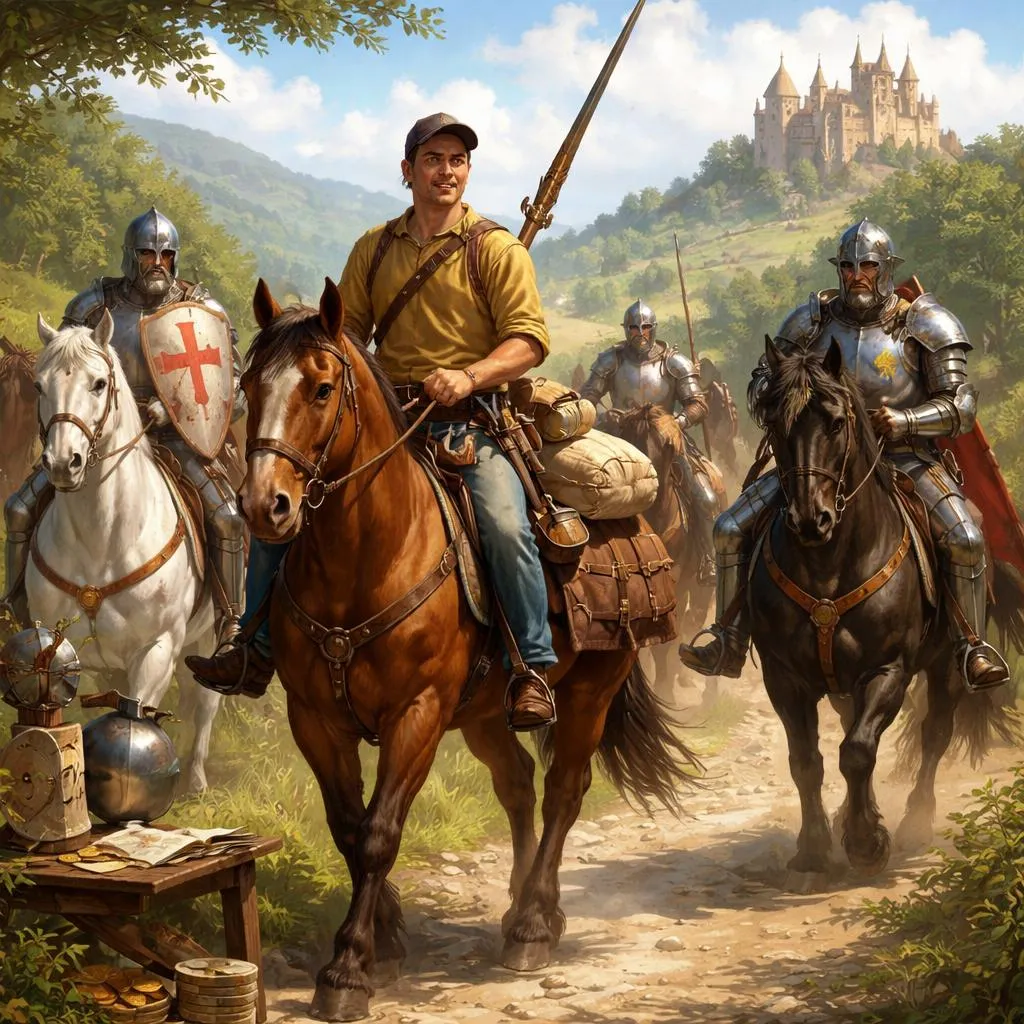

Sandy and I were on the road again, next morning, bright and early. It was so good to open up one’s lungs and take in whole luscious barrels-ful of the blessed God’s untainted, dew-fashioned, woodland-scented air once more, after suffocating body and mind for two days and nights in the moral and physical stenches of that intolerable old buzzard-roost! I mean, for me: of course the place was all right and agreeable enough for Sandy, for she had been used to high life all her days.
Poor girl, her jaws had had a wearisome rest now for a while, and I was expecting to get the consequences. I was right; but she had stood by me most helpfully in the castle, and had mightily supported and reinforced me with gigantic foolishnesses which were worth more for the occasion than wisdoms double their size; so I thought she had earned a right to work her mill for a while, if she wanted to, and I felt not a pang when she started it up:
“Now turn we unto Sir Marhaus that rode with the damsel of thirty winter of age southward—”
“Are you going to see if you can work up another half-stretch on the trail of the cowboys, Sandy?”
“Even so, fair my lord.”
“Go ahead, then. I won’t interrupt this time, if I can help it. Begin over again; start fair, and shake out all your reefs, and I will load my pipe and give good attention.”
“Now turn we unto Sir Marhaus that rode with the damsel of thirty winter of age southward. And so they came into a deep forest, and by fortune they were nighted, and rode along in a deep way, and at the last they came into a courtelage where abode the duke of South Marches, and there they asked harbour. And on the morn the duke sent unto Sir Marhaus, and bad him make him ready. And so Sir Marhaus arose and armed him, and there was a mass sung afore him, and he brake his fast, and so mounted on horseback in the court of the castle, there they should do the battle. So there was the duke already on horseback, clean armed, and his six sons by him, and every each had a spear in his hand, and so they encountered, whereas the duke and his two sons brake their spears upon him, but Sir Marhaus held up his spear and touched none of them. Then came the four sons by couples, and two of them brake their spears, and so did the other two. And all this while Sir Marhaus touched them not. Then Sir Marhaus ran to the duke, and smote him with his spear that horse and man fell to the earth. And so he served his sons. And then Sir Marhaus alight down, and bad the duke yield him or else he would slay him. And then some of his sons recovered, and would have set upon Sir Marhaus. Then Sir Marhaus said to the duke, Cease thy sons, or else I will do the uttermost to you all. When the duke saw he might not escape the death, he cried to his sons, and charged them to yield them to Sir Marhaus. And they kneeled all down and put the pommels of their swords to the knight, and so he received them. And then they holp up their father, and so by their common assent promised unto Sir Marhaus never to be foes unto King Arthur, and thereupon at Whitsuntide after, to come he and his sons, and put them in the king’s grace.*
[*Footnote: The story is borrowed, language and all, from the Morte d’Arthur.—M.T.]
“Even so standeth the history, fair Sir Boss. Now ye shall wit that that very duke and his six sons are they whom but few days past you also did overcome and send to Arthur’s court!”
“Why, Sandy, you can’t mean it!”
“An I speak not sooth, let it be the worse for me.”
“Well, well, well,—now who would ever have thought it? One whole duke and six dukelets; why, Sandy, it was an elegant haul. Knight-errantry is a most chuckle-headed trade, and it is tedious hard work, too, but I begin to see that there is money in it, after all, if you have luck. Not that I would ever engage in it as a business, for I wouldn’t. No sound and legitimate business can be established on a basis of speculation. A successful whirl in the knight-errantry line—now what is it when you blow away the nonsense and come down to the cold facts? It’s just a corner in pork, that’s all, and you can’t make anything else out of it. You’re rich—yes,—suddenly rich—for about a day, maybe a week; then somebody corners the market on you , and down goes your bucket-shop; ain’t that so, Sandy?”
“Whethersoever it be that my mind miscarrieth, bewraying simple language in such sort that the words do seem to come endlong and overthwart—”
“There’s no use in beating about the bush and trying to get around it that way, Sandy, it’s so, just as I say. I know it’s so. And, moreover, when you come right down to the bedrock, knight-errantry is worse than pork; for whatever happens, the pork’s left, and so somebody’s benefited anyway; but when the market breaks, in a knight-errantry whirl, and every knight in the pool passes in his checks, what have you got for assets? Just a rubbish-pile of battered corpses and a barrel or two of busted hardware. Can you call those assets? Give me pork, every time. Am I right?”
“Ah, peradventure my head being distraught by the manifold matters whereunto the confusions of these but late adventured haps and fortunings whereby not I alone nor you alone, but every each of us, meseemeth—”
“No, it’s not your head, Sandy. Your head’s all right, as far as it goes, but you don’t know business; that’s where the trouble is. It unfits you to argue about business, and you’re wrong to be always trying. However, that aside, it was a good haul, anyway, and will breed a handsome crop of reputation in Arthur’s court. And speaking of the cowboys, what a curious country this is for women and men that never get old. Now there’s Morgan le Fay, as fresh and young as a Vassar pullet, to all appearances, and here is this old duke of the South Marches still slashing away with sword and lance at his time of life, after raising such a family as he has raised. As I understand it, Sir Gawaine killed seven of his sons, and still he had six left for Sir Marhaus and me to take into camp. And then there was that damsel of sixty winter of age still excursioning around in her frosty bloom—How old are you, Sandy?”
It was the first time I ever struck a still place in her. The mill had shut down for repairs, or something.
Pengantar Latar Belakang dan Penulis
Kutipan ini diambil dari sebuah cerita yang terinspirasi oleh Morte d’Arthur, sebuah kumpulan terkenal legenda Arthurian yang disusun oleh Sir Thomas Malory pada abad ke-15. Karya Malory adalah salah satu sumber paling penting untuk kisah-kisah Raja Arthur, para ksatria-nya, dan petualangan ksatria yang telah membentuk sastra dan budaya Barat. Morte d’Arthur memadukan sejarah, mitos, dan roman, menyajikan kisah keberanian, kesetiaan, kehormatan, dan tragedi. Kisah di sini melibatkan Sir Marhaus, seorang ksatria Meja Bundar, dan menggambarkan pertempuran ksatria klasik serta tema kehormatan dan rekonsiliasi.
Interpretasi dan Signifikansi yang Detail
Pesan ini menangkap semangat ksatria pengembara abad pertengahan—para ksatria yang bepergian, mencari petualangan, dan terlibat dalam pertempuran untuk menegakkan keadilan dan kesetiaan. Pertemuan Sir Marhaus dengan Duke of South Marches dan putra-putranya adalah contoh nyata dari tantangan yang dihadapi para ksatria: pertempuran fisik, ujian keberanian, dan pencarian perdamaian melalui kekuatan. Kisah ini juga mengontraskan idealisme kesatriaan dengan realitas kehidupan yang keras, karena narator merenungkan sifat kesuksesan yang cepat berlalu dan “bisnis” ksatria pengembara.
Dialog antara narator dan Sandy menambahkan perspektif modern, yang agak lucu, pada kisah-kisah lama. Hal ini menyoroti ketegangan antara cita-cita romantis dan realitas praktis, sebuah tema yang beresonansi dengan pembaca dari segala usia. Penyebutan karakter seperti Morgan le Fay dan Sir Gawaine mengaitkan episode ini ke dalam mitos Arthurian yang lebih besar, memperkaya permadani legenda.
Pelajaran dan Wawasan untuk Siswa
-
Keberanian dan Kehormatan: Para ksatria menunjukkan keberanian dalam pertempuran dan kehormatan dalam kemenangan dan kekalahan. Siswa dapat belajar pentingnya membela apa yang benar, menghadapi tantangan dengan berani, dan memperlakukan orang lain dengan hormat bahkan dalam konflik.
-
Kesetiaan dan Rekonsiliasi: Kisah ini berakhir dengan duke yang kalah dan putra-putranya yang berjanji setia kepada Raja Arthur, menunjukkan bahwa kekuatan sejati mencakup kemampuan untuk memaafkan dan berdamai. Hal ini mengajarkan nilai menyelesaikan perselisihan secara damai dan menjaga aliansi.
-
Realitas vs. Idealisme: Refleksi narator mengingatkan siswa bahwa meskipun cita-cita itu penting, memahami sisi praktis kehidupan sama pentingnya. Keseimbangan ini adalah kunci dalam membuat keputusan yang bijaksana di sekolah, persahabatan, dan karier di masa depan.
-
Kekuatan Bercerita: Bercerita Sandy, meskipun “kebodohan yang luar biasa,” mendukung dan mendorong narator. Hal ini menunjukkan bagaimana cerita dapat menginspirasi, menghibur, dan mengajari kita, bahkan ketika mereka tampak aneh.
Menerapkan Pelajaran Ini dalam Kehidupan Sehari-hari
-
Dalam Belajar: Rangkul tantangan seperti yang dilakukan para ksatria, dengan keberanian dan tekad. Ketika menghadapi mata pelajaran yang sulit, bertahan dan cari bantuan, mengetahui bahwa upaya mengarah pada pertumbuhan.
-
Dalam Situasi Sosial: Berlatih kesetiaan dan keadilan dalam persahabatan. Ketika konflik muncul, bertujuan untuk rekonsiliasi dan pengertian daripada permusuhan yang berkepanjangan.
-
Dalam Pertumbuhan Pribadi: Seimbangkan impian dengan kenyataan. Tetapkan tujuan tetapi bersiaplah untuk beradaptasi dan belajar dari kemunduran, seperti pandangan narator tentang “bisnis” ksatria pengembara.
-
Dalam Kreativitas: Gunakan bercerita sebagai alat untuk mengekspresikan diri dan terhubung dengan orang lain. Seperti Sandy, imajinasi Anda bisa menjadi sumber kekuatan dan kegembiraan.
Mengembangkan Sifat Positif dari Kisah
-
Keberanian: Hadapi ketakutan dan tantangan secara langsung, baik dalam berbicara di depan umum, ujian, atau situasi sosial.
-
Hormat: Hormati pandangan dan latar belakang orang lain, membina komunitas yang suportif.
-
Kebijaksanaan: Belajar dari keberhasilan dan kegagalan, memahami bahwa setiap pengalaman berkontribusi pada pertumbuhan Anda.
-
Imajinasi: Jaga kreativitas Anda tetap hidup; itu dapat membantu memecahkan masalah dan memperkaya hidup Anda.
Kesimpulan
Pesan dari kisah yang terinspirasi Arthurian ini menawarkan materi yang kaya bagi siswa untuk menjelajahi tema keberanian, kehormatan, kesetiaan, dan keseimbangan antara idealisme dan realitas yang tak lekang oleh waktu. Dengan merenungkan kisah-kisah ini, pembaca muda dapat memperoleh wawasan berharga yang berlaku tidak hanya untuk sastra tetapi juga untuk kehidupan sehari-hari, membantu mereka tumbuh menjadi individu yang bijaksana, berani, dan penyayang.
