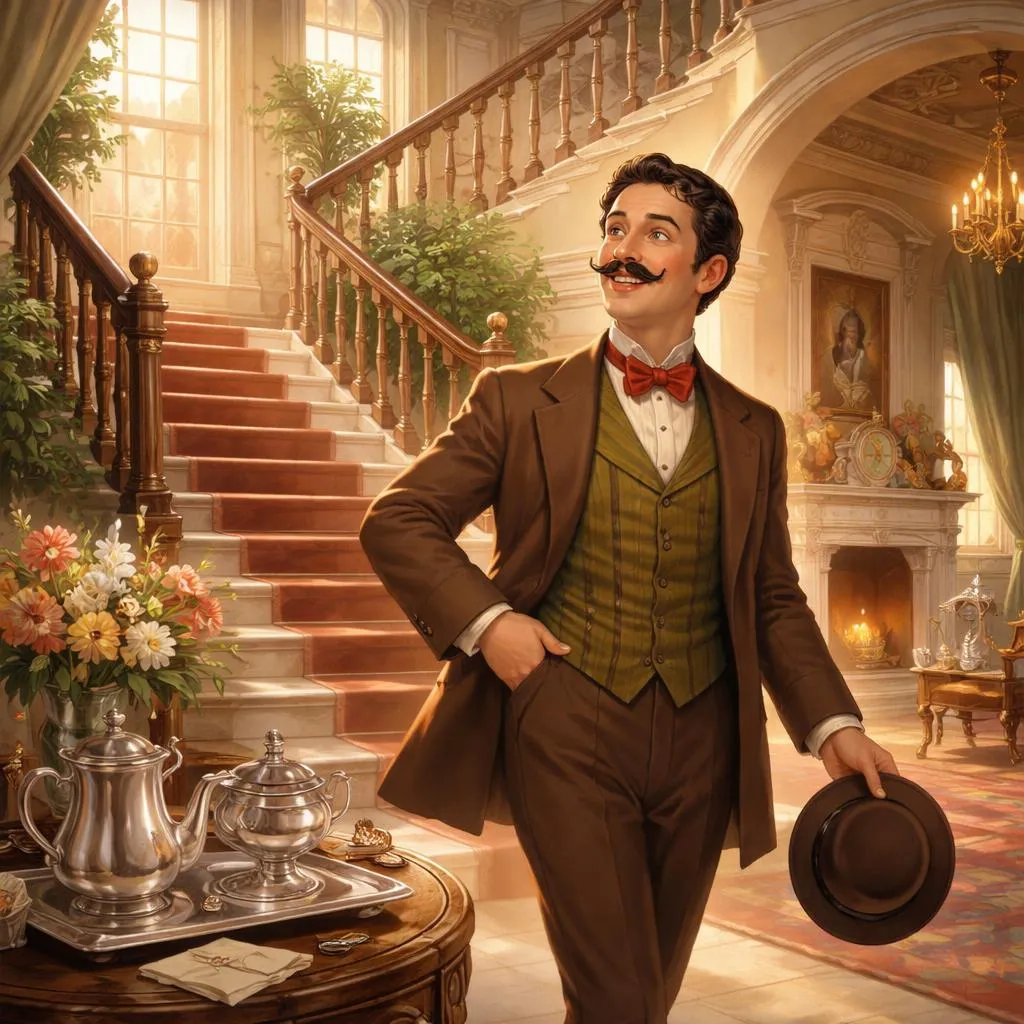

"Faith," muttered Passepartout, somewhat flurried, "I've seen people at Madame Tussaud's as lively as my new master!"
Madame Tussaud's "people," let it be said, are of wax, and are much visited in London; speech is all that is wanting to make them human.
During his brief interview with Mr. Fogg, Passepartout had been carefully observing him. He appeared to be a man about forty years of age, with fine, handsome features, and a tall, well-shaped figure; his hair and whiskers were light, his forehead compact and unwrinkled, his face rather pale, his teeth magnificent. His countenance possessed in the highest degree what physiognomists call "repose in action," a quality of those who act rather than talk. Calm and phlegmatic, with a clear eye, Mr. Fogg seemed a perfect type of that English composure which Angelica Kauffmann has so skilfully represented on canvas. Seen in the various phases of his daily life, he gave the idea of being perfectly well-balanced, as exactly regulated as a Leroy chronometer. Phileas Fogg was, indeed, exactitude personified, and this was betrayed even in the expression of his very hands and feet; for in men, as well as in animals, the limbs themselves are expressive of the passions.
He was so exact that he was never in a hurry, was always ready, and was economical alike of his steps and his motions. He never took one step too many, and always went to his destination by the shortest cut; he made no superfluous gestures, and was never seen to be moved or agitated. He was the most deliberate person in the world, yet always reached his destination at the exact moment.
He lived alone, and, so to speak, outside of every social relation; and as he knew that in this world account must be taken of friction, and that friction retards, he never rubbed against anybody.
As for Passepartout, he was a true Parisian of Paris. Since he had abandoned his own country for England, taking service as a valet, he had in vain searched for a master after his own heart. Passepartout was by no means one of those pert dunces depicted by Moliere with a bold gaze and a nose held high in the air; he was an honest fellow, with a pleasant face, lips a trifle protruding, soft-mannered and serviceable, with a good round head, such as one likes to see on the shoulders of a friend. His eyes were blue, his complexion rubicund, his figure almost portly and well-built, his body muscular, and his physical powers fully developed by the exercises of his younger days. His brown hair was somewhat tumbled; for, while the ancient sculptors are said to have known eighteen methods of arranging Minerva's tresses, Passepartout was familiar with but one of dressing his own: three strokes of a large-tooth comb completed his toilet.
It would be rash to predict how Passepartout's lively nature would agree with Mr. Fogg. It was impossible to tell whether the new servant would turn out as absolutely methodical as his master required; experience alone could solve the question. Passepartout had been a sort of vagrant in his early years, and now yearned for repose; but so far he had failed to find it, though he had already served in ten English houses. But he could not take root in any of these; with chagrin, he found his masters invariably whimsical and irregular, constantly running about the country, or on the look-out for adventure. His last master, young Lord Longferry, Member of Parliament, after passing his nights in the Haymarket taverns, was too often brought home in the morning on policemen's shoulders. Passepartout, desirous of respecting the gentleman whom he served, ventured a mild remonstrance on such conduct; which, being ill-received, he took his leave. Hearing that Mr. Phileas Fogg was looking for a servant, and that his life was one of unbroken regularity, that he neither travelled nor stayed from home overnight, he felt sure that this would be the place he was after. He presented himself, and was accepted, as has been seen.
At half-past eleven, then, Passepartout found himself alone in the house in Saville Row. He begun its inspection without delay, scouring it from cellar to garret. So clean, well-arranged, solemn a mansion pleased him; it seemed to him like a snail's shell, lighted and warmed by gas, which sufficed for both these purposes. When Passepartout reached the second story he recognised at once the room which he was to inhabit, and he was well satisfied with it. Electric bells and speaking-tubes afforded communication with the lower stories; while on the mantel stood an electric clock, precisely like that in Mr. Fogg's bedchamber, both beating the same second at the same instant. "That's good, that'll do," said Passepartout to himself.
He suddenly observed, hung over the clock, a card which, upon inspection, proved to be a programme of the daily routine of the house. It comprised all that was required of the servant, from eight in the morning, exactly at which hour Phileas Fogg rose, till half-past eleven, when he left the house for the Reform Club—all the details of service, the tea and toast at twenty-three minutes past eight, the shaving-water at thirty-seven minutes past nine, and the toilet at twenty minutes before ten. Everything was regulated and foreseen that was to be done from half-past eleven a.m. till midnight, the hour at which the methodical gentleman retired.
Mr. Fogg's wardrobe was amply supplied and in the best taste. Each pair of trousers, coat, and vest bore a number, indicating the time of year and season at which they were in turn to be laid out for wearing; and the same system was applied to the master's shoes. In short, the house in Saville Row, which must have been a very temple of disorder and unrest under the illustrious but dissipated Sheridan, was cosiness, comfort, and method idealised. There was no study, nor were there books, which would have been quite useless to Mr. Fogg; for at the Reform two libraries, one of general literature and the other of law and politics, were at his service. A moderate-sized safe stood in his bedroom, constructed so as to defy fire as well as burglars; but Passepartout found neither arms nor hunting weapons anywhere; everything betrayed the most tranquil and peaceable habits.
Having scrutinised the house from top to bottom, he rubbed his hands, a broad smile overspread his features, and he said joyfully, "This is just what I wanted! Ah, we shall get on together, Mr. Fogg and I! What a domestic and regular gentleman! A real machine; well, I don't mind serving a machine."
Latar Belakang dan Pengantar Penulis
Kutipan ini berasal dari novel klasik Keliling Dunia dalam Delapan Puluh Hari karya Jules Verne, seorang penulis Prancis terkenal yang dikenal karena karya petualangan dan fiksi ilmiahnya. Ditulis pada tahun 1873, novel ini menangkap semangat Revolusi Industri dan ketertarikan pada teknologi baru dan perjalanan global. Imajinasi Verne yang jelas dan deskripsi yang detail menghidupkan kegembiraan dan tantangan perjalanan keliling dunia pada saat perjalanan semacam itu masih merupakan pencapaian yang luar biasa.
Interpretasi Cerita yang Detail
Kutipan ini memperkenalkan dua tokoh utama: Phileas Fogg, seorang pria dengan rutinitas dan ketepatan yang ketat, dan pelayannya yang baru dipekerjakan, Passepartout, yang sifatnya yang lincah dan fleksibel sangat kontras dengan keteraturan mekanis Fogg. Fogg digambarkan sebagai model ketenangan dan ketelitian Inggris, menjalani kehidupan yang begitu teratur sehingga setiap menit dan gerakan direncanakan dan dilaksanakan dengan hati-hati. Passepartout, di sisi lain, adalah karakter manusia yang hangat dengan masa lalu yang penuh warna dan keinginan untuk stabilitas.
Pembukaan ini mengatur panggung untuk petualangan utama novel: taruhan Fogg untuk mengelilingi dunia dalam delapan puluh hari. Kontras antara sifat metodis Fogg dan dunia yang tidak dapat diprediksi yang akan ia hadapi menciptakan ketegangan dan humor di seluruh cerita.
Apa yang Dapat Dipelajari Siswa
-
Nilai Disiplin dan Rutinitas: Karakter Phileas Fogg mencontohkan kekuatan disiplin. Ketepatan waktu, perencanaan yang cermat, dan sikapnya yang tenang menunjukkan bagaimana struktur dapat membantu mencapai tujuan yang ambisius. Siswa dapat mempelajari pentingnya manajemen waktu dan organisasi dalam studi dan kehidupan sehari-hari mereka.
-
Kemampuan Beradaptasi dan Berpikiran Terbuka: Karakter Passepartout mengingatkan kita bahwa meskipun rutinitas itu berharga, fleksibilitas dan kebaikan sama pentingnya. Pengalaman masa lalunya dan sifatnya yang santai menyeimbangkan kekakuan Fogg, mengajari siswa untuk menghargai kepribadian yang berbeda dan beradaptasi dengan situasi baru.
-
Keberanian dan Petualangan: Novel ini mendorong pembaca untuk menerima tantangan dan keluar dari zona nyaman mereka. Perjalanan Fogg adalah metafora untuk ketekunan dan keberanian, menginspirasi pembaca muda untuk mengejar impian mereka meskipun ada rintangan.
-
Kesadaran Budaya: Saat cerita melakukan perjalanan melalui berbagai negara dan budaya, ia menawarkan jendela ke dalam keragaman dunia. Hal ini memperluas wawasan siswa dan menumbuhkan rasa hormat terhadap berbagai bangsa dan tradisi.
Menerapkan Pelajaran Ini dalam Kehidupan
- Dalam Pembelajaran: Siswa dapat mengadopsi dedikasi Fogg dengan menetapkan tujuan yang jelas dan mengikuti jadwal belajar, sambil juga mengingat fleksibilitas Passepartout untuk menangani perubahan atau kesulitan yang tak terduga dengan anggun.
- Dalam Pengaturan Sosial: Mengenali nilai dari kepribadian yang berbeda membantu membangun empati dan kerja tim. Sama seperti Fogg dan Passepartout saling melengkapi, siswa dapat belajar bekerja dengan baik dengan teman sekelas yang memiliki kekuatan yang berbeda.
- Dalam Pertumbuhan Pribadi: Semangat petualangan mendorong rasa ingin tahu dan ketahanan. Siswa dapat menantang diri mereka sendiri untuk mencoba aktivitas baru, bepergian, atau menjelajahi ide-ide baru, mengembangkan kepercayaan diri dan pandangan dunia mereka.
Mengembangkan Sifat Positif dari Cerita
- Ketepatan dan Tanggung Jawab: Seperti Fogg, siswa dapat berlatih bertanggung jawab atas tugas mereka dan tepat waktu dalam komitmen mereka.
- Keramahan dan Dukungan: Terinspirasi oleh Passepartout, menunjukkan kebaikan dan dukungan kepada orang lain menciptakan persahabatan yang kuat dan lingkungan yang positif.
- Pemecahan Masalah: Cerita menunjukkan bahwa masalah tak terduga muncul, tetapi pemikiran yang tenang dan tekad mengarah pada kesuksesan. Siswa dapat mengembangkan keterampilan memecahkan masalah dengan tetap tenang dan berpikir kreatif.
Kesimpulan
Keliling Dunia dalam Delapan Puluh Hari lebih dari sekadar petualangan yang mengasyikkan; itu adalah sumber pelajaran yang kaya tentang karakter, budaya, dan keberanian. Dengan membaca dan merenungkan cerita ini, siswa dapat memperoleh wawasan yang membantu mereka di sekolah, hubungan, dan banyak perjalanan hidup. Merangkul disiplin dan fleksibilitas, menghormati keragaman, dan berani menjelajahi hal yang tidak diketahui adalah nilai-nilai abadi yang disampaikan novel klasik ini dengan indah.
