
Between six and nine we made ten miles, which was plenty for a horse carrying triple—man, woman, and armor; then we stopped for a long nooning under some trees by a limpid brook.
Right so came by and by a knight riding; and as he drew near he made dolorous moan, and by the words of it I perceived that he was cursing and swearing; yet nevertheless was I glad of his coming, for that I saw he bore a bulletin-board whereon in letters all of shining gold was writ:
“USE PETERSON’S PROPHYLACTIC TOOTH-BRUSH—ALL THE GO.” I was glad of his coming, for even by this token I knew him for knight of mine. It was Sir Madok de la Montaine, a burly great fellow whose chief distinction was that he had come within an ace of sending Sir Launcelot down over his horse-tail once. He was never long in a stranger’s presence without finding some pretext or other to let out that great fact. But there was another fact of nearly the same size, which he never pushed upon anybody unasked, and yet never withheld when asked: that was, that the reason he didn’t quite succeed was, that he was interrupted and sent down over horse-tail himself. This innocent vast lubber did not see any particular difference between the two facts. I liked him, for he was earnest in his work, and very valuable. And he was so fine to look at, with his broad mailed shoulders, and the grand leonine set of his plumed head, and his big shield with its quaint device of a gauntleted hand clutching a prophylactic tooth-brush, with motto: “Try Noyoudont.” This was a tooth-wash that I was introducing.
He was aweary, he said, and indeed he looked it; but he would not alight. He said he was after the stove-polish man; and with this he broke out cursing and swearing anew. The bulletin-boarder referred to was Sir Ossaise of Surluse, a brave knight, and of considerable celebrity on account of his having tried conclusions in a tournament once, with no less a Mogul than Sir Gaheris himself—although not successfully. He was of a light and laughing disposition, and to him nothing in this world was serious. It was for this reason that I had chosen him to work up a stove-polish sentiment. There were no stoves yet, and so there could be nothing serious about stove-polish. All that the agent needed to do was to deftly and by degrees prepare the public for the great change, and have them established in predilections toward neatness against the time when the stove should appear upon the stage.
Sir Madok was very bitter, and brake out anew with cursings. He said he had cursed his soul to rags; and yet he would not get down from his horse, neither would he take any rest, or listen to any comfort, until he should have found Sir Ossaise and settled this account. It appeared, by what I could piece together of the unprofane fragments of his statement, that he had chanced upon Sir Ossaise at dawn of the morning, and been told that if he would make a short cut across the fields and swamps and broken hills and glades, he could head off a company of travelers who would be rare customers for prophylactics and tooth-wash. With characteristic zeal Sir Madok had plunged away at once upon this quest, and after three hours of awful crosslot riding had overhauled his game. And behold, it was the five patriarchs that had been released from the dungeons the evening before! Poor old creatures, it was all of twenty years since any one of them had known what it was to be equipped with any remaining snag or remnant of a tooth.
“Blank-blank-blank him,” said Sir Madok, “an I do not stove-polish him an I may find him, leave it to me; for never no knight that hight Ossaise or aught else may do me this disservice and bide on live, an I may find him, the which I have thereunto sworn a great oath this day.”
And with these words and others, he lightly took his spear and gat him thence. In the middle of the afternoon we came upon one of those very patriarchs ourselves, in the edge of a poor village. He was basking in the love of relatives and friends whom he had not seen for fifty years; and about him and caressing him were also descendants of his own body whom he had never seen at all till now; but to him these were all strangers, his memory was gone, his mind was stagnant. It seemed incredible that a man could outlast half a century shut up in a dark hole like a rat, but here were his old wife and some old comrades to testify to it. They could remember him as he was in the freshness and strength of his young manhood, when he kissed his child and delivered it to its mother’s hands and went away into that long oblivion. The people at the castle could not tell within half a generation the length of time the man had been shut up there for his unrecorded and forgotten offense; but this old wife knew; and so did her old child, who stood there among her married sons and daughters trying to realize a father who had been to her a name, a thought, a formless image, a tradition, all her life, and now was suddenly concreted into actual flesh and blood and set before her face.
It was a curious situation; yet it is not on that account that I have made room for it here, but on account of a thing which seemed to me still more curious. To wit, that this dreadful matter brought from these downtrodden people no outburst of rage against these oppressors. They had been heritors and subjects of cruelty and outrage so long that nothing could have startled them but a kindness. Yes, here was a curious revelation, indeed, of the depth to which this people had been sunk in slavery. Their entire being was reduced to a monotonous dead level of patience, resignation, dumb uncomplaining acceptance of whatever might befall them in this life. Their very imagination was dead. When you can say that of a man, he has struck bottom, I reckon; there is no lower deep for him.
I rather wished I had gone some other road. This was not the sort of experience for a statesman to encounter who was planning out a peaceful revolution in his mind. For it could not help bringing up the unget-aroundable fact that, all gentle cant and philosophizing to the contrary notwithstanding, no people in the world ever did achieve their freedom by goody-goody talk and moral suasion: it being immutable law that all revolutions that will succeed must begin in blood, whatever may answer afterward. If history teaches anything, it teaches that. What this folk needed, then, was a Reign of Terror and a guillotine, and I was the wrong man for them.
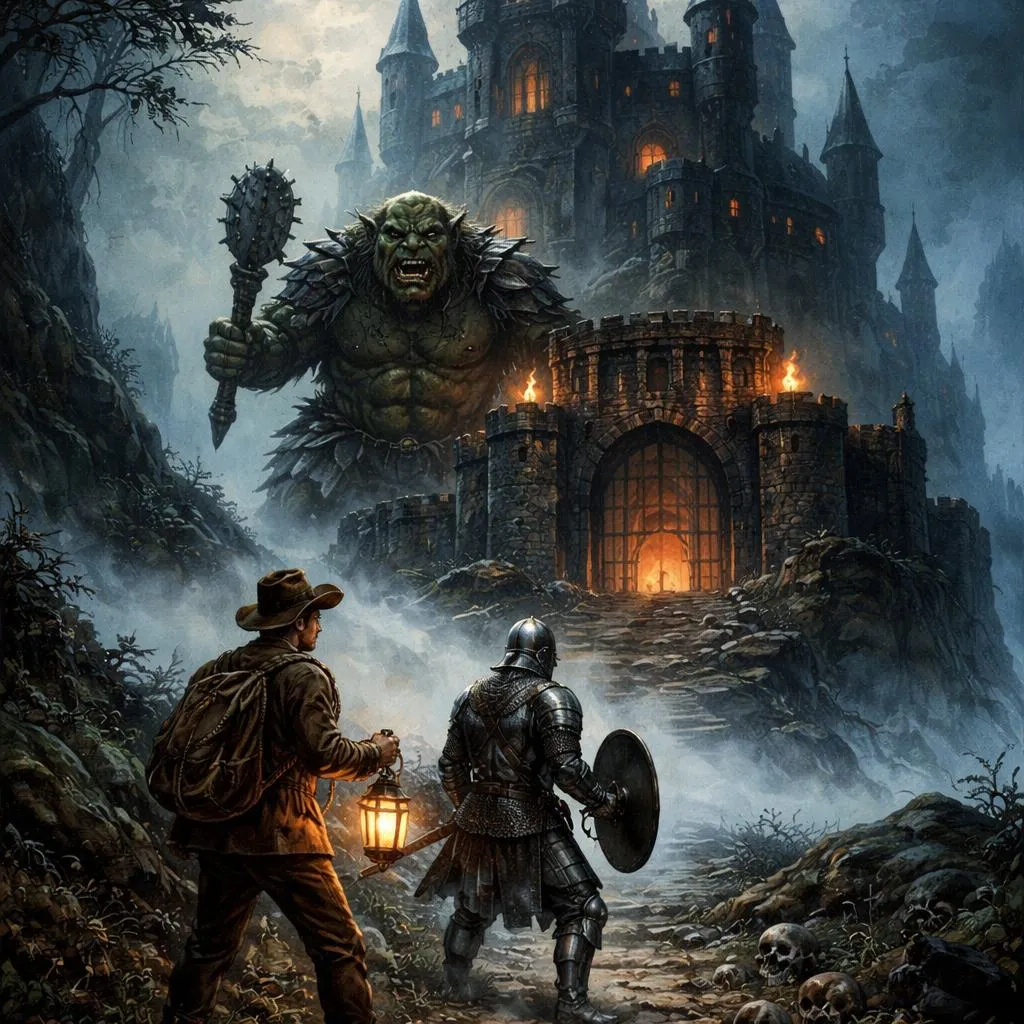
Two days later, toward noon, Sandy began to show signs of excitement and feverish expectancy. She said we were approaching the ogre’s castle. I was surprised into an uncomfortable shock. The object of our quest had gradually dropped out of my mind; this sudden resurrection of it made it seem quite a real and startling thing for a moment, and roused up in me a smart interest. Sandy’s excitement increased every moment; and so did mine, for that sort of thing is catching. My heart got to thumping. You can’t reason with your heart; it has its own laws, and thumps about things which the intellect scorns. Presently, when Sandy slid from the horse, motioned me to stop, and went creeping stealthily, with her head bent nearly to her knees, toward a row of bushes that bordered a declivity, the thumpings grew stronger and quicker. And they kept it up while she was gaining her ambush and getting her glimpse over the declivity; and also while I was creeping to her side on my knees. Her eyes were burning now, as she pointed with her finger, and said in a panting whisper:
“The castle! The castle! Lo, where it looms!”
What a welcome disappointment I experienced! I said:
“Castle? It is nothing but a pigsty; a pigsty with a wattled fence around it.”
She looked surprised and distressed. The animation faded out of her face; and during many moments she was lost in thought and silent. Then:
“It was not enchanted aforetime,” she said in a musing fashion, as if to herself. “And how strange is this marvel, and how awful —that to the one perception it is enchanted and dight in a base and shameful aspect; yet to the perception of the other it is not enchanted, hath suffered no change, but stands firm and stately still, girt with its moat and waving its banners in the blue air from its towers. And God shield us, how it pricks the heart to see again these gracious captives, and the sorrow deepened in their sweet faces! We have tarried along, and are to blame.”
I saw my cue. The castle was enchanted to me , not to her. It would be wasted time to try to argue her out of her delusion, it couldn’t be done; I must just humor it. So I said:
“This is a common case—the enchanting of a thing to one eye and leaving it in its proper form to another. You have heard of it before, Sandy, though you haven’t happened to experience it. But no harm is done. In fact, it is lucky the way it is. If these ladies were hogs to everybody and to themselves, it would be necessary to break the enchantment, and that might be impossible if one failed to find out the particular process of the enchantment. And hazardous, too; for in attempting a disenchantment without the true key, you are liable to err, and turn your hogs into dogs, and the dogs into cats, the cats into rats, and so on, and end by reducing your materials to nothing finally, or to an odorless gas which you can’t follow—which, of course, amounts to the same thing. But here, by good luck, no one’s eyes but mine are under the enchantment, and so it is of no consequence to dissolve it. These ladies remain ladies to you, and to themselves, and to everybody else; and at the same time they will suffer in no way from my delusion, for when I know that an ostensible hog is a lady, that is enough for me, I know how to treat her.”
“Thanks, oh, sweet my lord, thou talkest like an angel. And I know that thou wilt deliver them, for that thou art minded to great deeds and art as strong a knight of your hands and as brave to will and to do, as any that is on live.”
“I will not leave a princess in the sty, Sandy. Are those three yonder that to my disordered eyes are starveling swine-herds—”
“The ogres, Are they changed also? It is most wonderful. Now am I fearful; for how canst thou strike with sure aim when five of their nine cubits of stature are to thee invisible? Ah, go warily, fair sir; this is a mightier emprise than I wend.”
“You be easy, Sandy. All I need to know is, how much of an ogre is invisible; then I know how to locate his vitals. Don’t you be afraid, I will make short work of these bunco-steerers. Stay where you are.”
I left Sandy kneeling there, corpse-faced but plucky and hopeful, and rode down to the pigsty, and struck up a trade with the swine-herds. I won their gratitude by buying out all the hogs at the lump sum of sixteen pennies, which was rather above latest quotations. I was just in time; for the Church, the lord of the manor, and the rest of the tax-gatherers would have been along next day and swept off pretty much all the stock, leaving the swine-herds very short of hogs and Sandy out of princesses. But now the tax people could be paid in cash, and there would be a stake left besides. One of the men had ten children; and he said that last year when a priest came and of his ten pigs took the fattest one for tithes, the wife burst out upon him, and offered him a child and said:
“Thou beast without bowels of mercy, why leave me my child, yet rob me of the wherewithal to feed it?”
How curious. The same thing had happened in the Wales of my day, under this same old Established Church, which was supposed by many to have changed its nature when it changed its disguise.
I sent the three men away, and then opened the sty gate and beckoned Sandy to come—which she did; and not leisurely, but with the rush of a prairie fire. And when I saw her fling herself upon those hogs, with tears of joy running down her cheeks, and strain them to her heart, and kiss them, and caress them, and call them reverently by grand princely names, I was ashamed of her, ashamed of the human race.
We had to drive those hogs home—ten miles; and no ladies were ever more fickle-minded or contrary. They would stay in no road, no path; they broke out through the brush on all sides, and flowed away in all directions, over rocks, and hills, and the roughest places they could find. And they must not be struck, or roughly accosted; Sandy could not bear to see them treated in ways unbecoming their rank. The troublesomest old sow of the lot had to be called my Lady, and your Highness, like the rest. It is annoying and difficult to scour around after hogs, in armor. There was one small countess, with an iron ring in her snout and hardly any hair on her back, that was the devil for perversity. She gave me a race of an hour, over all sorts of country, and then we were right where we had started from, having made not a rod of real progress. I seized her at last by the tail, and brought her along squealing. When I overtook Sandy she was horrified, and said it was in the last degree indelicate to drag a countess by her train.
We got the hogs home just at dark—most of them. The princess Nerovens de Morganore was missing, and two of her ladies in waiting: namely, Miss Angela Bohun, and the Demoiselle Elaine Courtemains, the former of these two being a young black sow with a white star in her forehead, and the latter a brown one with thin legs and a slight limp in the forward shank on the starboard side—a couple of the tryingest blisters to drive that I ever saw. Also among the missing were several mere baronesses—and I wanted them to stay missing; but no, all that sausage-meat had to be found; so servants were sent out with torches to scour the woods and hills to that end.
Of course, the whole drove was housed in the house, and, great guns!—well, I never saw anything like it. Nor ever heard anything like it. And never smelt anything like it. It was like an insurrection in a gasometer.
Latar Belakang dan Pengantar Penulis
Kisah ini adalah kutipan dari "The Prophylactic Knight", sebuah kisah satir dan imajinatif karya Mark Twain, seorang penulis Amerika terkenal yang dikenal karena kecerdasan dan komentar sosialnya yang tajam. Karya-karya Twain sering kali memadukan humor dengan refleksi mendalam tentang sifat manusia dan masyarakat. Ditulis pada akhir abad ke-19, kisah ini menggunakan kerangka ksatria abad pertengahan dan fantasi untuk mengeksplorasi tema ketidakadilan sosial, transformasi, dan perjuangan untuk kebebasan.
Mark Twain (Samuel Clemens) terkenal dengan karya-karya klasiknya seperti The Adventures of Tom Sawyer dan Adventures of Huckleberry Finn. Kisah-kisahnya sering kali menantang norma-norma sosial dan mendorong pembaca untuk mempertanyakan otoritas dan tradisi.
Interpretasi dan Makna Cerita
Pada pandangan pertama, kisah ini tampak seperti petualangan aneh yang dipenuhi dengan ksatria, ogre, dan kastil yang terpesona. Namun, di bawah permukaannya terdapat alegori yang kuat tentang penindasan dan pembebasan. Para ksatria mewakili agen perubahan, sementara kastil yang terpesona dan para putri yang berubah melambangkan orang-orang yang terperangkap dalam keadaan sulit, disalahpahami atau diperlakukan buruk oleh masyarakat.
Penggambaran cerita tentang "patriark" yang telah dipenjara dan dilupakan, dan penerimaan pasrah penduduk desa terhadap nasib mereka, menyoroti dampak buruk dari penindasan jangka panjang. Kurangnya kemarahan dan penerimaan penderitaan yang tumpul mengungkapkan betapa dalam perbudakan atau tirani dapat menghancurkan semangat manusia.
Kastil yang terpesona yang dilihat secara berbeda oleh narator dan Sandy menggambarkan bagaimana persepsi membentuk realitas. Visi ganda ini mengundang pembaca untuk mempertimbangkan bagaimana harapan dan keyakinan dapat mengubah bahkan situasi yang paling suram.
Pelajaran dan Wawasan untuk Siswa
-
Memahami Penindasan dan Empati: Kisah ini mengajarkan kepada pembaca muda tentang dampak ketidakadilan dan pentingnya empati terhadap mereka yang menderita dalam diam. Ini mendorong siswa untuk melihat melampaui penampilan dan memahami perjuangan yang lebih dalam yang mungkin dihadapi orang.
-
Kekuatan Perspektif: Pandangan kastil yang kontras mengingatkan kita bahwa pola pikir kita memengaruhi cara kita menafsirkan dunia. Mengembangkan pandangan yang positif dan penuh harapan dapat membantu kita melihat potensi dan kebaikan di mana orang lain melihat keputusasaan.
-
Keberanian dan Tekad: Upaya Sir Madok yang tak kenal lelah untuk mencari keadilan, meskipun kelelahan dan kemunduran, mencontohkan ketekunan. Siswa dapat mempelajari nilai dedikasi dan membela apa yang benar, bahkan ketika tugas itu sulit.
-
Peran Humor dan Satir: Twain menggunakan humor untuk membahas topik-topik serius, menunjukkan bahwa tawa dan kecerdasan dapat menjadi alat yang ampuh untuk menantang ketidakadilan dan memprovokasi pemikiran. Pendekatan ini dapat menginspirasi siswa untuk menggunakan kreativitas dalam mengekspresikan pandangan mereka.
Menerapkan Semangat Cerita dalam Kehidupan Sehari-hari
-
Dalam Belajar: Siswa dapat mengadopsi kesungguhan Sir Madok dengan mendekati studi dengan dedikasi dan ketahanan, memahami bahwa kemajuan seringkali membutuhkan usaha dan ketekunan.
-
Dalam Interaksi Sosial: Kisah ini mendorong kebaikan dan rasa hormat, bahkan terhadap mereka yang tampak berbeda atau sulit, seperti perlakuan lembut Sandy terhadap babi yang sebenarnya adalah putri yang sedang terpesona.
-
Dalam Menghadapi Tantangan: Sama seperti narator menerima realitas ganda kastil yang terpesona, siswa dapat belajar untuk merangkul tantangan dengan fleksibilitas, melihat rintangan sebagai peluang untuk tumbuh.
-
Dalam Mengembangkan Empati: Dengan mengenali kepasrahan yang mendalam dari penduduk desa yang tertindas, siswa diingatkan untuk bersikap penyayang dan mendukung teman sebaya yang mungkin berjuang dalam diam.
Mengembangkan Nilai-nilai Positif dari Cerita
-
Keadilan dan Advokasi: Dorong siswa untuk melawan ketidakadilan dan mendukung mereka yang tidak dapat membela diri.
-
Harapan dan Optimisme: Ajarkan pentingnya menjaga harapan, bahkan ketika situasi tampak suram.
-
Hormat terhadap Orang Lain: Soroti martabat yang melekat pada setiap orang, terlepas dari penampilan atau keadaan mereka.
-
Berpikir Kreatif: Inspirasi siswa untuk menggunakan imajinasi dan humor untuk memahami masalah yang kompleks dan berkomunikasi secara efektif.
Kesimpulan
Kisah ini, meskipun dibungkus dalam fantasi dan humor, menawarkan refleksi mendalam tentang sifat manusia, masyarakat, dan pencarian kebebasan. Bagi pembaca muda, ini memberikan narasi yang menarik dan sumber pelajaran yang kaya tentang keberanian, empati, dan kekuatan perspektif. Dengan mengeksplorasi tema-tema ini, siswa dapat mengembangkan pemahaman yang lebih dalam tentang diri mereka sendiri dan dunia, mempersiapkan mereka untuk menghadapi tantangan hidup dengan kebijaksanaan dan hati.
