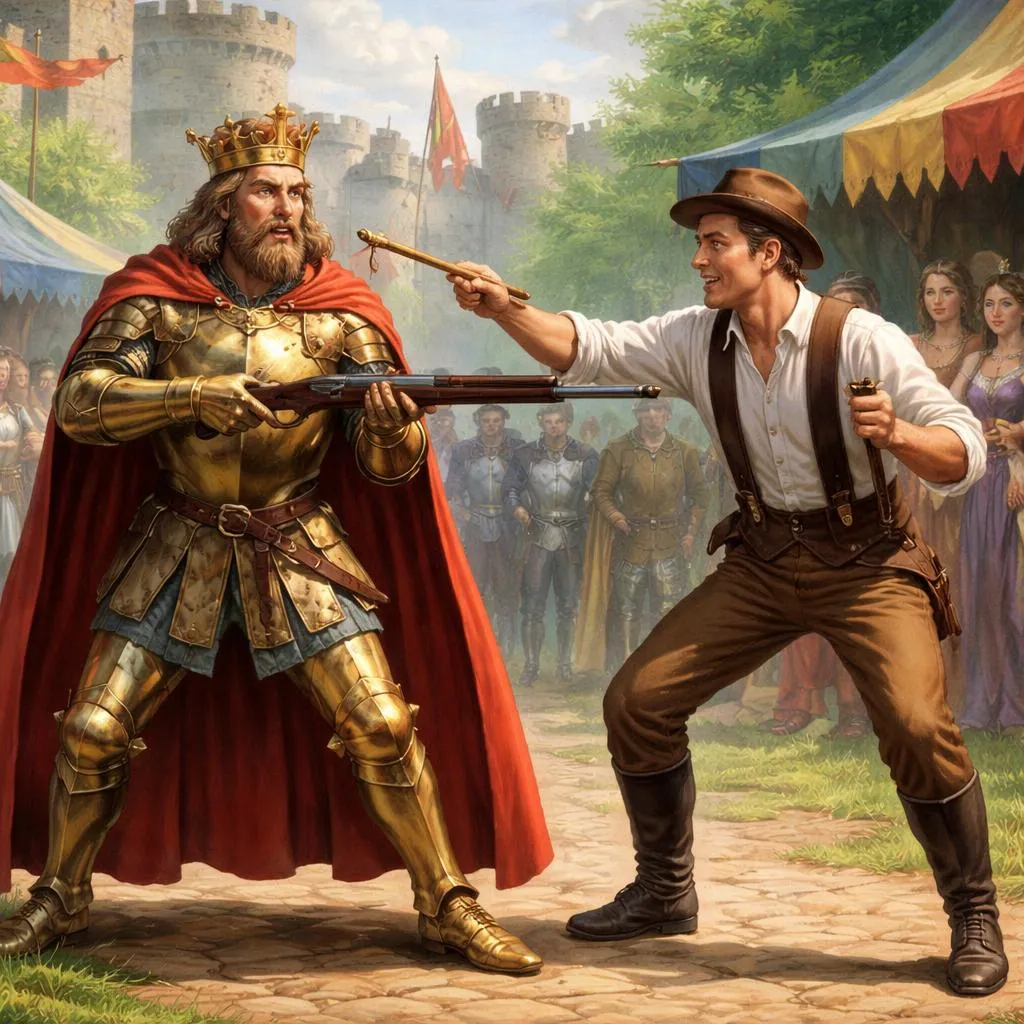

On the morning of the fourth day, when it was just sunrise, and we had been tramping an hour in the chill dawn, I came to a resolution: the king must be drilled; things could not go on so, he must be taken in hand and deliberately and conscientiously drilled, or we couldn’t ever venture to enter a dwelling; the very cats would know this masquerader for a humbug and no peasant. So I called a halt and said:
“Sire, as between clothes and countenance, you are all right, there is no discrepancy; but as between your clothes and your bearing, you are all wrong, there is a most noticeable discrepancy. Your soldierly stride, your lordly port—these will not do. You stand too straight, your looks are too high, too confident. The cares of a kingdom do not stoop the shoulders, they do not droop the chin, they do not depress the high level of the eye-glance, they do not put doubt and fear in the heart and hang out the signs of them in slouching body and unsure step. It is the sordid cares of the lowly born that do these things. You must learn the trick; you must imitate the trademarks of poverty, misery, oppression, insult, and the other several and common inhumanities that sap the manliness out of a man and make him a loyal and proper and approved subject and a satisfaction to his masters, or the very infants will know you for better than your disguise, and we shall go to pieces at the first hut we stop at. Pray try to walk like this.”
The king took careful note, and then tried an imitation.
“Pretty fair—pretty fair. Chin a little lower, please—there, very good. Eyes too high; pray don’t look at the horizon, look at the ground, ten steps in front of you. Ah—that is better, that is very good. Wait, please; you betray too much vigor, too much decision; you want more of a shamble. Look at me, please—this is what I mean.... Now you are getting it; that is the idea—at least, it sort of approaches it.... Yes, that is pretty fair. But! There is a great big something wanting, I don’t quite know what it is. Please walk thirty yards, so that I can get a perspective on the thing.... Now, then—your head’s right, speed’s right, shoulders right, eyes right, chin right, gait, carriage, general style right—everything’s right! And yet the fact remains, the aggregate’s wrong. The account don’t balance. Do it again, please.... Now I think I begin to see what it is. Yes, I’ve struck it. You see, the genuine spiritlessness is wanting; that’s what’s the trouble. It’s all amateur—mechanical details all right, almost to a hair; everything about the delusion perfect, except that it don’t delude.”
“What, then, must one do, to prevail?”
“Let me think... I can’t seem to quite get at it. In fact, there isn’t anything that can right the matter but practice. This is a good place for it: roots and stony ground to break up your stately gait, a region not liable to interruption, only one field and one hut in sight, and they so far away that nobody could see us from there. It will be well to move a little off the road and put in the whole day drilling you, sire.”
After the drill had gone on a little while, I said:
“Now, sire, imagine that we are at the door of the hut yonder, and the family are before us. Proceed, please—accost the head of the house.”
The king unconsciously straightened up like a monument, and said, with frozen austerity:
“Varlet, bring a seat; and serve to me what cheer ye have.”
“Ah, your grace, that is not well done.”
“In what lacketh it?”
“These people do not call each other varlets.”
“Nay, is that true?”
“Yes; only those above them call them so.”
“Then must I try again. I will call him villein.”
“No-no; for he may be a freeman.”
“Ah—so. Then peradventure I should call him goodman.”
“That would answer, your grace, but it would be still better if you said friend, or brother.”
“Brother!—to dirt like that?”
“Ah, but we are pretending to be dirt like that, too.”
“It is even true. I will say it. Brother, bring a seat, and thereto what cheer ye have, withal. Now ‘tis right.”
“Not quite, not wholly right. You have asked for one, not us —for one, not both; food for one, a seat for one.”
The king looked puzzled—he wasn’t a very heavy weight, intellectually. His head was an hour-glass; it could stow an idea, but it had to do it a grain at a time, not the whole idea at once.
“Would you have a seat also—and sit?”
“If I did not sit, the man would perceive that we were only pretending to be equals—and playing the deception pretty poorly, too.”
“It is well and truly said! How wonderful is truth, come it in whatsoever unexpected form it may! Yes, he must bring out seats and food for both, and in serving us present not ewer and napkin with more show of respect to the one than to the other.”
“And there is even yet a detail that needs correcting. He must bring nothing outside; we will go in—in among the dirt, and possibly other repulsive things,—and take the food with the household, and after the fashion of the house, and all on equal terms, except the man be of the serf class; and finally, there will be no ewer and no napkin, whether he be serf or free. Please walk again, my liege. There—it is better—it is the best yet; but not perfect. The shoulders have known no ignobler burden than iron mail, and they will not stoop.”
“Give me, then, the bag. I will learn the spirit that goeth with burdens that have not honor. It is the spirit that stoopeth the shoulders, I ween, and not the weight; for armor is heavy, yet it is a proud burden, and a man standeth straight in it.... Nay, but me no buts, offer me no objections. I will have the thing. Strap it upon my back.”
He was complete now with that knapsack on, and looked as little like a king as any man I had ever seen. But it was an obstinate pair of shoulders; they could not seem to learn the trick of stooping with any sort of deceptive naturalness. The drill went on, I prompting and correcting:
“Now, make believe you are in debt, and eaten up by relentless creditors; you are out of work—which is horse-shoeing, let us say—and can get none; and your wife is sick, your children are crying because they are hungry—”
And so on, and so on. I drilled him as representing in turn all sorts of people out of luck and suffering dire privations and misfortunes. But lord, it was only just words, words—they meant nothing in the world to him, I might just as well have whistled. Words realize nothing, vivify nothing to you, unless you have suffered in your own person the thing which the words try to describe. There are wise people who talk ever so knowingly and complacently about “the working classes,” and satisfy themselves that a day’s hard intellectual work is very much harder than a day’s hard manual toil, and is righteously entitled to much bigger pay. Why, they really think that, you know, because they know all about the one, but haven’t tried the other. But I know all about both; and so far as I am concerned, there isn’t money enough in the universe to hire me to swing a pickaxe thirty days, but I will do the hardest kind of intellectual work for just as near nothing as you can cipher it down—and I will be satisfied, too.
Intellectual “work” is misnamed; it is a pleasure, a dissipation, and is its own highest reward. The poorest paid architect, engineer, general, author, sculptor, painter, lecturer, advocate, legislator, actor, preacher, singer is constructively in heaven when he is at work; and as for the musician with the fiddle-bow in his hand who sits in the midst of a great orchestra with the ebbing and flowing tides of divine sound washing over him—why, certainly, he is at work, if you wish to call it that, but lord, it’s a sarcasm just the same. The law of work does seem utterly unfair—but there it is, and nothing can change it: the higher the pay in enjoyment the worker gets out of it, the higher shall be his pay in cash, also. And it’s also the very law of those transparent swindles, transmissible nobility and kingship.
Latar Belakang dan Pengantar Penulis
Kutipan ini berasal dari novel klasik karya Mark Twain, The Prince and the Pauper, yang pertama kali diterbitkan pada tahun 1881. Twain, salah satu penulis dan humoris terbesar Amerika, menggunakan cerita ini untuk mengeksplorasi tema ketidaksetaraan sosial, identitas, dan empati. Novel ini menceritakan kisah dua anak laki-laki—satu pangeran dan yang lainnya seorang pengemis miskin—yang bertukar tempat dan mengalami kehidupan masing-masing yang sangat berbeda. Kecerdasan tajam dan pengamatan sosial yang tajam dari Twain menjadikan buku ini sebagai kritik yang kuat terhadap perbedaan kelas dan ketidakadilan.
Interpretasi Mendalam dan Signifikansi
Dalam kutipan ini, narator menginstruksikan pangeran tentang cara meyakinkan meniru postur dan sikap seorang rakyat jelata yang miskin. Sikap kerajaan alami pangeran mengkhianatinya, jadi dia harus belajar berjalan dan berperilaku seperti seseorang yang dibebani oleh kesulitan dan kemiskinan. Latihan ini bukan hanya tentang penampilan fisik tetapi tentang mewujudkan semangat penderitaan dan kerendahan hati yang ditimbulkan oleh kemiskinan.
Adegan ini menyoroti kesulitan untuk benar-benar memahami pengalaman orang lain tanpa menjalaninya. Narator menekankan bahwa kata-kata saja tidak dapat menyampaikan realitas kesulitan; hanya pengalaman hidup yang bisa. Ini adalah pelajaran mendalam tentang empati dan batas-batas pemahaman yang dangkal.
Selain itu, bagian ini mengkritik peran sosial dan artifisialitas perbedaan kelas. Pangeran harus belajar untuk tampak tertindas agar diterima oleh rakyat jelata, yang menunjukkan bagaimana penilaian masyarakat didasarkan pada penampilan luar dan perilaku yang dibentuk oleh status sosial.
Pelajaran dan Wawasan untuk Siswa
-
Empati Melalui Pengalaman: Cerita ini mengajarkan bahwa empati sejati membutuhkan lebih dari sekadar membayangkan situasi orang lain; itu menuntut upaya mendalam untuk memahami perasaan dan perjuangan mereka. Siswa dapat belajar untuk lebih berbelas kasih dengan mendengarkan dengan cermat dan mencoba melihat dunia dari perspektif orang lain.
-
Kekuatan Kerendahan Hati: Upaya pangeran untuk merendahkan dirinya menunjukkan pentingnya kerendahan hati dalam interaksi sosial. Mengakui hak istimewa dan keterbatasan diri sendiri dapat mendorong rasa hormat dan kebaikan terhadap orang lain.
-
Berpikir Kritis tentang Peran Sosial: Novel ini mendorong pembaca untuk mempertanyakan struktur dan stereotip masyarakat. Siswa dapat merenungkan bagaimana penampilan dan label sosial memengaruhi cara kita memperlakukan orang lain dan bagaimana mereka dapat menantang penilaian yang tidak adil.
-
Nilai Latihan dan Ketekunan: Upaya berulang pangeran untuk menguasai sikap seorang pengemis menggambarkan bahwa mempelajari keterampilan baru—baik sosial, emosional, atau intelektual—membutuhkan kesabaran dan ketekunan.
Penerapan dalam Kehidupan Sehari-hari
-
Di Sekolah: Siswa dapat menerapkan empati dengan mendukung teman sekelas yang mungkin sedang berjuang atau merasa tersisih. Memahami latar belakang yang berbeda dapat meningkatkan kerja tim dan persahabatan.
-
Dalam Situasi Sosial: Mempraktikkan kerendahan hati dan kebaikan membantu membangun hubungan yang lebih kuat. Menyadari perbedaan sosial tanpa menghakimi mendorong inklusivitas.
-
Dalam Pertumbuhan Pribadi: Merangkul tantangan dan mempraktikkan perilaku baru, seperti yang dilakukan pangeran, dapat membantu siswa mengembangkan ketahanan dan kemampuan beradaptasi.
Mengembangkan Kualitas Positif dari Cerita
-
Empati: Dorong siswa untuk membaca berbagai cerita dan terlibat dalam kegiatan bermain peran untuk lebih memahami pengalaman orang lain.
-
Kerendahan Hati: Ajarkan nilai mengakui kekuatan dan kelemahan diri sendiri dan menghormati orang lain tanpa memandang status mereka.
-
Ketekunan: Soroti pentingnya latihan dan belajar dari kesalahan, seperti yang dilakukan pangeran saat berlatih untuk menyesuaikan diri dengan peran sosial baru.
-
Kesadaran Kritis: Promosikan diskusi tentang keadilan, keadilan sosial, dan dampak stereotip untuk mengembangkan individu yang bijaksana dan sadar sosial.
Dengan menjelajahi The Prince and the Pauper, siswa tidak hanya menikmati cerita yang menawan tetapi juga mendapatkan pelajaran hidup yang berharga yang membantu mereka tumbuh menjadi individu yang empatik, rendah hati, dan sadar sosial.
