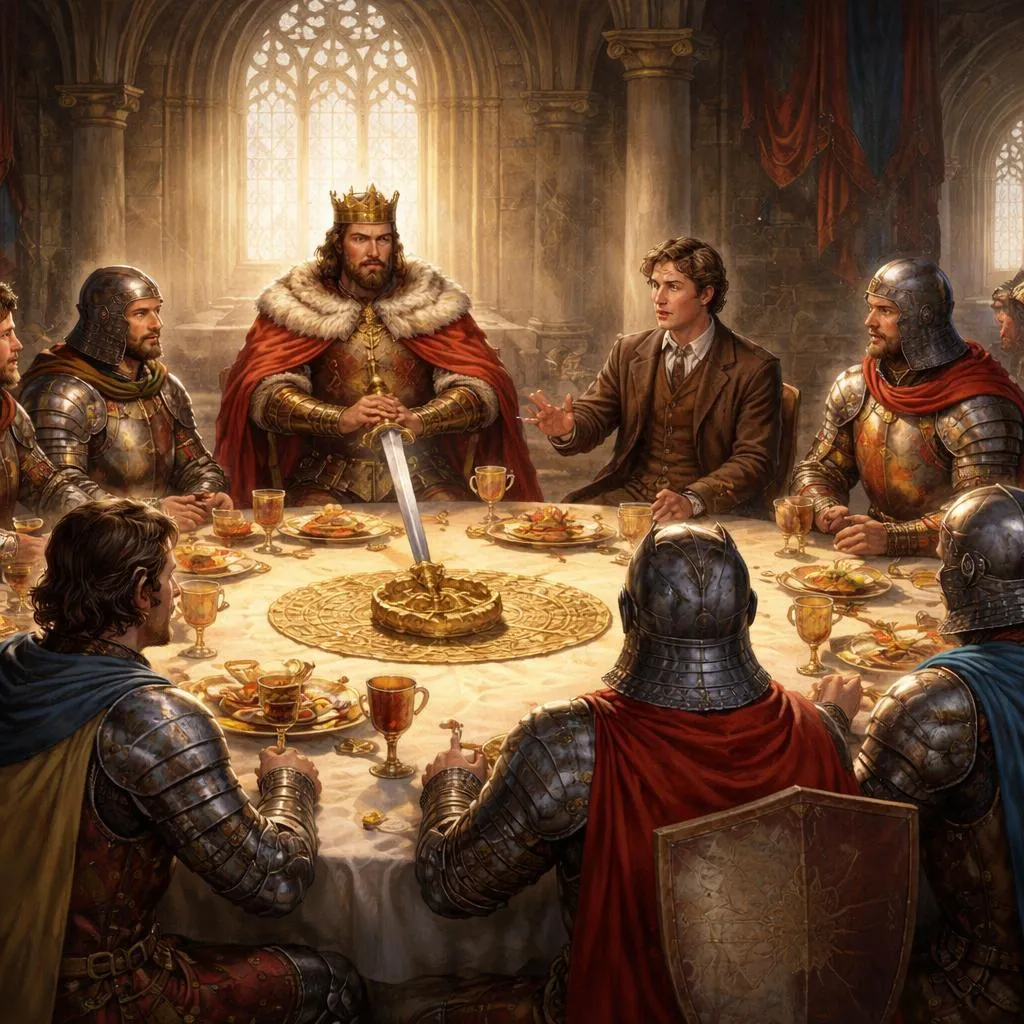

Mainly the Round Table talk was monologues—narrative accounts of the adventures in which these prisoners were captured and their friends and backers killed and stripped of their steeds and armor. As a general thing—as far as I could make out—these murderous adventures were not forays undertaken to avenge injuries, nor to settle old disputes or sudden fallings out; no, as a rule they were simply duels between strangers—duels between people who had never even been introduced to each other, and between whom existed no cause of offense whatever. Many a time I had seen a couple of boys, strangers, meet by chance, and say simultaneously, “I can lick you,” and go at it on the spot; but I had always imagined until now that that sort of thing belonged to children only, and was a sign and mark of childhood; but here were these big boobies sticking to it and taking pride in it clear up into full age and beyond. Yet there was something very engaging about these great simple-hearted creatures, something attractive and lovable. There did not seem to be brains enough in the entire nursery, so to speak, to bait a fish-hook with; but you didn’t seem to mind that, after a little, because you soon saw that brains were not needed in a society like that, and indeed would have marred it, hindered it, spoiled its symmetry—perhaps rendered its existence impossible.
There was a fine manliness observable in almost every face; and in some a certain loftiness and sweetness that rebuked your belittling criticisms and stilled them. A most noble benignity and purity reposed in the countenance of him they called Sir Galahad, and likewise in the king’s also; and there was majesty and greatness in the giant frame and high bearing of Sir Launcelot of the Lake.
There was presently an incident which centered the general interest upon this Sir Launcelot. At a sign from a sort of master of ceremonies, six or eight of the prisoners rose and came forward in a body and knelt on the floor and lifted up their hands toward the ladies’ gallery and begged the grace of a word with the queen. The most conspicuously situated lady in that massed flower-bed of feminine show and finery inclined her head by way of assent, and then the spokesman of the prisoners delivered himself and his fellows into her hands for free pardon, ransom, captivity, or death, as she in her good pleasure might elect; and this, as he said, he was doing by command of Sir Kay the Seneschal, whose prisoners they were, he having vanquished them by his single might and prowess in sturdy conflict in the field.
Surprise and astonishment flashed from face to face all over the house; the queen’s gratified smile faded out at the name of Sir Kay, and she looked disappointed; and the page whispered in my ear with an accent and manner expressive of extravagant derision—
“Sir Kay , forsooth! Oh, call me pet names, dearest, call me a marine! In twice a thousand years shall the unholy invention of man labor at odds to beget the fellow to this majestic lie!”
Every eye was fastened with severe inquiry upon Sir Kay. But he was equal to the occasion. He got up and played his hand like a major—and took every trick. He said he would state the case exactly according to the facts; he would tell the simple straightforward tale, without comment of his own; “and then,” said he, “if ye find glory and honor due, ye will give it unto him who is the mightiest man of his hands that ever bare shield or strake with sword in the ranks of Christian battle—even him that sitteth there!” and he pointed to Sir Launcelot. Ah, he fetched them; it was a rattling good stroke. Then he went on and told how Sir Launcelot, seeking adventures, some brief time gone by, killed seven giants at one sweep of his sword, and set a hundred and forty-two captive maidens free; and then went further, still seeking adventures, and found him (Sir Kay) fighting a desperate fight against nine foreign knights, and straightway took the battle solely into his own hands, and conquered the nine; and that night Sir Launcelot rose quietly, and dressed him in Sir Kay’s armor and took Sir Kay’s horse and gat him away into distant lands, and vanquished sixteen knights in one pitched battle and thirty-four in another; and all these and the former nine he made to swear that about Whitsuntide they would ride to Arthur’s court and yield them to Queen Guenever’s hands as captives of Sir Kay the Seneschal, spoil of his knightly prowess; and now here were these half dozen, and the rest would be along as soon as they might be healed of their desperate wounds.
Well, it was touching to see the queen blush and smile, and look embarrassed and happy, and fling furtive glances at Sir Launcelot that would have got him shot in Arkansas, to a dead certainty.
Everybody praised the valor and magnanimity of Sir Launcelot; and as for me, I was perfectly amazed, that one man, all by himself, should have been able to beat down and capture such battalions of practiced fighters. I said as much to Clarence; but this mocking featherhead only said:
“An Sir Kay had had time to get another skin of sour wine into him, ye had seen the accompt doubled.”
I looked at the boy in sorrow; and as I looked I saw the cloud of a deep despondency settle upon his countenance. I followed the direction of his eye, and saw that a very old and white-bearded man, clothed in a flowing black gown, had risen and was standing at the table upon unsteady legs, and feebly swaying his ancient head and surveying the company with his watery and wandering eye. The same suffering look that was in the page’s face was observable in all the faces around—the look of dumb creatures who know that they must endure and make no moan.
“Marry, we shall have it again,” sighed the boy; “that same old weary tale that he hath told a thousand times in the same words, and that he will tell till he dieth, every time he hath gotten his barrel full and feeleth his exaggeration-mill a-working. Would God I had died or I saw this day!”
“Who is it?”
“Merlin, the mighty liar and magician, perdition singe him for the weariness he worketh with his one tale! But that men fear him for that he hath the storms and the lightnings and all the devils that be in hell at his beck and call, they would have dug his entrails out these many years ago to get at that tale and squelch it. He telleth it always in the third person, making believe he is too modest to glorify himself—maledictions light upon him, misfortune be his dole! Good friend, prithee call me for evensong.”
The boy nestled himself upon my shoulder and pretended to go to sleep. The old man began his tale; and presently the lad was asleep in reality; so also were the dogs, and the court, the lackeys, and the files of men-at-arms. The droning voice droned on; a soft snoring arose on all sides and supported it like a deep and subdued accompaniment of wind instruments. Some heads were bowed upon folded arms, some lay back with open mouths that issued unconscious music; the flies buzzed and bit, unmolested, the rats swarmed softly out from a hundred holes, and pattered about, and made themselves at home everywhere; and one of them sat up like a squirrel on the king’s head and held a bit of cheese in its hands and nibbled it, and dribbled the crumbs in the king’s face with naive and impudent irreverence. It was a tranquil scene, and restful to the weary eye and the jaded spirit.
This was the old man’s tale. He said:
“Right so the king and Merlin departed, and went until an hermit that was a good man and a great leech. So the hermit searched all his wounds and gave him good salves; so the king was there three days, and then were his wounds well amended that he might ride and go, and so departed. And as they rode, Arthur said, I have no sword. No force,* [*Footnote from M.T.: No matter.] said Merlin, hereby is a sword that shall be yours and I may. So they rode till they came to a lake, the which was a fair water and broad, and in the midst of the lake Arthur was ware of an arm clothed in white samite, that held a fair sword in that hand. Lo, said Merlin, yonder is that sword that I spake of. With that they saw a damsel going upon the lake. What damsel is that? said Arthur. That is the Lady of the lake, said Merlin; and within that lake is a rock, and therein is as fair a place as any on earth, and richly beseen, and this damsel will come to you anon, and then speak ye fair to her that she will give you that sword. Anon withal came the damsel unto Arthur and saluted him, and he her again. Damsel, said Arthur, what sword is that, that yonder the arm holdeth above the water? I would it were mine, for I have no sword. Sir Arthur King, said the damsel, that sword is mine, and if ye will give me a gift when I ask it you, ye shall have it. By my faith, said Arthur, I will give you what gift ye will ask. Well, said the damsel, go ye into yonder barge and row yourself to the sword, and take it and the scabbard with you, and I will ask my gift when I see my time. So Sir Arthur and Merlin alight, and tied their horses to two trees, and so they went into the ship, and when they came to the sword that the hand held, Sir Arthur took it up by the handles, and took it with him. And the arm and the hand went under the water; and so they came unto the land and rode forth. And then Sir Arthur saw a rich pavilion. What signifieth yonder pavilion? It is the knight’s pavilion, said Merlin, that ye fought with last, Sir Pellinore, but he is out, he is not there; he hath ado with a knight of yours, that hight Egglame, and they have fought together, but at the last Egglame fled, and else he had been dead, and he hath chased him even to Carlion, and we shall meet with him anon in the highway. That is well said, said Arthur, now have I a sword, now will I wage battle with him, and be avenged on him. Sir, ye shall not so, said Merlin, for the knight is weary of fighting and chasing, so that ye shall have no worship to have ado with him; also, he will not lightly be matched of one knight living; and therefore it is my counsel, let him pass, for he shall do you good service in short time, and his sons, after his days. Also ye shall see that day in short space ye shall be right glad to give him your sister to wed. When I see him, I will do as ye advise me, said Arthur. Then Sir Arthur looked on the sword, and liked it passing well. Whether liketh you better, said Merlin, the sword or the scabbard? Me liketh better the sword, said Arthur. Ye are more unwise, said Merlin, for the scabbard is worth ten of the sword, for while ye have the scabbard upon you ye shall never lose no blood, be ye never so sore wounded; therefore, keep well the scabbard always with you. So they rode into Carlion, and by the way they met with Sir Pellinore; but Merlin had done such a craft that Pellinore saw not Arthur, and he passed by without any words. I marvel, said Arthur, that the knight would not speak. Sir, said Merlin, he saw you not; for and he had seen you ye had not lightly departed. So they came unto Carlion, whereof his knights were passing glad. And when they heard of his adventures they marveled that he would jeopard his person so alone. But all men of worship said it was merry to be under such a chieftain that would put his person in adventure as other poor knights did.”
Pengantar Latar Belakang dan Penulis
Kutipan yang baru saja Anda baca adalah bagian yang terinspirasi oleh kisah-kisah legendaris Raja Arthur dan Ksatria Meja Bundarnya, tema sentral dalam sastra dan cerita rakyat abad pertengahan. Kisah-kisah ini telah diceritakan dan diceritakan kembali selama berabad-abad, dengan banyak versi oleh penulis yang berbeda. Penulis abad pertengahan paling terkenal yang terkait dengan kisah-kisah ini adalah Sir Thomas Malory, yang menyusun dan menulis Le Morte d'Arthur pada abad ke-15. Karyanya mengumpulkan berbagai legenda Arthur menjadi satu narasi, membentuk persepsi modern tentang istana Raja Arthur, para ksatria, dan petualangan kesatria mereka.
Kutipan tersebut mencerminkan cita-cita kesatriaan tentang keberanian, kehormatan, dan kesetiaan yang sangat dihargai dalam masyarakat abad pertengahan. Ia juga memperkenalkan tokoh-tokoh kunci seperti Sir Launcelot, Sir Kay, Ratu Guinevere, dan Merlin, yang merupakan tokoh utama dalam legenda Arthur. Latar cerita adalah dunia abad pertengahan mitos di mana para ksatria terlibat dalam pencarian dan pertempuran, dan sihir serta mistisisme terjalin dengan urusan manusia.
Interpretasi dan Signifikansi Terperinci
Bagian ini menyoroti beberapa tema penting:
-
Kesatriaan dan Kehormatan: Duel dan pertempuran para ksatria tidak didorong oleh dendam pribadi tetapi oleh kode kehormatan dan pengejaran kejayaan. Hal ini mencerminkan cita-cita abad pertengahan bahwa para ksatria harus berani dan mulia, berjuang untuk keadilan dan melindungi yang lemah.
-
Persahabatan dan Kesetiaan: Prestasi keberanian Sir Launcelot, termasuk menyelamatkan tahanan dan melawan banyak musuh sendirian, menunjukkan kesetiaan kepada teman-temannya dan dedikasi pada tujuan raja.
-
Peran Sihir dan Misteri: Kehadiran Merlin dan pedang ajaib dari Lady of the Lake memperkenalkan unsur supranatural, yang merupakan motif berulang dalam kisah-kisah Arthur. Hal ini menambah lapisan keajaiban dan melambangkan gagasan bahwa takdir dan nasib membimbing para pahlawan.
-
Sifat Manusia dan Pertumbuhan: Perbandingan antara perkelahian kekanak-kanakan dan duel para ksatria menunjukkan refleksi tentang sifat manusia—bagaimana kebanggaan dan konflik tetap ada hingga dewasa, tetapi juga bagaimana kualitas-kualitas ini dapat disalurkan ke dalam pengejaran yang mulia.
Pelajaran dan Wawasan untuk Siswa
Membaca tentang Ksatria Meja Bundar menawarkan pelajaran berharga bagi pembaca muda:
-
Keberanian dalam Menghadapi Kesulitan: Keberanian Sir Launcelot mendorong siswa untuk menghadapi tantangan dengan berani, baik di sekolah, olahraga, atau kehidupan pribadi.
-
Pentingnya Integritas: Kepatuhan para ksatria pada kode etik mengajarkan nilai kejujuran, keadilan, dan rasa hormat terhadap orang lain.
-
Kerja Tim dan Dukungan: Para ksatria mengandalkan kekuatan satu sama lain dan saling melindungi, menunjukkan bagaimana kerja sama mengarah pada kesuksesan.
-
Menghormati Perbedaan: Kisah ini menunjukkan para ksatria bertarung dengan orang asing tanpa kebencian pribadi, mengingatkan pembaca untuk mendekati konflik dengan keadilan dan menghindari permusuhan yang tidak perlu.
-
Menghargai Sejarah dan Budaya: Belajar tentang legenda Arthur menghubungkan siswa dengan tradisi sastra yang kaya yang telah memengaruhi cerita modern, film, dan budaya populer.
Menerapkan Nilai-Nilai Ini dalam Kehidupan Sehari-hari
Siswa dapat menerapkan semangat dari kisah-kisah ini dalam banyak hal:
-
Di Sekolah: Dekati studi dengan tekad dan kejujuran. Bantu teman sekelas dan bekerja sama dalam proyek, seperti halnya para ksatria saling mendukung.
-
Dalam Persahabatan: Latih kesetiaan dan kebaikan. Bela teman dan selesaikan konflik secara damai.
-
Dalam Pertumbuhan Pribadi: Hadapi ketakutan dan tantangan dengan berani. Belajar dari kesalahan dan berusaha untuk meningkatkan diri, seperti halnya para ksatria mencari petualangan baru untuk membuktikan diri.
-
Dalam Komunitas: Tunjukkan rasa hormat kepada orang lain, bahkan mereka yang berbeda atau tidak dikenal. Promosikan keadilan dan kebaikan dalam interaksi sosial.
Mengembangkan Sifat Positif yang Terinspirasi oleh Kisah
Untuk mengembangkan kualitas mulia yang ditunjukkan oleh para ksatria, siswa dapat:
-
Menetapkan Tujuan Pribadi: Seperti para ksatria yang mencari pencarian, tetapkan tantangan untuk diri sendiri untuk mengembangkan keterampilan dan karakter Anda.
-
Berlatih Disiplin Diri: Ikuti aturan dan hormati orang lain, memahami bahwa kekuatan sejati berasal dari pengendalian diri.
-
Membaca Secara Luas: Jelajahi lebih banyak legenda dan cerita untuk mendapatkan wawasan tentang budaya dan pelajaran moral yang berbeda.
-
Terlibat dalam Kegiatan Tim: Bergabunglah dengan klub, olahraga, atau proyek kelompok untuk membangun kerja tim dan keterampilan kepemimpinan.
-
Renungkan Tindakan: Pikirkan bagaimana pilihan Anda memengaruhi orang lain dan berusahalah untuk bertindak dengan kebaikan dan kehormatan.
Kesimpulan
Kisah-kisah Raja Arthur dan para ksatria-Nya lebih dari sekadar petualangan yang mengasyikkan; mereka kaya dengan pelajaran tentang keberanian, kehormatan, persahabatan, dan semangat manusia. Dengan membaca dan merenungkan kisah-kisah ini, siswa dapat menemukan inspirasi untuk menghadapi tantangan mereka sendiri dengan keberanian dan integritas, membangun hubungan yang kuat, dan tumbuh menjadi individu yang bijaksana dan mulia. Legenda abadi ini terus mengajari kita bagaimana hidup dengan martabat dan tujuan di dunia yang kompleks.
