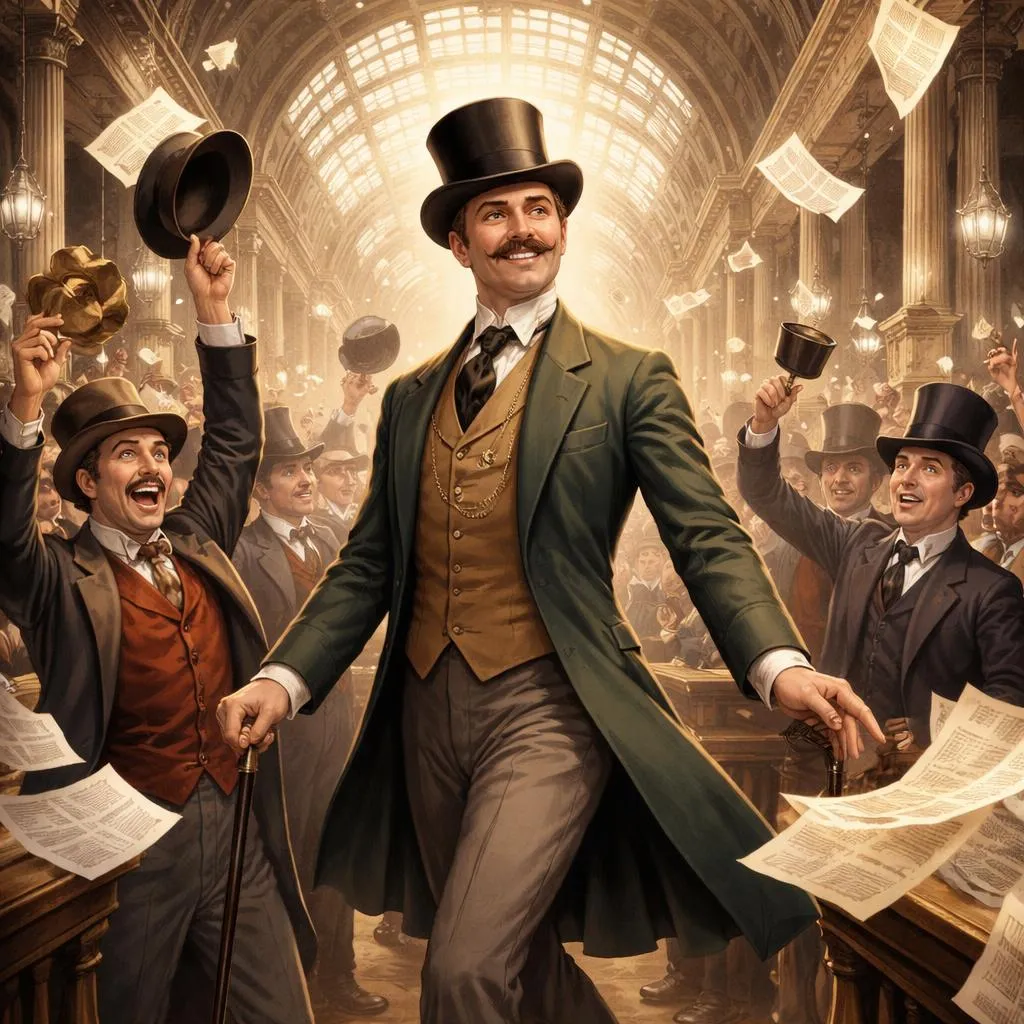

It is time to relate what a change took place in English public opinion when it transpired that the real bankrobber, a certain James Strand, had been arrested, on the 17th day of December, at Edinburgh. Three days before, Phileas Fogg had been a criminal, who was being desperately followed up by the police; now he was an honourable gentleman, mathematically pursuing his eccentric journey round the world.
The papers resumed their discussion about the wager; all those who had laid bets, for or against him, revived their interest, as if by magic; the "Phileas Fogg bonds" again became negotiable, and many new wagers were made. Phileas Fogg's name was once more at a premium on 'Change.
His five friends of the Reform Club passed these three days in a state of feverish suspense. Would Phileas Fogg, whom they had forgotten, reappear before their eyes! Where was he at this moment? The 17th of December, the day of James Strand's arrest, was the seventy–sixth since Phileas Fogg's departure, and no news of him had been received. Was he dead? Had he abandoned the effort, or was he continuing his journey along the route agreed upon? And would he appear on Saturday, the 21st of December, at a quarter before nine in the evening, on the threshold of the Reform Club saloon?
The anxiety in which, for three days, London society existed, cannot be described. Telegrams were sent to America and Asia for news of Phileas Fogg. Messengers were dispatched to the house in Saville Row morning and evening. No news. The police were ignorant what had become of the detective, Fix, who had so unfortunately followed up a false scent. Bets increased, nevertheless, in number and value. Phileas Fogg, like a racehorse, was drawing near his last turning–point. The bonds were quoted, no longer at a hundred below par, but at twenty, at ten, and at five; and paralytic old Lord Albemarle bet even in his favour.
A great crowd was collected in Pall Mall and the neighbouring streets on Saturday evening; it seemed like a multitude of brokers permanently established around the Reform Club. Circulation was impeded, and everywhere disputes, discussions, and financial transactions were going on. The police had great difficulty in keeping back the crowd, and as the hour when Phileas Fogg was due approached, the excitement rose to its highest pitch.
The five antagonists of Phileas Fogg had met in the great saloon of the club. John Sullivan and Samuel Fallentin, the bankers, Andrew Stuart, the engineer, Gauthier Ralph, the director of the Bank of England, and Thomas Flanagan, the brewer, one and all waited anxiously.
When the clock indicated twenty minutes past eight, Andrew Stuart got up, saying, "Gentlemen, in twenty minutes the time agreed upon between Mr. Fogg and ourselves will have expired."
"What time did the last train arrive from Liverpool?" asked Thomas Flanagan.
"At twenty–three minutes past seven," replied Gauthier Ralph; "and the next does not arrive till ten minutes after twelve."
"Well, gentlemen," resumed Andrew Stuart, "if Phileas Fogg had come in the 7:23 train, he would have got here by this time. We can, therefore, regard the bet as won."
"Wait; don't let us be too hasty," replied Samuel Fallentin. "You know that Mr. Fogg is very eccentric. His punctuality is well known; he never arrives too soon, or too late; and I should not be surprised if he appeared before us at the last minute."
"Why," said Andrew Stuart nervously, "if I should see him, I should not believe it was he."
"The fact is," resumed Thomas Flanagan, "Mr. Fogg's project was absurdly foolish. Whatever his punctuality, he could not prevent the delays which were certain to occur; and a delay of only two or three days would be fatal to his tour."
"Observe, too," added John Sullivan, "that we have received no intelligence from him, though there are telegraphic lines all along is route."
"He has lost, gentleman," said Andrew Stuart, "he has a hundred times lost! You know, besides, that the China the only steamer he could have taken from New York to get here in time arrived yesterday. I have seen a list of the passengers, and the name of Phileas Fogg is not among them. Even if we admit that fortune has favoured him, he can scarcely have reached America. I think he will be at least twenty days behind–hand, and that Lord Albemarle will lose a cool five thousand."
"It is clear," replied Gauthier Ralph; "and we have nothing to do but to present Mr. Fogg's cheque at Barings to–morrow."
At this moment, the hands of the club clock pointed to twenty minutes to nine.
"Five minutes more," said Andrew Stuart.
The five gentlemen looked at each other. Their anxiety was becoming intense; but, not wishing to betray it, they readily assented to Mr. Fallentin's proposal of a rubber.
"I wouldn't give up my four thousand of the bet," said Andrew Stuart, as he took his seat, "for three thousand nine hundred and ninety–nine."
The clock indicated eighteen minutes to nine.
The players took up their cards, but could not keep their eyes off the clock. Certainly, however secure they felt, minutes had never seemed so long to them!
"Seventeen minutes to nine," said Thomas Flanagan, as he cut the cards which Ralph handed to him.
Then there was a moment of silence. The great saloon was perfectly quiet; but the murmurs of the crowd outside were heard, with now and then a shrill cry. The pendulum beat the seconds, which each player eagerly counted, as he listened, with mathematical regularity.
"Sixteen minutes to nine!" said John Sullivan, in a voice which betrayed his emotion.
One minute more, and the wager would be won. Andrew Stuart and his partners suspended their game. They left their cards, and counted the seconds.
At the fortieth second, nothing. At the fiftieth, still nothing.
At the fifty–fifth, a loud cry was heard in the street, followed by applause, hurrahs, and some fierce growls.
The players rose from their seats.
At the fifty–seventh second the door of the saloon opened; and the pendulum had not beat the sixtieth second when Phileas Fogg appeared, followed by an excited crowd who had forced their way through the club doors, and in his calm voice, said, "Here I am, gentlemen!"
Latar Belakang dan Pengantar Penulis
Kutipan ini berasal dari novel petualangan klasik Keliling Dunia dalam Delapan Puluh Hari karya Jules Verne, seorang penulis Prancis yang dikenal karena karya-karyanya yang menjadi pelopor dalam fiksi ilmiah dan sastra petualangan. Ditulis pada tahun 1873, novel ini menangkap semangat abad ke-19—masa kemajuan teknologi yang pesat dan eksplorasi global. Gaya bercerita Verne yang imajinatif dan deskripsi yang detail membuat karya-karyanya abadi, menginspirasi generasi pembaca untuk bermimpi tentang tempat-tempat yang jauh dan eksploitasi yang berani.
Interpretasi dan Signifikansi yang Detail
Kisah ini berkisah tentang Phileas Fogg, seorang pria Inggris yang teliti dan metodis yang bertaruh bahwa ia dapat mengelilingi dunia hanya dalam waktu delapan puluh hari. Kutipan ini menangkap klimaks dari kisah tersebut, di mana opini publik berubah secara dramatis saat nasib Fogg berada dalam keseimbangan. Awalnya dicurigai melakukan kejahatan, kehormatan dan tekad Fogg dipulihkan ketika pelaku sebenarnya tertangkap. Ketegangan meningkat saat waktu terus berjalan hingga saat terakhir taruhan, yang berpuncak pada kembalinya Fogg dengan penuh kemenangan.
Adegan ini menyoroti tema ketekunan, ketepatan waktu, dan kemenangan kehendak manusia melawan rintangan yang tampaknya mustahil. Hal ini juga mencerminkan ketertarikan era Victoria terhadap kemajuan, ketepatan waktu, dan perluasan jangkauan Kekaisaran Inggris. Kisah ini dengan cerdik menggabungkan petualangan dengan kritik halus terhadap norma-norma sosial dan nilai yang ditempatkan pada penampilan dan reputasi.
Pelajaran dan Inspirasi untuk Siswa
-
Ketekunan dan Tekad: Perjalanan Phileas Fogg mengajarkan pentingnya tetap berkomitmen pada tujuan seseorang, bahkan ketika menghadapi kemunduran dan keraguan. Siswa dapat belajar untuk bertahan dalam studi dan tantangan pribadi mereka dengan mengadopsi pola pikir yang serupa.
-
Manajemen Waktu dan Ketepatan Waktu: Kepatuhan ketat Fogg terhadap jadwalnya adalah contoh kuat tentang bagaimana mengelola waktu secara efektif dapat mengarah pada kesuksesan. Pembaca muda dapat merenungkan bagaimana perencanaan dan ketepatan waktu membantu dalam pekerjaan sekolah dan tanggung jawab sehari-hari.
-
Berpikir Kritis dan Penilaian: Opini publik yang berfluktuasi tentang Fogg mengingatkan kita untuk tidak terburu-buru mengambil kesimpulan berdasarkan informasi yang tidak lengkap. Siswa harus mengembangkan keterampilan berpikir kritis dan menghindari penilaian yang tergesa-gesa terhadap orang lain.
-
Keberanian untuk Mengambil Risiko: Taruhan Fogg berani dan berisiko, namun mendorongnya untuk menjelajahi dunia dan berkembang. Hal ini mendorong siswa untuk keluar dari zona nyaman mereka dan menerima tantangan yang mendorong pembelajaran dan penemuan diri.
-
Ketahanan Sosial dan Emosional: Terlepas dari kecurigaan publik dan tekanan taruhan, Fogg tetap tenang dan terkendali. Hal ini mengajarkan ketahanan emosional dan nilai menjaga ketenangan di bawah tekanan.
Menerapkan Pelajaran Ini dalam Kehidupan Sehari-hari
-
Dalam Pembelajaran: Siswa dapat menetapkan tujuan dan tenggat waktu yang jelas untuk tugas mereka, seperti halnya Fogg merencanakan perjalanannya. Memecah tugas besar menjadi langkah-langkah yang lebih kecil dan berpegang pada jadwal dapat meningkatkan kinerja akademik.
-
Dalam Interaksi Sosial: Memahami pentingnya untuk tidak menilai orang lain secara prematur membantu membangun empati dan hubungan yang lebih baik. Siswa dapat berlatih mendengarkan dan mengumpulkan fakta sebelum membentuk opini.
-
Dalam Pertumbuhan Pribadi: Mengambil risiko yang diperhitungkan, seperti bergabung dengan klub baru atau mencoba hobi baru, dapat memperluas wawasan dan membangun kepercayaan diri.
-
Dalam Mengembangkan Karakter: Meniru ketenangan dan tekad Fogg dapat membantu siswa menghadapi ujian, kompetisi, atau tantangan pribadi dengan pikiran yang stabil.
Mengembangkan Sifat Positif dari Kisah Tersebut
Guru dan orang tua dapat mendorong anak-anak untuk:
- Mengembangkan rasa tanggung jawab dengan menetapkan tujuan pribadi.
- Berlatih ketepatan waktu dengan membuat rutinitas harian.
- Membangun ketahanan dengan mendiskusikan kisah-kisah mengatasi rintangan.
- Membina rasa ingin tahu tentang dunia melalui membaca dan eksplorasi.
- Menghargai nilai persahabatan dan dukungan, seperti yang terlihat pada teman-teman Fogg.
Singkatnya, Keliling Dunia dalam Delapan Puluh Hari bukan hanya petualangan yang mengasyikkan; itu adalah sumber pelajaran hidup yang kaya yang menginspirasi pembaca muda untuk bermimpi besar, bekerja keras, dan menghadapi tantangan hidup dengan keberanian dan integritas.
