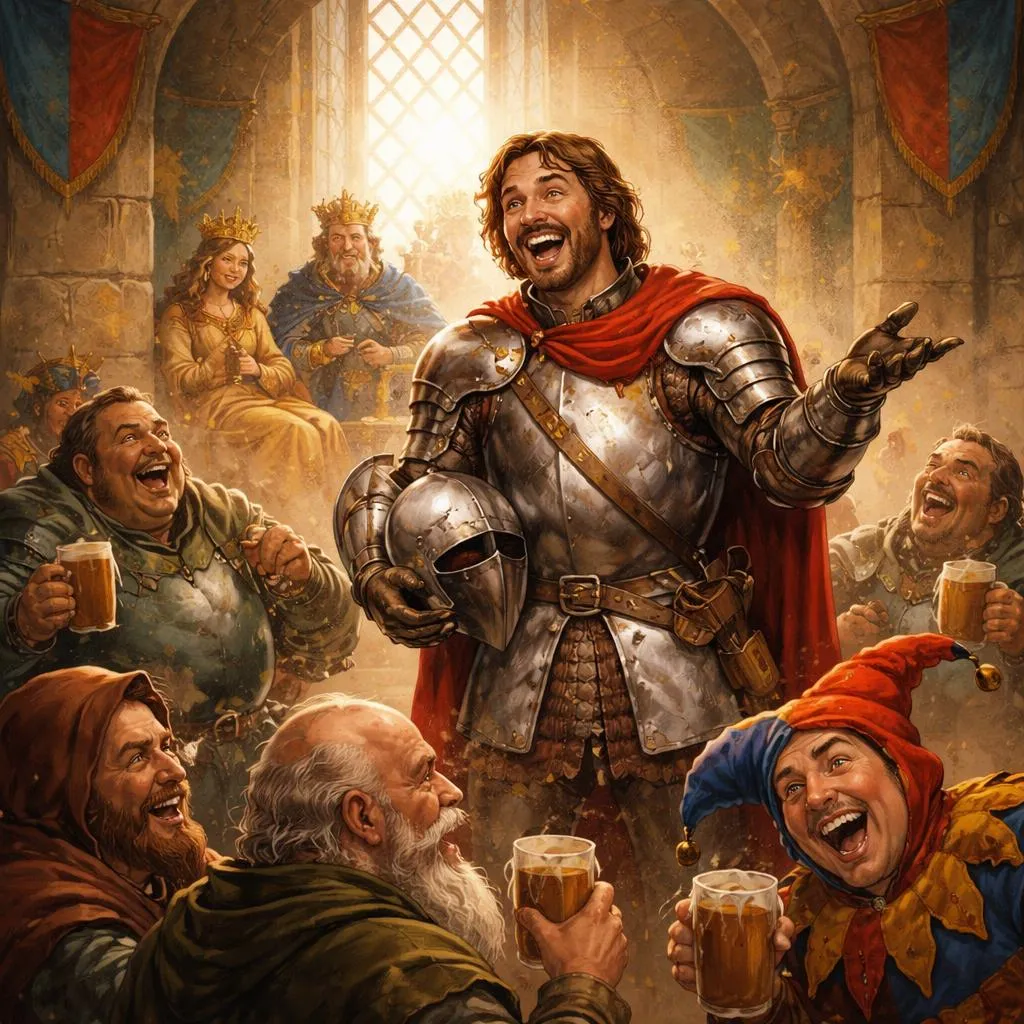

It seemed to me that this quaint lie was most simply and beautifully told; but then I had heard it only once, and that makes a difference; it was pleasant to the others when it was fresh, no doubt.
Sir Dinadan the Humorist was the first to awake, and he soon roused the rest with a practical joke of a sufficiently poor quality. He tied some metal mugs to a dog’s tail and turned him loose, and he tore around and around the place in a frenzy of fright, with all the other dogs bellowing after him and battering and crashing against everything that came in their way and making altogether a chaos of confusion and a most deafening din and turmoil; at which every man and woman of the multitude laughed till the tears flowed, and some fell out of their chairs and wallowed on the floor in ecstasy. It was just like so many children. Sir Dinadan was so proud of his exploit that he could not keep from telling over and over again, to weariness, how the immortal idea happened to occur to him; and as is the way with humorists of his breed, he was still laughing at it after everybody else had got through. He was so set up that he concluded to make a speech —of course a humorous speech. I think I never heard so many old played-out jokes strung together in my life. He was worse than the minstrels, worse than the clown in the circus. It seemed peculiarly sad to sit here, thirteen hundred years before I was born, and listen again to poor, flat, worm-eaten jokes that had given me the dry gripes when I was a boy thirteen hundred years afterwards. It about convinced me that there isn’t any such thing as a new joke possible. Everybody laughed at these antiquities —but then they always do; I had noticed that, centuries later. However, of course the scoffer didn’t laugh—I mean the boy. No, he scoffed; there wasn’t anything he wouldn’t scoff at. He said the most of Sir Dinadan’s jokes were rotten and the rest were petrified. I said “petrified” was good; as I believed, myself, that the only right way to classify the majestic ages of some of those jokes was by geologic periods. But that neat idea hit the boy in a blank place, for geology hadn’t been invented yet. However, I made a note of the remark, and calculated to educate the commonwealth up to it if I pulled through. It is no use to throw a good thing away merely because the market isn’t ripe yet.
Now Sir Kay arose and began to fire up on his history-mill with me for fuel. It was time for me to feel serious, and I did. Sir Kay told how he had encountered me in a far land of barbarians, who all wore the same ridiculous garb that I did—a garb that was a work of enchantment, and intended to make the wearer secure from hurt by human hands. However he had nullified the force of the enchantment by prayer, and had killed my thirteen knights in a three hours’ battle, and taken me prisoner, sparing my life in order that so strange a curiosity as I was might be exhibited to the wonder and admiration of the king and the court. He spoke of me all the time, in the blandest way, as “this prodigious giant,” and “this horrible sky-towering monster,” and “this tusked and taloned man-devouring ogre”, and everybody took in all this bosh in the naivest way, and never smiled or seemed to notice that there was any discrepancy between these watered statistics and me. He said that in trying to escape from him I sprang into the top of a tree two hundred cubits high at a single bound, but he dislodged me with a stone the size of a cow, which “all-to brast” the most of my bones, and then swore me to appear at Arthur’s court for sentence. He ended by condemning me to die at noon on the 21st; and was so little concerned about it that he stopped to yawn before he named the date.
I was in a dismal state by this time; indeed, I was hardly enough in my right mind to keep the run of a dispute that sprung up as to how I had better be killed, the possibility of the killing being doubted by some, because of the enchantment in my clothes. And yet it was nothing but an ordinary suit of fifteen-dollar slop-shops. Still, I was sane enough to notice this detail, to wit: many of the terms used in the most matter-of-fact way by this great assemblage of the first ladies and gentlemen in the land would have made a Comanche blush. Indelicacy is too mild a term to convey the idea. However, I had read “Tom Jones,” and “Roderick Random,” and other books of that kind, and knew that the highest and first ladies and gentlemen in England had remained little or no cleaner in their talk, and in the morals and conduct which such talk implies, clear up to a hundred years ago; in fact clear into our own nineteenth century—in which century, broadly speaking, the earliest samples of the real lady and real gentleman discoverable in English history—or in European history, for that matter—may be said to have made their appearance. Suppose Sir Walter, instead of putting the conversations into the mouths of his characters, had allowed the characters to speak for themselves? We should have had talk from Rebecca and Ivanhoe and the soft lady Rowena which would embarrass a tramp in our day. However, to the unconsciously indelicate all things are delicate. King Arthur’s people were not aware that they were indecent and I had presence of mind enough not to mention it.
They were so troubled about my enchanted clothes that they were mightily relieved, at last, when old Merlin swept the difficulty away for them with a common-sense hint. He asked them why they were so dull—why didn’t it occur to them to strip me. In half a minute I was as naked as a pair of tongs! And dear, dear, to think of it: I was the only embarrassed person there. Everybody discussed me; and did it as unconcernedly as if I had been a cabbage. Queen Guenever was as naively interested as the rest, and said she had never seen anybody with legs just like mine before. It was the only compliment I got—if it was a compliment.
Finally I was carried off in one direction, and my perilous clothes in another. I was shoved into a dark and narrow cell in a dungeon, with some scant remnants for dinner, some moldy straw for a bed, and no end of rats for company.
Latar Belakang dan Pengantar Penulis
Kutipan ini berasal dari novel Mark Twain, Seorang Yankee di Pengadilan Raja Arthur, yang pertama kali diterbitkan pada tahun 1889. Twain, salah satu humoris dan kritikus sosial terbesar Amerika, menggunakan cerita ini untuk memadukan fantasi, satire, dan fiksi sejarah. Novel ini menceritakan kisah seorang insinyur Amerika abad ke-19 yang secara misterius terlempar kembali ke masa lalu, ke zaman Raja Arthur. Twain menggunakan pengaturan imajinatif ini untuk mengeksplorasi tema kemajuan, teknologi, keadilan sosial, dan sifat manusia.
Interpretasi dan Signifikansi yang Mendalam
Kutipan ini menangkap benturan lucu dan seringkali absurd antara dunia modern dan abad pertengahan. Sang protagonis, seorang pria dari masa depan, mengamati para ksatria dan bangsawan legenda Arthurian dengan campuran ironi dan ketidakpercayaan. Lelucon oleh Sir Dinadan dan kisah-kisah berlebihan yang diceritakan oleh Sir Kay menyoroti kontras antara cita-cita kesatriaan dan realitas yang seringkali konyol di baliknya.
Gaya naratif Twain menggabungkan nada yang menyenangkan dengan komentar sosial yang tajam. “Kebohongan kuno” dan “lelucon usang” melambangkan bagaimana cerita dan tradisi dapat terdistorsi atau kehilangan makna seiring waktu. Refleksi sang protagonis tentang bahasa dan tata krama masa lalu mengungkapkan kritik Twain terhadap kepura-puraan sosial dan kemunafikan, baik dalam setting abad pertengahan maupun pada zamannya sendiri.
Pakaian yang terpesona dan penahanan sang protagonis menggambarkan ketegangan antara takhayul dan akal sehat, tema yang berulang dalam novel. Nasihat praktis karakter Merlin untuk menelanjangi sang protagonis untuk mematahkan mantra tersebut mewakili kemenangan akal sehat atas kepercayaan buta.
Pelajaran dan Wawasan untuk Siswa
-
Berpikir Kritis dan Skeptisisme: Cerita ini mendorong pembaca untuk mempertanyakan kebenaran dan tradisi yang diterima. Sama seperti sang protagonis meragukan cerita para ksatria dan kekuatan mantra, siswa harus belajar untuk berpikir kritis tentang informasi dan tidak menerima semuanya begitu saja.
-
Humor sebagai Alat untuk Refleksi: Penggunaan humor oleh Twain membantu mengungkap kebodohan manusia dan kekurangan sosial. Siswa dapat menghargai bagaimana tawa dan satire dapat menjadi cara yang ampuh untuk memahami dan mengkritik dunia di sekitar mereka.
-
Memahami Konteks Sejarah: Novel ini memadukan legenda sejarah dengan gagasan modern, menunjukkan bagaimana perspektif berubah seiring waktu. Hal ini mendorong siswa untuk menjelajahi sejarah dengan pikiran terbuka dan mengenali pengaruh budaya dan waktu pada cerita dan kepercayaan.
-
Menghargai Pengetahuan dan Kemajuan: Latar belakang sang protagonis sebagai seorang insinyur melambangkan pentingnya sains dan teknologi dalam memajukan masyarakat. Siswa dapat terinspirasi untuk menghargai pendidikan dan inovasi sambil menghormati pelajaran dari masa lalu.
-
Empati dan Keterbukaan Pikiran: Pengalaman sang protagonis sebagai orang luar di dunia yang aneh mengajarkan pentingnya empati dan kemampuan beradaptasi. Siswa dapat belajar untuk menghargai budaya dan sudut pandang yang berbeda, yang sangat penting dalam masyarakat yang beragam saat ini.
Menerapkan Semangat Cerita dalam Kehidupan Sehari-hari
-
Dalam Belajar: Rangkul rasa ingin tahu dan pertanyakan asumsi. Dekati studi dengan keseimbangan skeptisisme dan keterbukaan, seperti sang protagonis yang menavigasi dunia yang asing.
-
Dalam Interaksi Sosial: Gunakan humor dengan baik untuk meredakan ketegangan dan membangun hubungan, tetapi perhatikan perasaan orang lain. Seperti lelucon Sir Dinadan, humor dapat menyatukan orang ketika digunakan dengan bijaksana.
-
Dalam Menghadapi Tantangan: Terapkan akal sehat untuk memecahkan masalah, seperti yang disarankan Merlin. Jangan takut untuk menghilangkan komplikasi yang tidak perlu untuk menemukan solusi yang jelas.
-
Dalam Mengembangkan Karakter: Kembangkan ketahanan dan kemampuan beradaptasi. Perjalanan sang protagonis menunjukkan bahwa situasi yang tidak terduga membutuhkan keberanian dan fleksibilitas.
Mendorong Nilai-nilai Positif
Siswa dapat belajar dari pengalaman sang protagonis untuk mengembangkan kebajikan seperti kejujuran, keberanian, dan kerendahan hati. Mengenali kekurangan pada orang lain dan diri sendiri dengan humor dan keanggunan membantu membangun karakter yang kuat. Novel ini juga mempromosikan nilai membela apa yang benar, mempertanyakan ketidakadilan, dan menggunakan pengetahuan secara bertanggung jawab.
Dengan membaca dan merenungkan Seorang Yankee di Pengadilan Raja Arthur, pembaca muda tidak hanya mendapatkan hiburan tetapi juga pemahaman yang lebih dalam tentang sejarah, masyarakat, dan sifat manusia. Mereka diundang untuk berpikir secara mandiri, menghargai kekuatan bercerita, dan membawa semangat penyelidikan dan kebaikan dalam kehidupan mereka sendiri.
