
The circumstances under which this telegraphic dispatch about Phileas Fogg was sent were as follows:
The steamer Mongolia, belonging to the Peninsular and Oriental Company, built of iron, of two thousand eight hundred tons burden, and five hundred horse–power, was due at eleven o'clock a.m. on Wednesday, the 9th of October, at Suez. The Mongolia plied regularly between Brindisi and Bombay via the Suez Canal, and was one of the fastest steamers belonging to the company, always making more than ten knots an hour between Brindisi and Suez, and nine and a half between Suez and Bombay.
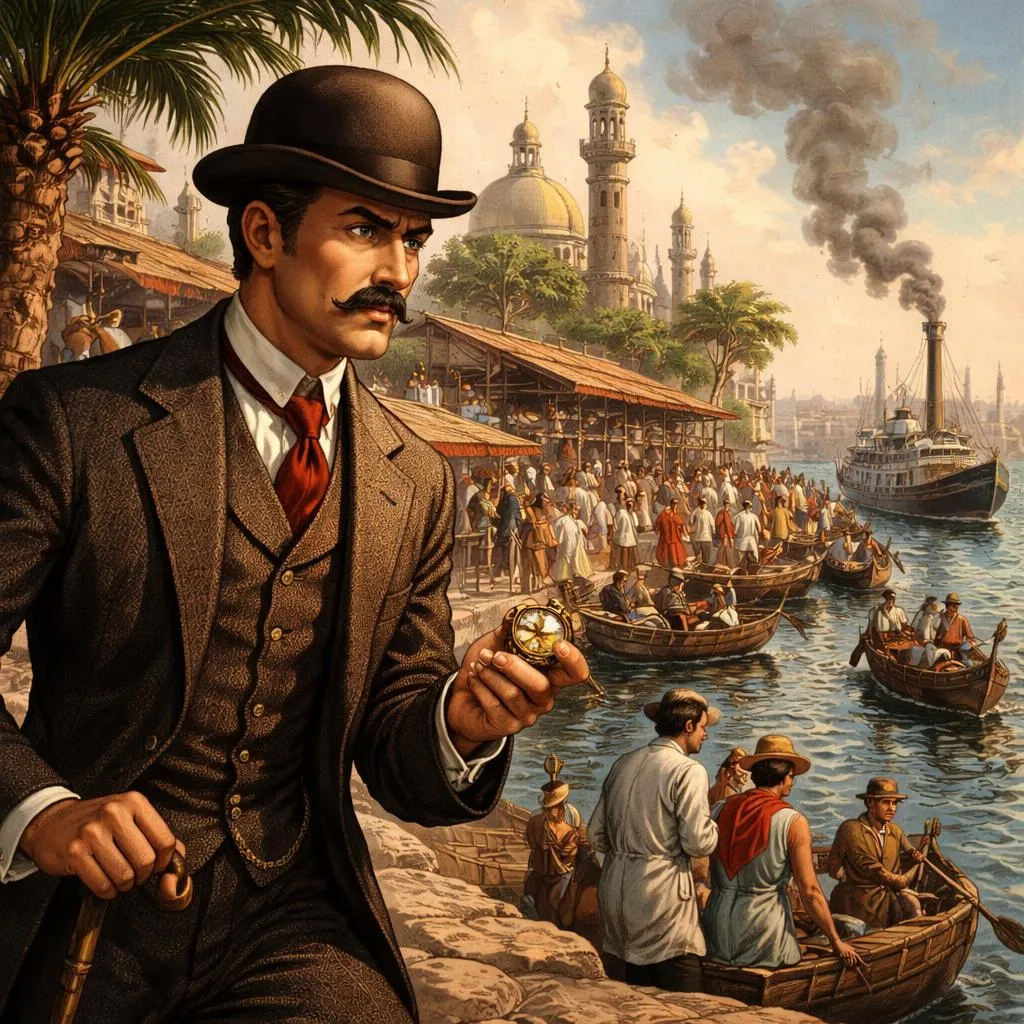
Two men were promenading up and down the wharves, among the crowd of natives and strangers who were sojourning at this once straggling village—now, thanks to the enterprise of M. Lesseps, a fast–growing town. One was the British consul at Suez, who, despite the prophecies of the English Government, and the unfavourable predictions of Stephenson, was in the habit of seeing, from his office window, English ships daily passing to and fro on the great canal, by which the old roundabout route from England to India by the Cape of Good Hope was abridged by at least a half. The other was a small, slight–built personage, with a nervous, intelligent face, and bright eyes peering out from under eyebrows which he was incessantly twitching. He was just now manifesting unmistakable signs of impatience, nervously pacing up and down, and unable to stand still for a moment. This was Fix, one of the detectives who had been dispatched from England in search of the bank robber; it was his task to narrowly watch every passenger who arrived at Suez, and to follow up all who seemed to be suspicious characters, or bore a resemblance to the description of the criminal, which he had received two days before from the police headquarters at London. The detective was evidently inspired by the hope of obtaining the splendid reward which would be the prize of success, and awaited with a feverish impatience, easy to understand, the arrival of the steamer Mongolia.
"So you say, consul," asked he for the twentieth time, "that this steamer is never behind time?"
"No, Mr. Fix," replied the consul. "She was bespoken yesterday at Port Said, and the rest of the way is of no account to such a craft. I repeat that the Mongolia has been in advance of the time required by the company's regulations, and gained the prize awarded for excess of speed."
"Does she come directly from Brindisi?"
"Directly from Brindisi; she takes on the Indian mails there, and she left there Saturday at five p.m. Have patience, Mr. Fix; she will not be late. But really, I don't see how, from the description you have, you will be able to recognise your man, even if he is on board the Mongolia."
"A man rather feels the presence of these fellows, consul, than recognises them. You must have a scent for them, and a scent is like a sixth sense which combines hearing, seeing, and smelling. I've arrested more than one of these gentlemen in my time, and, if my thief is on board, I'll answer for it; he'll not slip through my fingers."
"I hope so, Mr. Fix, for it was a heavy robbery."
"A magnificent robbery, consul; fifty–five thousand pounds! We don't often have such windfalls. Burglars are getting to be so contemptible nowadays! A fellow gets hung for a handful of shillings!"
"Mr. Fix," said the consul, "I like your way of talking, and hope you'll succeed; but I fear you will find it far from easy. Don't you see, the description which you have there has a singular resemblance to an honest man?"
"Consul," remarked the detective, dogmatically, "great robbers always resemble honest folks. Fellows who have rascally faces have only one course to take, and that is to remain honest; otherwise they would be arrested off–hand. The artistic thing is, to unmask honest countenances; it's no light task, I admit, but a real art."
Mr. Fix evidently was not wanting in a tinge of self–conceit.
Little by little the scene on the quay became more animated; sailors of various nations, merchants, ship–brokers, porters, fellahs, bustled to and fro as if the steamer were immediately expected. The weather was clear, and slightly chilly. The minarets of the town loomed above the houses in the pale rays of the sun. A jetty pier, some two thousand yards along, extended into the roadstead. A number of fishing–smacks and coasting boats, some retaining the fantastic fashion of ancient galleys, were discernible on the Red Sea.
As he passed among the busy crowd, Fix, according to habit, scrutinised the passers–by with a keen, rapid glance.
It was now half–past ten.
"The steamer doesn't come!" he exclaimed, as the port clock struck.
"She can't be far off now," returned his companion.
"How long will she stop at Suez?"
"Four hours; long enough to get in her coal. It is thirteen hundred and ten miles from Suez to Aden, at the other end of the Red Sea, and she has to take in a fresh coal supply."
"And does she go from Suez directly to Bombay?"
"Without putting in anywhere."
"Good!" said Fix. "If the robber is on board he will no doubt get off at Suez, so as to reach the Dutch or French colonies in Asia by some other route. He ought to know that he would not be safe an hour in India, which is English soil."
"Unless," objected the consul, "he is exceptionally shrewd. An English criminal, you know, is always better concealed in London than anywhere else."
This observation furnished the detective food for thought, and meanwhile the consul went away to his office. Fix, left alone, was more impatient than ever, having a presentiment that the robber was on board the Mongolia. If he had indeed left London intending to reach the New World, he would naturally take the route via India, which was less watched and more difficult to watch than that of the Atlantic. But Fix's reflections were soon interrupted by a succession of sharp whistles, which announced the arrival of the Mongolia. The porters and fellahs rushed down the quay, and a dozen boats pushed off from the shore to go and meet the steamer. Soon her gigantic hull appeared passing along between the banks, and eleven o'clock struck as she anchored in the road. She brought an unusual number of passengers, some of whom remained on deck to scan the picturesque panorama of the town, while the greater part disembarked in the boats, and landed on the quay.
Fix took up a position, and carefully examined each face and figure which made its appearance. Presently one of the passengers, after vigorously pushing his way through the importunate crowd of porters, came up to him and politely asked if he could point out the English consulate, at the same time showing a passport which he wished to have visaed. Fix instinctively took the passport, and with a rapid glance read the description of its bearer. An involuntary motion of surprise nearly escaped him, for the description in the passport was identical with that of the bank robber which he had received from Scotland Yard.
"Is this your passport?" asked he.
"No, it's my master's."
"And your master is—"
"He stayed on board."
"But he must go to the consul's in person, so as to establish his identity."
"Oh, is that necessary?"
"Quite indispensable."
"And where is the consulate?"
"There, on the corner of the square," said Fix, pointing to a house two hundred steps off.
"I'll go and fetch my master, who won't be much pleased, however, to be disturbed."
The passenger bowed to Fix, and returned to the steamer.
Pengantar Latar Belakang dan Penulis
Cuplikan ini berasal dari novel petualangan klasik Keliling Dunia dalam Delapan Puluh Hari, yang ditulis oleh penulis Prancis Jules Verne pada tahun 1873. Verne dikenal sebagai salah satu pelopor fiksi ilmiah dan sastra petualangan. Karyanya sering kali menggabungkan pengetahuan ilmiah yang mendetail dengan penceritaan yang menarik, menginspirasi generasi pembaca untuk menjelajahi dunia dan membayangkan kemungkinan-kemungkinan baru. Keliling Dunia dalam Delapan Puluh Hari menangkap semangat abad ke-19 yang terpesona dengan perjalanan, teknologi, dan eksplorasi, berpusat pada perjalanan berani Phileas Fogg, seorang pria Inggris yang teliti yang bertaruh bahwa ia dapat mengelilingi dunia hanya dalam waktu delapan puluh hari.
Interpretasi dan Signifikansi Cerita yang Mendetail
Dalam bagian ini, kita melihat detektif Fix dengan cemas menunggu kedatangan kapal uap Mongolia di Terusan Suez, berharap dapat menangkap perampok bank yang diyakini berada di kapal. Adegan itu hidup dan ramai, menunjukkan pentingnya Terusan Suez sebagai titik strategis yang menghubungkan Eropa dan Asia. Dialog antara Fix dan konsul Inggris menyoroti tema kecurigaan, identitas, dan tantangan membedakan kebenaran dari penampilan. Keyakinan Fix bahwa penjahat besar seringkali terlihat seperti orang jujur menambah lapisan ironi dan kompleksitas pada cerita, mengingatkan pembaca bahwa penampilan bisa menipu.
Bagian cerita ini menjadi dasar bagi ketegangan dan intrik yang akan mengikuti saat perjalanan Phileas Fogg terungkap. Hal ini juga mencerminkan kemajuan teknologi pada era tersebut—kapal uap, telegraf, dan komunikasi global—yang memungkinkan perjalanan seperti itu dan menangkap imajinasi pembaca di seluruh dunia.
Pelajaran dan Wawasan untuk Siswa
-
Berpikir Kritis dan Persepsi: Kesulitan Fix dalam mengidentifikasi penjahat berdasarkan penampilan mengajarkan kita bahwa kita tidak boleh menilai orang hanya dari penampilan mereka. Sebaliknya, kita harus mengembangkan keterampilan berpikir kritis dan melihat lebih dalam fakta dan perilaku sebelum membentuk opini.
-
Kesabaran dan Observasi: Penantian Fix dan pengamatan penumpang yang cermat menunjukkan pentingnya kesabaran dan perhatian terhadap detail—keterampilan yang berharga baik dalam studi akademis maupun kehidupan sehari-hari.
-
Keberanian dan Tekad: Perjalanan Phileas Fogg, yang tersirat dalam bagian ini, adalah bukti keberanian dan tekad manusia. Siswa dapat belajar untuk menetapkan tujuan yang ambisius dan mengejarnya dengan ketekunan, bahkan ketika menghadapi ketidakpastian.
-
Nilai Teknologi dan Inovasi: Novel ini merayakan kekuatan teknologi baru seperti kapal uap dan telegraf, mendorong siswa untuk menghargai kemajuan ilmiah dan dampaknya terhadap masyarakat.
Aplikasi dalam Kehidupan, Pembelajaran, dan Situasi Sosial
-
Dalam Pembelajaran: Sama seperti Fix yang dengan hati-hati menganalisis petunjuk, siswa harus mengembangkan keterampilan observasi dan analitis yang kuat untuk memecahkan masalah dan memahami mata pelajaran yang kompleks.
-
Dalam Interaksi Sosial: Cerita ini memperingatkan agar tidak membuat penilaian cepat tentang orang lain. Siswa dapat melatih empati dan pikiran terbuka dengan mengenal orang-orang di luar kesan pertama.
-
Dalam Pertumbuhan Pribadi: Semangat petualangan dan ketahanan yang ditunjukkan oleh Fogg mendorong siswa untuk menerima tantangan dan tetap tenang di bawah tekanan, kualitas yang akan membantu mereka dalam ujian, proyek, dan karier di masa depan.
Mengembangkan Nilai-nilai Positif dari Cerita
-
Kejujuran dan Integritas: Terlepas dari kecurigaan detektif, novel ini pada akhirnya merayakan kejujuran. Siswa harus berusaha untuk menjadi dapat dipercaya dan tulus dalam tindakan mereka.
-
Rasa Ingin Tahu dan Pikiran Terbuka: Karya Verne menginspirasi rasa ingin tahu tentang dunia. Siswa dapat mengembangkan kecintaan belajar dengan menjelajahi budaya, sains, dan ide-ide baru.
-
Ketekunan: Komitmen Fogg yang tak tergoyahkan terhadap tujuannya mengajarkan pentingnya ketekunan, bahkan ketika rintangan muncul.
Kesimpulan
Keliling Dunia dalam Delapan Puluh Hari lebih dari sekadar petualangan yang mengasyikkan; itu adalah sumber pelajaran yang kaya tentang sifat manusia, teknologi, dan semangat eksplorasi. Dengan membaca dan merenungkan cerita ini, siswa dapat mengembangkan keterampilan dan sikap berharga yang akan bermanfaat bagi mereka di sekolah dan dalam kehidupan. Merangkul rasa ingin tahu, kesabaran, dan tekad yang dicontohkan dalam novel dapat membantu pembaca muda menjadi individu yang bijaksana, berani, dan berpikiran terbuka yang siap untuk menavigasi perjalanan mereka sendiri di dunia.
