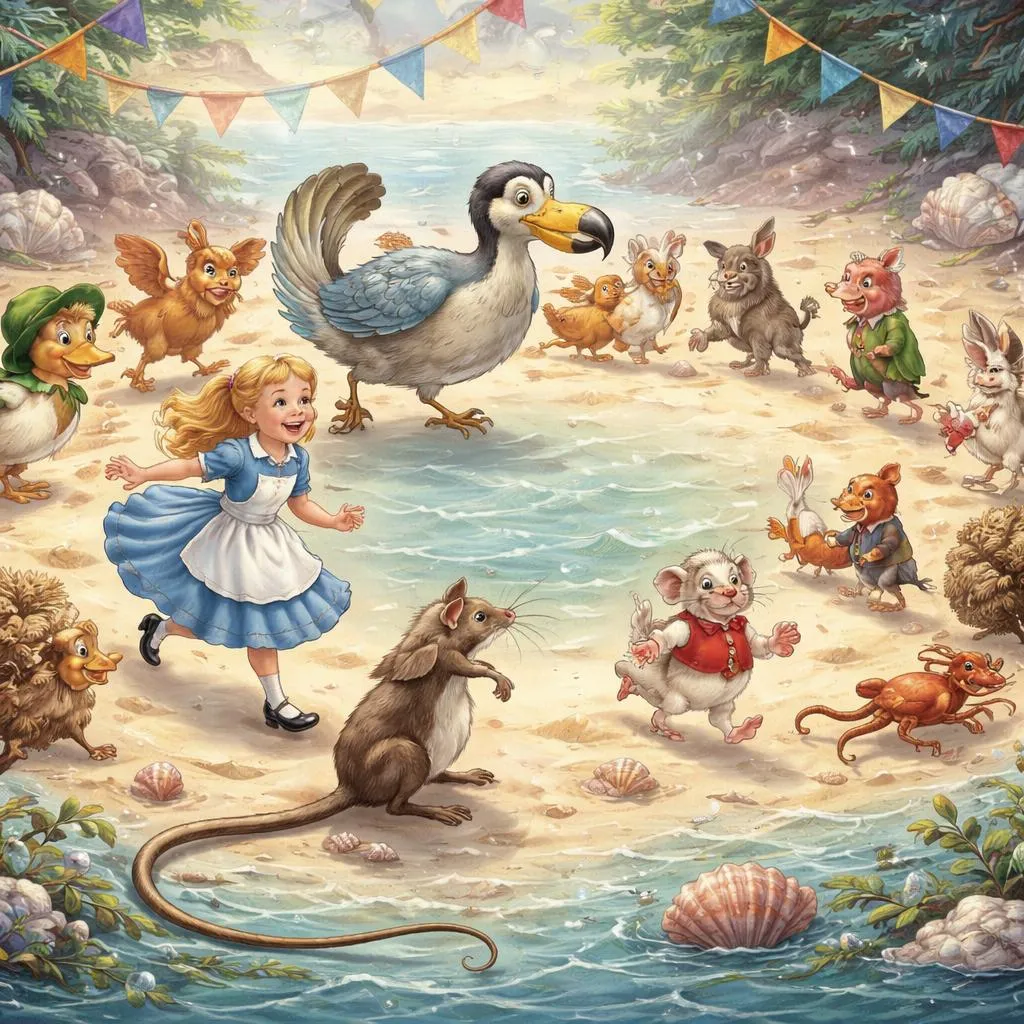

They were indeed a queer–looking party that assembled on the bank—the birds with draggled feathers, the animals with their fur clinging close to them, and all dripping wet, cross, and uncomfortable.
The first question of course was, how to get dry again: they had a consultation about this, and after a few minutes it seemed quite natural to Alice to find herself talking familiarly with them, as if she had known them all her life. Indeed, she had quite a long argument with the Lory, who at last turned sulky, and would only say, 'I am older than you, and must know better'; and this Alice would not allow without knowing how old it was, and, as the Lory positively refused to tell its age, there was no more to be said.
At last the Mouse, who seemed to be a person of authority among them, called out, 'Sit down, all of you, and listen to me! I'LL soon make you dry enough!' They all sat down at once, in a large ring, with the Mouse in the middle. Alice kept her eyes anxiously fixed on it, for she felt sure she would catch a bad cold if she did not get dry very soon.
'Ahem!' said the Mouse with an important air, 'are you all ready? This is the driest thing I know. Silence all round, if you please! "William the Conqueror, whose cause was favoured by the pope, was soon submitted to by the English, who wanted leaders, and had been of late much accustomed to usurpation and conquest. Edwin and Morcar, the earls of Mercia and Northumbria—"'
'Ugh!' said the Lory, with a shiver.
'I beg your pardon!' said the Mouse, frowning, but very politely: 'Did you speak?'
'Not I!' said the Lory hastily.
'I thought you did,' said the Mouse. '—I proceed. "Edwin and Morcar, the earls of Mercia and Northumbria, declared for him: and even Stigand, the patriotic archbishop of Canterbury, found it advisable—"'
'Found WHAT?' said the Duck.
'Found IT,' the Mouse replied rather crossly: 'of course you know what "it" means.'
'I know what "it" means well enough, when I find a thing,' said the Duck: 'it's generally a frog or a worm. The question is, what did the archbishop find?'
The Mouse did not notice this question, but hurriedly went on, '"—found it advisable to go with Edgar Atheling to meet William and offer him the crown. William's conduct at first was moderate. But the insolence of his Normans—" How are you getting on now, my dear?' it continued, turning to Alice as it spoke.
'As wet as ever,' said Alice in a melancholy tone: 'it doesn't seem to dry me at all.'
'In that case,' said the Dodo solemnly, rising to its feet, 'I move that the meeting adjourn, for the immediate adoption of more energetic remedies—'
'Speak English!' said the Eaglet. 'I don't know the meaning of half those long words, and, what's more, I don't believe you do either!' And the Eaglet bent down its head to hide a smile: some of the other birds tittered audibly.
'What I was going to say,' said the Dodo in an offended tone, 'was, that the best thing to get us dry would be a Caucus–race.'
'What IS a Caucus–race?' said Alice; not that she wanted much to know, but the Dodo had paused as if it thought that SOMEBODY ought to speak, and no one else seemed inclined to say anything.
'Why,' said the Dodo, 'the best way to explain it is to do it.' (And, as you might like to try the thing yourself, some winter day, I will tell you how the Dodo managed it.)
First it marked out a race–course, in a sort of circle, ('the exact shape doesn't matter,' it said,) and then all the party were placed along the course, here and there. There was no 'One, two, three, and away,' but they began running when they liked, and left off when they liked, so that it was not easy to know when the race was over. However, when they had been running half an hour or so, and were quite dry again, the Dodo suddenly called out 'The race is over!' and they all crowded round it, panting, and asking, 'But who has won?'
This question the Dodo could not answer without a great deal of thought, and it sat for a long time with one finger pressed upon its forehead (the position in which you usually see Shakespeare, in the pictures of him), while the rest waited in silence. At last the Dodo said, 'EVERYBODY has won, and all must have prizes.'
'But who is to give the prizes?' quite a chorus of voices asked.
'Why, SHE, of course,' said the Dodo, pointing to Alice with one finger; and the whole party at once crowded round her, calling out in a confused way, 'Prizes! Prizes!'
Alice had no idea what to do, and in despair she put her hand in her pocket, and pulled out a box of comfits, (luckily the salt water had not got into it), and handed them round as prizes. There was exactly one a–piece all round.
'But she must have a prize herself, you know,' said the Mouse.
'Of course,' the Dodo replied very gravely. 'What else have you got in your pocket?' he went on, turning to Alice.
'Only a thimble,' said Alice sadly.
'Hand it over here,' said the Dodo.
Then they all crowded round her once more, while the Dodo solemnly presented the thimble, saying 'We beg your acceptance of this elegant thimble'; and, when it had finished this short speech, they all cheered.
Alice thought the whole thing very absurd, but they all looked so grave that she did not dare to laugh; and, as she could not think of anything to say, she simply bowed, and took the thimble, looking as solemn as she could.
The next thing was to eat the comfits: this caused some noise and confusion, as the large birds complained that they could not taste theirs, and the small ones choked and had to be patted on the back. However, it was over at last, and they sat down again in a ring, and begged the Mouse to tell them something more.
'You promised to tell me your history, you know,' said Alice, 'and why it is you hate—C and D,' she added in a whisper, half afraid that it would be offended again.
'Mine is a long and a sad tale!' said the Mouse, turning to Alice, and sighing.
'It IS a long tail, certainly,' said Alice, looking down with wonder at the Mouse's tail; 'but why do you call it sad?' And she kept on puzzling about it while the Mouse was speaking, so that her idea of the tale was something like this:—
'Fury said to a mouse, That he met in the house, "Let us both go to law: I will prosecute YOU.—Come, I'll take no denial; We must have a trial: For really this morning I've nothing to do." Said the mouse to the cur, "Such a trial, dear Sir, With no jury or judge, would be wasting our breath." "I'll be judge, I'll be jury," Said cunning old Fury: "I'll try the whole cause, and condemn you to death."'
'You are not attending!' said the Mouse to Alice severely. 'What are you thinking of?'
'I beg your pardon,' said Alice very humbly: 'you had got to the fifth bend, I think?'
'I had NOT!' cried the Mouse, sharply and very angrily.
'A knot!' said Alice, always ready to make herself useful, and looking anxiously about her. 'Oh, do let me help to undo it!'
'I shall do nothing of the sort,' said the Mouse, getting up and walking away. 'You insult me by talking such nonsense!'
'I didn't mean it!' pleaded poor Alice. 'But you're so easily offended, you know!'
The Mouse only growled in reply.
'Please come back and finish your story!' Alice called after it; and the others all joined in chorus, 'Yes, please do!' but the Mouse only shook its head impatiently, and walked a little quicker.
'What a pity it wouldn't stay!' sighed the Lory, as soon as it was quite out of sight; and an old Crab took the opportunity of saying to her daughter 'Ah, my dear! Let this be a lesson to you never to lose YOUR temper!' 'Hold your tongue, Ma!' said the young Crab, a little snappishly. 'You're enough to try the patience of an oyster!'
'I wish I had our Dinah here, I know I do!' said Alice aloud, addressing nobody in particular. 'She'd soon fetch it back!'
'And who is Dinah, if I might venture to ask the question?' said the Lory.
Alice replied eagerly, for she was always ready to talk about her pet: 'Dinah's our cat. And she's such a capital one for catching mice you can't think! And oh, I wish you could see her after the birds! Why, she'll eat a little bird as soon as look at it!'
This speech caused a remarkable sensation among the party. Some of the birds hurried off at once: one old Magpie began wrapping itself up very carefully, remarking, 'I really must be getting home; the night–air doesn't suit my throat!' and a Canary called out in a trembling voice to its children, 'Come away, my dears! It's high time you were all in bed!' On various pretexts they all moved off, and Alice was soon left alone.
'I wish I hadn't mentioned Dinah!' she said to herself in a melancholy tone. 'Nobody seems to like her, down here, and I'm sure she's the best cat in the world! Oh, my dear Dinah! I wonder if I shall ever see you any more!' And here poor Alice began to cry again, for she felt very lonely and low–spirited. In a little while, however, she again heard a little pattering of footsteps in the distance, and she looked up eagerly, half hoping that the Mouse had changed his mind, and was coming back to finish his story.
Pengantar Latar Belakang dan Penulis
Kutipan ini berasal dari Alice's Adventures in Wonderland, sebuah novel klasik yang ditulis oleh Lewis Carroll, nama pena dari Charles Lutwidge Dodgson, pertama kali diterbitkan pada tahun 1865. Carroll adalah seorang matematikawan, ahli logika, dan penulis, yang dikenal karena penggunaan bahasa dan teka-teki logika yang jenaka. Kisah ini mengikuti seorang gadis muda bernama Alice yang jatuh ke dalam lubang kelinci ke dunia fantastis yang penuh dengan makhluk aneh dan petualangan unik.
Interpretasi dan Signifikansi Detail
Dalam bagian ini, Alice dan sekelompok hewan dan burung yang basah kuyup berkumpul di tepi sungai setelah jatuh ke air. Karakter-karakter tersebut terlibat dalam diskusi lucu dan tidak masuk akal tentang sejarah dan politik, yang dengan cepat berubah menjadi "Perlombaan-Caucus" yang aneh — sebuah perlombaan tanpa aturan atau pemenang yang jelas, yang melambangkan keabsurdan proses sosial atau politik tertentu. Upaya Mouse untuk menceritakan sebuah kisah terganggu oleh rasa ingin tahu dan kesalahpahaman Alice, yang menggambarkan kebingungan jenaka yang berjalan di seluruh buku.
Adegan ini menyoroti penggunaan satire dan keabsurdan Carroll untuk mengolok-olok formalitas dan konvensi masyarakat Victoria. Perilaku hewan mencerminkan sifat-sifat manusia seperti keras kepala, tidak sabar, dan keinginan akan keteraturan, tetapi dengan cara yang terbalik dan tidak logis. Interaksi Alice menunjukkan kepolosannya dan rasa ingin tahunya, serta usahanya untuk memahami dunia yang membingungkan.
Pelajaran dan Wawasan untuk Anak-Anak dan Siswa
-
Rasa Ingin Tahu dan Berpikir Kritis: Sikap bertanya Alice mendorong pembaca muda untuk menjadi ingin tahu dan berpikir kritis tentang informasi yang mereka terima. Dia menantang klaim Lory yang merasa tahu lebih baik hanya karena lebih tua dan mempertanyakan cerita Mouse, menunjukkan bahwa tidak apa-apa untuk bertanya dan mencari pemahaman.
-
Nilai Imajinasi: Latar dan karakter yang fantastis mengundang pembaca untuk menggunakan imajinasi mereka, yang sangat penting untuk kreativitas dan pemecahan masalah dalam kehidupan nyata.
-
Memahami Keabsurdan dan Humor: Mengenali humor dan omong kosong dapat membantu anak-anak mengembangkan pola pikir yang fleksibel, belajar mengatasi situasi yang membingungkan atau membuat frustrasi dengan melihatnya dari perspektif yang berbeda.
-
Interaksi Sosial dan Empati: Kisah ini menunjukkan kepribadian yang berbeda dan bagaimana mereka berinteraksi — beberapa pemarah, beberapa sombong, beberapa pemalu. Memahami sifat-sifat ini dapat membantu anak-anak mengembangkan empati dan keterampilan sosial yang lebih baik.
-
Kesabaran dan Pengendalian Diri: Iritasi Mouse dan nasihat yang diberikan oleh Kepiting tua tentang tidak kehilangan kesabaran mengajarkan anak-anak pentingnya kesabaran dan mengelola emosi dalam situasi sosial.
Menerapkan Pelajaran Ini dalam Kehidupan Sehari-hari
-
Dalam Pembelajaran: Siswa dapat meniru rasa ingin tahu Alice dengan mengajukan pertanyaan di kelas dan tidak menerima informasi begitu saja. Mereka juga dapat menggunakan imajinasi untuk meningkatkan tugas menulis, seni, dan pemecahan masalah.
-
Dalam Pengaturan Sosial: Mengenali kepribadian yang berbeda membantu dalam menjalin pertemanan dan menyelesaikan konflik. Anak-anak dapat belajar untuk bersabar dan hormat, bahkan ketika orang lain berperilaku berbeda.
-
Dalam Pertumbuhan Emosional: Memahami bahwa adalah hal yang normal untuk merasa bingung atau frustrasi terkadang, dan bahwa humor atau perspektif baru dapat membantu, adalah keterampilan emosional yang berharga.
Mendorong Perilaku Positif dari Cerita
- Bersikap Ingin Tahu: Seperti Alice, selalu siap untuk menjelajahi dan mempertanyakan dunia di sekitar Anda.
- Tetap Berpikiran Terbuka: Terima bahwa tidak semuanya masuk akal dengan segera; terkadang, hal-hal hanya konyol atau aneh.
- Berlatih Kebaikan: Bahkan ketika orang lain pemarah atau sulit, cobalah untuk pengertian dan sabar.
- Gunakan Imajinasi: Biarkan kreativitas membimbing Anda dalam belajar dan bermain.
- Kelola Emosi: Belajar mengendalikan amarah Anda dan mengekspresikan perasaan dengan tenang.
Dengan membaca Alice’s Adventures in Wonderland, anak-anak dan remaja tidak hanya menikmati kisah ajaib tetapi juga mendapatkan wawasan berharga tentang sifat manusia, interaksi sosial, dan kekuatan imajinasi yang dapat memperkaya kehidupan pribadi dan akademis mereka.
