
Miss Murray now always went twice to church, for she so loved admiration that she could not bear to lose a single opportunity of obtaining it; and she was so sure of it wherever she showed herself, that, whether Harry Meltham and Mr. Green were there or not, there was certain to be somebody present who would not be insensible to her charms, besides the Rector, whose official capacity generally obliged him to attend. Usually, also, if the weather permitted, both she and her sister would walk home; Matilda, because she hated the confinement of the carriage; she, because she disliked the privacy of it, and enjoyed the company that generally enlivened the first mile of the journey in walking from the church to Mr. Green’s park–gates: near which commenced the private road to Horton Lodge, which lay in the opposite direction, while the highway conducted in a straightforward course to the still more distant mansion of Sir Hugh Meltham. Thus there was always a chance of being accompanied, so far, either by Harry Meltham, with or without Miss Meltham, or Mr. Green, with perhaps one or both of his sisters, and any gentlemen visitors they might have.
Whether I walked with the young ladies or rode with their parents, depended upon their own capricious will: if they chose to ‘take’ me, I went; if, for reasons best known to themselves, they chose to go alone, I took my seat in the carriage. I liked walking better, but a sense of reluctance to obtrude my presence on anyone who did not desire it, always kept me passive on these and similar occasions; and I never inquired into the causes of their varying whims. Indeed, this was the best policy—for to submit and oblige was the governess’s part, to consult their own pleasure was that of the pupils. But when I did walk, the first half of journey was generally a great nuisance to me. As none of the before–mentioned ladies and gentlemen ever noticed me, it was disagreeable to walk beside them, as if listening to what they said, or wishing to be thought one of them, while they talked over me, or across; and if their eyes, in speaking, chanced to fall on me, it seemed as if they looked on vacancy—as if they either did not see me, or were very desirous to make it appear so. It was disagreeable, too, to walk behind, and thus appear to acknowledge my own inferiority; for, in truth, I considered myself pretty nearly as good as the best of them, and wished them to know that I did so, and not to imagine that I looked upon myself as a mere domestic, who knew her own place too well to walk beside such fine ladies and gentlemen as they were—though her young ladies might choose to have her with them, and even condescend to converse with her when no better company were at hand. Thus—I am almost ashamed to confess it—but indeed I gave myself no little trouble in my endeavours (if I did keep up with them) to appear perfectly unconscious or regardless of their presence, as if I were wholly absorbed in my own reflections, or the contemplation of surrounding objects; or, if I lingered behind, it was some bird or insect, some tree or flower, that attracted my attention, and having duly examined that, I would pursue my walk alone, at a leisurely pace, until my pupils had bidden adieu to their companions and turned off into the quiet private road.
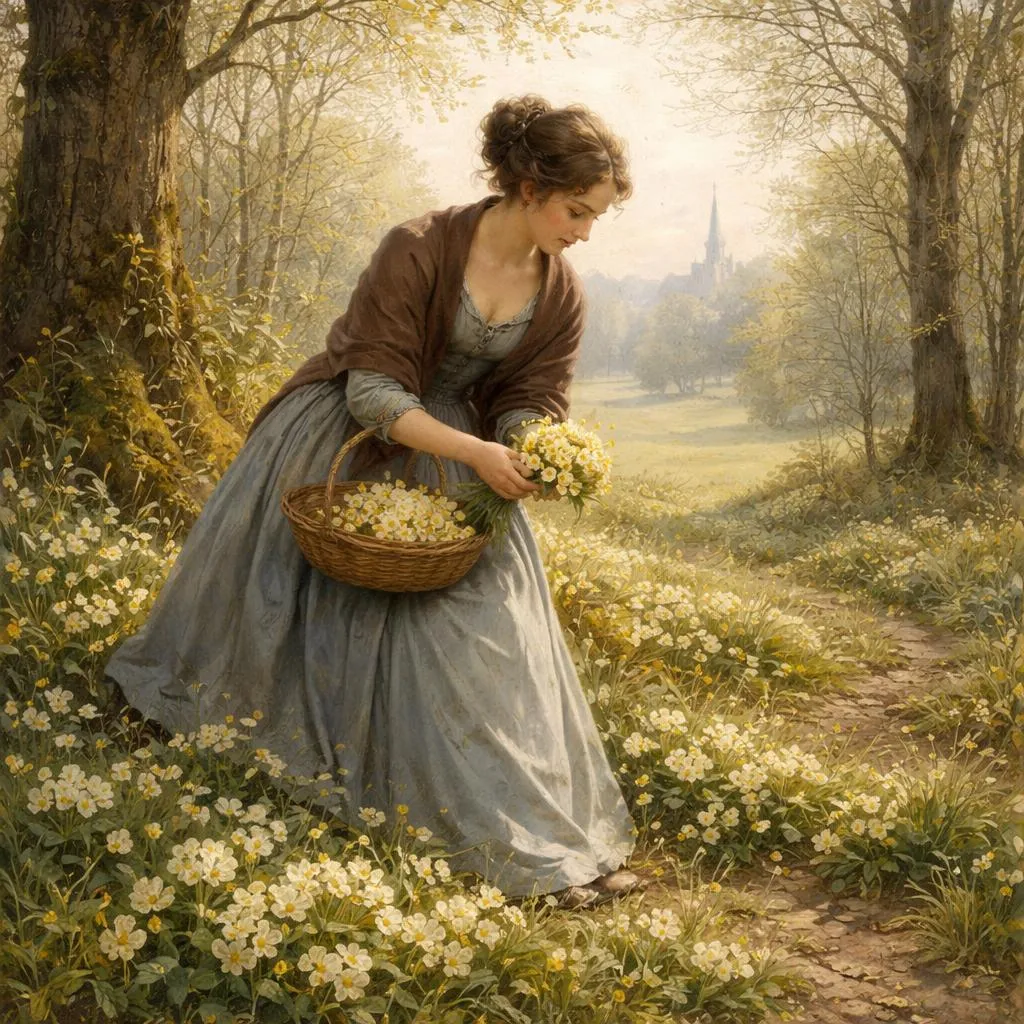
One such occasion I particularly well remember; it was a lovely afternoon about the close of March; Mr. Green and his sisters had sent their carriage back empty, in order to enjoy the bright sunshine and balmy air in a sociable walk home along with their visitors, Captain Somebody and Lieutenant Somebody–else (a couple of military fops), and the Misses Murray, who, of course, contrived to join them. Such a party was highly agreeable to Rosalie; but not finding it equally suitable to my taste, I presently fell back, and began to botanise and entomologise along the green banks and budding hedges, till the company was considerably in advance of me, and I could hear the sweet song of the happy lark; then my spirit of misanthropy began to melt away beneath the soft, pure air and genial sunshine; but sad thoughts of early childhood, and yearnings for departed joys, or for a brighter future lot, arose instead. As my eyes wandered over the steep banks covered with young grass and green–leaved plants, and surmounted by budding hedges, I longed intensely for some familiar flower that might recall the woody dales or green hill–sides of home: the brown moorlands, of course, were out of the question. Such a discovery would make my eyes gush out with water, no doubt; but that was one of my greatest enjoyments now. At length I descried, high up between the twisted roots of an oak, three lovely primroses, peeping so sweetly from their hiding–place that the tears already started at the sight; but they grew so high above me, that I tried in vain to gather one or two, to dream over and to carry with me: I could not reach them unless I climbed the bank, which I was deterred from doing by hearing a footstep at that moment behind me, and was, therefore, about to turn away, when I was startled by the words, ‘Allow me to gather them for you, Miss Grey,’ spoken in the grave, low tones of a well–known voice. Immediately the flowers were gathered, and in my hand. It was Mr. Weston, of course—who else would trouble himself to do so much for ME?
‘I thanked him; whether warmly or coldly, I cannot tell: but certain I am that I did not express half the gratitude I felt. It was foolish, perhaps, to feel any gratitude at all; but it seemed to me, at that moment, as if this were a remarkable instance of his good–nature: an act of kindness, which I could not repay, but never should forget: so utterly unaccustomed was I to receive such civilities, so little prepared to expect them from anyone within fifty miles of Horton Lodge. Yet this did not prevent me from feeling a little uncomfortable in his presence; and I proceeded to follow my pupils at a much quicker pace than before; though, perhaps, if Mr. Weston had taken the hint, and let me pass without another word, I might have repeated it an hour after: but he did not. A somewhat rapid walk for me was but an ordinary pace for him.
‘Your young ladies have left you alone,’ said he.
‘Yes, they are occupied with more agreeable company.’
‘Then don’t trouble yourself to overtake them.’ I slackened my pace; but next moment regretted having done so: my companion did not speak; and I had nothing in the world to say, and feared he might be in the same predicament. At length, however, he broke the pause by asking, with a certain quiet abruptness peculiar to himself, if I liked flowers.
‘Yes; very much,’ I answered, ‘wild–flowers especially.’
‘I like wild–flowers,’ said he; ‘others I don’t care about, because I have no particular associations connected with them— except one or two. What are your favourite flowers?’
‘Primroses, bluebells, and heath–blossoms.’
‘Not violets?’
‘No; because, as you say, I have no particular associations connected with them; for there are no sweet violets among the hills and valleys round my home.’
‘It must be a great consolation to you to have a home, Miss Grey,’ observed my companion after a short pause: ‘however remote, or however seldom visited, still it is something to look to.’
‘It is so much that I think I could not live without it,’ replied I, with an enthusiasm of which I immediately repented; for I thought it must have sounded essentially silly.
‘Oh, yes, you could,’ said he, with a thoughtful smile. ‘The ties that bind us to life are tougher than you imagine, or than anyone can who has not felt how roughly they may be pulled without breaking. You might be miserable without a home, but even YOU could live; and not so miserably as you suppose. The human heart is like india–rubber; a little swells it, but a great deal will not burst it. If “little more than nothing will disturb it, little less than all things will suffice” to break it. As in the outer members of our frame, there is a vital power inherent in itself that strengthens it against external violence. Every blow that shakes it will serve to harden it against a future stroke; as constant labour thickens the skin of the hand, and strengthens its muscles instead of wasting them away: so that a day of arduous toil, that might excoriate a lady’s palm, would make no sensible impression on that of a hardy ploughman.
‘I speak from experience—partly my own. There was a time when I thought as you do—at least, I was fully persuaded that home and its affections were the only things that made life tolerable: that, if deprived of these, existence would become a burden hard to be endured; but now I have no home—unless you would dignify my two hired rooms at Horton by such a name;—and not twelve months ago I lost the last and dearest of my early friends; and yet, not only I live, but I am not wholly destitute of hope and comfort, even for this life: though I must acknowledge that I can seldom enter even an humble cottage at the close of day, and see its inhabitants peaceably gathered around their cheerful hearth, without a feeling ALMOST of envy at their domestic enjoyment.’
‘You don’t know what happiness lies before you yet,’ said I: ‘you are now only in the commencement of your journey.’
‘The best of happiness,’ replied he, ‘is mine already—the power and the will to be useful.’
We now approached a stile communicating with a footpath that conducted to a farm–house, where, I suppose, Mr. Weston purposed to make himself ‘useful;’ for he presently took leave of me, crossed the stile, and traversed the path with his usual firm, elastic tread, leaving me to ponder his words as I continued my course alone. I had heard before that he had lost his mother not many months before he came. She then was the last and dearest of his early friends; and he had NO HOME. I pitied him from my heart: I almost wept for sympathy. And this, I thought, accounted for the shade of premature thoughtfulness that so frequently clouded his brow, and obtained for him the reputation of a morose and sullen disposition with the charitable Miss Murray and all her kin. ‘But,’ thought I, ‘he is not so miserable as I should be under such a deprivation: he leads an active life; and a wide field for useful exertion lies before him. He can MAKE friends; and he can make a home too, if he pleases; and, doubtless, he will please some time. God grant the partner of that home may be worthy of his choice, and make it a happy one—such a home as he deserves to have! And how delightful it would be to—’ But no matter what I thought.
I began this book with the intention of concealing nothing; that those who liked might have the benefit of perusing a fellow–creature’s heart: but we have some thoughts that all the angels in heaven are welcome to behold, but not our brother–men—not even the best and kindest amongst them.
By this time the Greens had taken themselves to their own abode, and the Murrays had turned down the private road, whither I hastened to follow them. I found the two girls warm in an animated discussion on the respective merits of the two young officers; but on seeing me Rosalie broke off in the middle of a sentence to exclaim, with malicious glee—
‘Oh–ho, Miss Grey! you’re come at last, are you? No WONDER you lingered so long behind; and no WONDER you always stand up so vigorously for Mr. Weston when I abuse him. Ah–ha! I see it all now!’
‘Now, come, Miss Murray, don’t be foolish,’ said I, attempting a good–natured laugh; ‘you know such nonsense can make no impression on me.’
But she still went on talking such intolerable stuff—her sister helping her with appropriate fiction coined for the occasion—that I thought it necessary to say something in my own justification.
‘What folly all this is!’ I exclaimed. ‘If Mr. Weston’s road happened to be the same as mine for a few yards, and if he chose to exchange a word or two in passing, what is there so remarkable in that? I assure you, I never spoke to him before: except once.’
‘Where? where? and when?’ cried they eagerly.
‘In Nancy’s cottage.’
‘Ah–ha! you’ve met him there, have you?’ exclaimed Rosalie, with exultant laughter. ‘Ah! now, Matilda, I’ve found out why she’s so fond of going to Nancy Brown’s! She goes there to flirt with Mr. Weston.’
‘Really, that is not worth contradicting—I only saw him there once, I tell you—and how could I know he was coming?’
Irritated as I was at their foolish mirth and vexatious imputations, the uneasiness did not continue long: when they had had their laugh out, they returned again to the captain and lieutenant; and, while they disputed and commented upon them, my indignation rapidly cooled; the cause of it was quickly forgotten, and I turned my thoughts into a pleasanter channel. Thus we proceeded up the park, and entered the hall; and as I ascended the stairs to my own chamber, I had but one thought within me: my heart was filled to overflowing with one single earnest wish. Having entered the room, and shut the door, I fell upon my knees and offered up a fervent but not impetuous prayer: ‘Thy will be done,’ I strove to say throughout; but, ‘Father, all things are possible with Thee, and may it be Thy will,’ was sure to follow. That wish—that prayer—both men and women would have scorned me for—’But, Father, THOU wilt NOT despise!’ I said, and felt that it was true. It seemed to me that another’s welfare was at least as ardently implored for as my own; nay, even THAT was the principal object of my heart’s desire. I might have been deceiving myself; but that idea gave me confidence to ask, and power to hope I did not ask in vain. As for the primroses, I kept two of them in a glass in my room until they were completely withered, and the housemaid threw them out; and the petals of the other I pressed between the leaves of my Bible—I have them still, and mean to keep them always.
Pengantar Latar Belakang dan Penulis
Kutipan ini berasal dari novel klasik abad ke-19 yang mengeksplorasi kehidupan dan pikiran batin seorang pengasuh bernama Nona Grey. Kisah ini berlatar di pedesaan Inggris, di mana kelas sosial dan hubungan pribadi memainkan peran penting dalam membentuk kehidupan para tokoh. Penulis, seorang penulis era Victoria, sering berfokus pada tema hierarki sosial, martabat pribadi, dan perjuangan diam-diam wanita yang hidup di pinggiran masyarakat. Melalui deskripsi terperinci dan narasi introspektif, penulis mengundang pembaca untuk memahami dunia emosional seorang pengasuh, sosok yang terjebak antara perbudakan dan persahabatan.
Interpretasi dan Makna Terperinci
Kutipan tersebut mengungkapkan perasaan kompleks Nona Grey tentang posisi sosialnya dan interaksinya dengan orang lain. Dia menyadari kekaguman yang dicari Nona Murray dan permainan sosial yang dimainkan oleh kelas atas. Refleksi Nona Grey tentang berjalan dengan para wanita muda atau naik kereta menyoroti kepekaannya terhadap pengucilan sosial dan keinginannya untuk dilihat sebagai orang yang sederajat daripada hanya seorang pelayan. Momen bersama Tuan Weston yang mengumpulkan bunga primrose untuknya menandai contoh kebaikan dan koneksi yang langka, yang sangat menyentuhnya, mencerminkan kesepiannya dan kerinduannya akan persahabatan sejati.
Percakapan tentang bunga melambangkan tema yang lebih dalam: bunga liar mewakili hubungan Nona Grey dengan rumahnya yang jauh dan kegembiraan yang lebih sederhana, sementara refleksi Tuan Weston tentang ketahanan dan hati manusia mengungkapkan pandangan filosofis tentang penderitaan dan harapan. Kata-katanya mendorong gagasan bahwa bahkan dalam kesulitan, orang dapat menemukan kekuatan dan tujuan. Adegan penutup, di mana Nona Grey berdoa dan menghargai bunga primrose, menggarisbawahi iman batinnya dan harapan akan masa depan yang lebih baik.
Pelajaran dan Wawasan untuk Siswa
-
Memahami Kepekaan Sosial dan Empati: Pengalaman Nona Grey mengajari kita tentang pentingnya empati dan kesadaran akan perasaan orang lain, terutama ketika perbedaan sosial menciptakan hambatan. Siswa dapat belajar untuk lebih inklusif dan perhatian dalam persahabatan dan interaksi sosial mereka.
-
Ketahanan dan Harapan: Refleksi Tuan Weston menawarkan pelajaran yang kuat tentang ketahanan. Hidup mungkin membawa kesulitan, tetapi dengan kekuatan batin dan pandangan positif, seseorang dapat bertahan dan menemukan makna. Ini adalah pesan yang menggembirakan bagi pembaca muda yang menghadapi tantangan mereka sendiri.
-
Apresiasi Terhadap Alam: Perhatian terperinci pada bunga dan alam mendorong siswa untuk mengamati dan menghargai dunia alami di sekitar mereka. Ini dapat mendorong kesadaran dan rasa damai.
-
Nilai Kebaikan: Tindakan kebaikan kecil, seperti isyarat Tuan Weston, dapat berdampak besar. Siswa dapat terinspirasi untuk menunjukkan kebaikan dalam kehidupan sehari-hari, memahami kekuatannya untuk mengangkat orang lain.
Menerapkan Pelajaran Ini dalam Kehidupan
- Di Sekolah: Siswa dapat mempraktikkan empati dengan memasukkan teman sekelas yang mungkin merasa tersisih, menyadari bahwa setiap orang memiliki perasaan dan perjuangan yang unik.
- Dalam Persahabatan: Membangun hubungan yang tulus, seperti yang dialami Nona Grey, membutuhkan kebaikan, mendengarkan, dan menghormati orang lain.
- Dalam Pertumbuhan Pribadi: Mengembangkan ketahanan berarti belajar menghadapi kesulitan dengan keberanian dan harapan, seperti filosofi Tuan Weston.
- Dalam Alam dan Kesadaran: Meluangkan waktu untuk memperhatikan dan menikmati alam dapat membantu mengurangi stres dan meningkatkan fokus, bermanfaat bagi kesehatan mental dan kinerja akademik.
Mengembangkan Sifat Positif dari Cerita
- Harga Diri: Seperti Nona Grey, siswa harus mengakui nilai mereka sendiri, terlepas dari pendapat orang lain.
- Kesabaran dan Pengertian: Dinamika sosial bisa jadi kompleks, tetapi kesabaran membantu menavigasi hubungan dengan kebaikan.
- Rasa Syukur: Menghargai tindakan kebaikan kecil dan momen keindahan dapat memperkaya hidup dan membangun pola pikir yang positif.
- Iman dan Harapan: Baik spiritual maupun pribadi, berpegang pada harapan memberikan kekuatan selama masa-masa sulit.
Kisah ini mendorong pembaca muda untuk melihat melampaui penampilan dan peran sosial, untuk menghargai kualitas dan hubungan batin, dan untuk menemukan kekuatan dalam kebaikan dan harapan. Ini adalah pengingat abadi bahwa kisah setiap orang penting dan bahwa kasih sayang dapat menjembatani bahkan jurang yang paling lebar.
