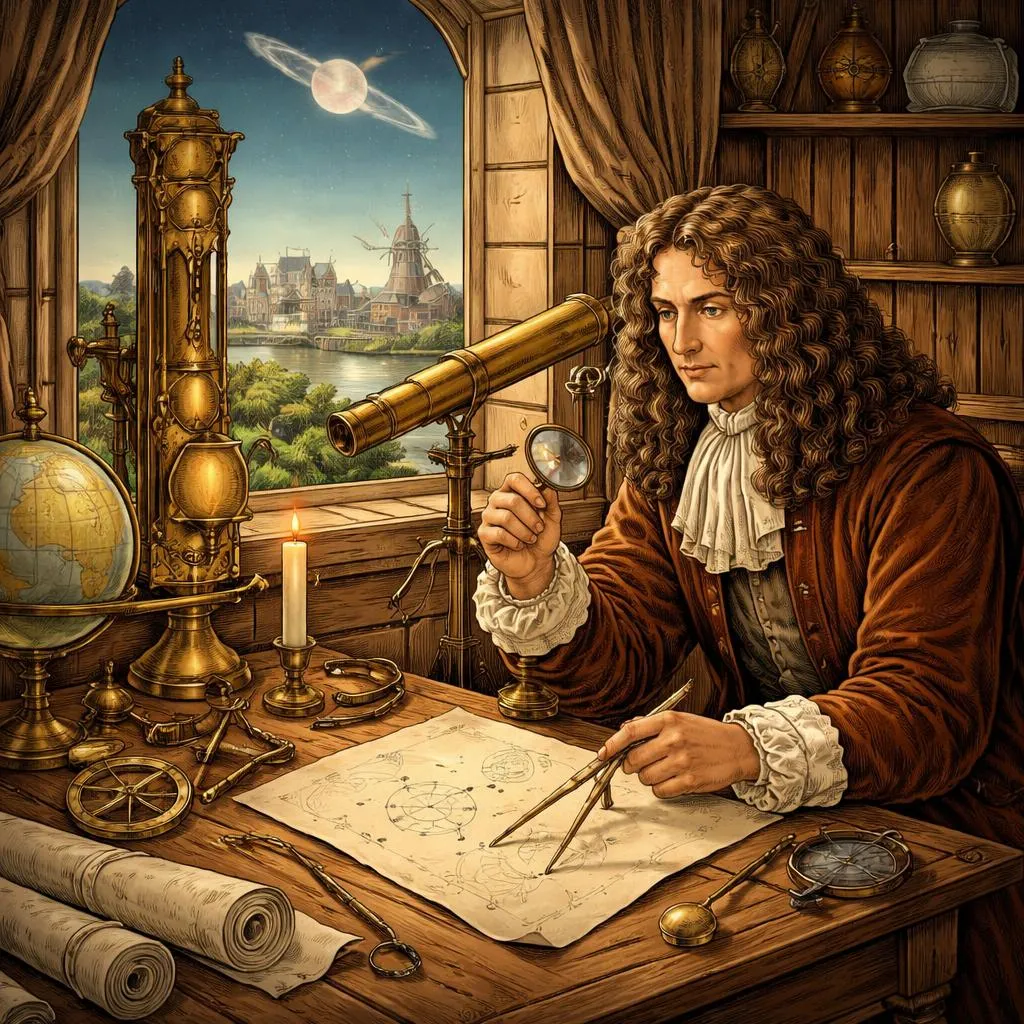

Christian Huygens was born at the Hague on April 14, 1629, and died in the same town on July 8, 1695. He generally wrote his name as Hugens, but I follow the usual custom in spelling it as above: it is also sometimes written as Huyghens. His life was uneventful, and there is little more to record in it than a statement of his various memoirs and researches.
In 1651 he published an essay in which he shewed the fallacy in a system of quadratures proposed by Grégoire de Saint-Vincent, who was well versed in the geometry of the Greeks, but had not grasped the essential points in the more modern methods. This essay was followed by tracts on the quadrature of the conics and the approximate rectification of the circle.
In 1654 his attention was directed to the improvement of the telescope. In conjunction with his brother he devised a new and better way of grinding and polishing lenses. As a result of these improvements he was able during the following two years, 1655 and 1656, to resolve numerous astronomical questions; as, for example, the nature of Saturn's appendage. His astronomical observations required some exact means of measuring time, and he was thus led in 1656 to invent the pendulum clock, as described in his tract Horologium , 1658. The time-pieces previously in use had been balance-clocks.
In the year 1657 Huygens wrote a small work on the calculus of probabilities founded on the correspondence of Pascal and Fermat. He spent a couple of years in England about this time. His reputation was now so great that in 1665 Louis XIV offered him a pension if he would live in Paris, which accordingly then became his place of residence.
In 1668 he sent to the Royal Society of London, in answer to a problem they had proposed, a memoir in which (simultaneously with Wallis and Wren) he proved by experiment that the momentum in a certain direction before the collision of two bodies is equal to the momentum in that direction after the collision. This was one of the points in mechanics on which Descartes had been mistaken.
The most important of Huygens's work was his Horologium Oscillatorium published at Paris in 1673. The first chapter is devoted to pendulum clocks. The second chapter contains a complete account of the descent of heavy bodies under their own weights in a vacuum, either vertically down or on smooth curves. Amongst other propositions he shews that the cycloid is tautochronous. In the third chapter he defines evolutes and involutes, proves some of their more elementary properties, and illustrates his methods by finding the evolutes of the cycloid and the parabola. These are the earliest instances in which the envelope of a moving line was determined. In the fourth chapter he solves the problem of the compound pendulum, and shews that the centres of oscillation and suspension are interchangeable. In the fifth and last chapter he discusses again the theory of clocks, points out that if the bob of the pendulum were, by means of cycloidal clocks, made to oscillate in a cycloid the oscillations would be isochronous; and finishes by shewing that the centrifugal force on a body which moves around a circle of radius r with a uniform velocity v varies directly as v 2 and inversely as r . This work contains the first attempt to apply dynamics to bodies of finite size, and not merely to particles.
In 1675 Huygens proposed to regulate the motion of watches by the use of the balance spring, in the theory of which he had been perhaps anticipated in a somewhat ambiguous and incomplete statement made by Hooke in 1658. Watches or portable clocks had been invented early in the sixteenth century, and by the end of that century were not very uncommon, but they were clumsy and unreliable, being driven by a main spring and regulated by a conical pulley and verge escapement; moreover, until 1687 they had only one hand. The first watch whose motion was regulated by a balance spring was made at Paris under Huygens's directions, and presented by him to Louis XIV.
The increasing intolerance of the Catholics led to his return to Holland in 1681, and after the revocation of the edict of Nantes he refused to hold any further communication with France. He now devoted himself to the construction of lenses of enormous focal length: of these three of focal lengths 123 feet, 180 feet, and 210 feet, were subsequently given by him to the Royal Society of London, in whose possession they still remain. It was about this time that he discovered the achromatic eye-piece (for a telescope) which is known by his name. In 1689 he came from Holland to England in order to make the acquaintance of Newton, whose Principia had been published in 1687. Huygens fully recognized the intellectual merits of the work, but seems to have deemed any theory incomplete which did not explain gravitation by mechanical means.
On his return in 1690 Huygens published his treatise on light in which the undulatory theory was expounded and explained. Most of this had been written as early as 1678. The general idea of the theory had been suggested by Robert Hooke in 1664, but he had not investigated its consequences in any detail. Only three ways have been suggested in which light can be produced mechanically. Either the eye may be supposed to send out something which, so to speak, feels the object (as the Greeks believed); or the object perceived may send out something which hits or affects the eye (as assumed in the emission theory); or there may be some medium between the eye and the object, and the object may cause some change in the form or condition of this intervening medium and thus affect the eye (as Hooke and Huygens supposed in the wave or undulatory theory). According to this last theory space is filled with an extremely rare ether, and light is caused by a series of waves or vibrations in this ether which are set in motion by the pulsations of the luminous body. From this hypothesis Huygens deduced the laws of reflexion and refraction, explained the phenomenon of double refraction, and gave a construction for the extraordinary ray in biaxal crystals; while he found by experiment the chief phenomena of polarization.
The immense reputation and unrivalled powers of Newton led to disbelief in a theory which he rejected, and to the general adoption of Newton's emission theory. Within the present century crucial experiments have been devised which give different results according as one or the other theory is adopted; all these experiments agree with the results of the undulatory theory and differ from the results of the Newtonian theory; the latter is therefore untenable. Until, however, the theory of interference, suggested by Young, was worked out by Fresnel, the hypothesis of Huygens failed to account for all the facts, and even now the properties which, under it, have to be attributed to the intervening medium or ether involve difficulties of which we still seek a solution. Hence the problem as to how the effects of light are really produced cannot be said to be finally solved.
Besides these works Huygens took part in most of the controversies and challenges which then played so large a part in the mathematical world, and wrote several minor tracts. In one of these he investigated the form and properties of the catenary. In another he stated in general terms the rule for finding maxima and minima of which Fermat had made use, and shewed that the subtangent of an algebraical curve f ( x,y ) = 0 was equal to yf y / f x , where f y is the derived function of f ( x,y ) regarded as a function of y . In some posthumous works, issued at Leyden in 1703, he further shewed how from the focal lengths of the component lenses the magnifying power of a telescope could be determined; and explained some of the phenomena connected with haloes and parhelia.
I should add that almost all his demonstrations, like those of Newton, are rigidly geometrical, and he would seem to have made no use of the differential or fluxional calculus, though he admitted the validity of the methods used therein. Thus, even when first written, his works were expressed in an archaic language, and perhaps received less attention than their intrinsic merits deserved.
Latar Belakang dan Pengantar Penulis
Christian Huygens adalah seorang ilmuwan dan matematikawan Belanda yang brilian dari abad ke-17, suatu masa ketika dunia dengan cepat memperluas pemahamannya tentang sains dan alam semesta. Lahir pada tahun 1629 di Den Haag, Huygens hidup selama Revolusi Ilmiah, sebuah era yang ditandai oleh penemuan dan penemuan terobosan. Karyanya mencakup banyak bidang termasuk astronomi, fisika, matematika, dan horologi (ilmu tentang pengukuran waktu). Meskipun hidup di periode ketika ketegangan agama dan politik tinggi, Huygens mengabdikan hidupnya untuk penyelidikan dan inovasi ilmiah.
Huygens terkenal karena menemukan jam bandul, yang sangat meningkatkan akurasi pengukuran waktu, dan untuk teori gelombang cahayanya, yang meletakkan dasar bagi optik modern. Kontribusinya pada mekanika, terutama studinya tentang gerakan benda dan tumbukan, menantang gagasan sebelumnya dan membantu membentuk dasar fisika klasik.
Penjelasan Rinci dan Signifikansi Karya Huygens
Hidup dan karya Huygens menggambarkan kekuatan rasa ingin tahu dan pengamatan yang cermat. Peningkatannya pada teleskop memungkinkan para astronom melihat benda-benda langit dengan lebih jelas, yang mengarah pada pemahaman yang lebih baik tentang planet-planet seperti Saturnus. Dengan menemukan jam bandul, ia memecahkan masalah kritis dalam mengukur waktu secara tepat—sebuah terobosan yang penting untuk navigasi dan eksperimen ilmiah.
Salah satu karyanya yang paling penting, Horologium Oscillatorium, adalah mahakarya penulisan ilmiah yang menggabungkan teori dan aplikasi praktis. Di dalamnya, Huygens menjelaskan bagaimana bandul bergerak dan bagaimana gerakan ini dapat digunakan untuk mengatur jam. Ia juga mengeksplorasi sifat-sifat kurva seperti sikloid, yang memiliki sifat unik dari tautokronisme—yang berarti benda yang meluncur ke bawah membutuhkan waktu yang sama terlepas dari titik awalnya. Penemuan ini tidak hanya indah secara matematis tetapi juga berguna secara praktis dalam desain jam.
Teori gelombang cahaya Huygens sangat revolusioner. Pada saat teori partikel cahaya Isaac Newton dominan, Huygens mengusulkan bahwa cahaya bergerak dalam gelombang melalui medium yang disebut eter. Gagasan ini menjelaskan banyak fenomena optik seperti refleksi, refraksi, dan polarisasi lebih baik daripada teori Newton. Meskipun butuh waktu berabad-abad bagi gagasan Huygens untuk diterima sepenuhnya, hari ini mereka membentuk dasar fisika dan optik modern.
Apa yang Dapat Dipelajari Siswa dari Kisah Huygens
-
Pentingnya Rasa Ingin Tahu dan Ketekunan
Kehidupan Huygens mengajarkan siswa bahwa kemajuan ilmiah sering kali berasal dari mengajukan pertanyaan dan menguji ide dengan hati-hati. Karyanya tentang jam, cahaya, dan mekanika menunjukkan bagaimana rasa ingin tahu yang dikombinasikan dengan ketekunan dapat mengarah pada terobosan. -
Nilai Pembelajaran Interdisipliner
Huygens tidak terbatas pada satu bidang; ia menggabungkan matematika, fisika, dan teknik. Pendekatan ini mendorong siswa untuk menjelajahi berbagai mata pelajaran dan melihat bagaimana mereka terhubung dalam kehidupan nyata. -
Berpikir Kritis dan Menantang Gagasan yang Sudah Ada
Huygens menantang teori-teori yang diterima pada zamannya, seperti gagasan Descartes tentang tumbukan dan teori cahaya Newton. Ini menunjukkan kepada siswa pentingnya berpikir kritis dan terbuka terhadap bukti baru. -
Ketelitian dan Perhatian terhadap Detail
Peningkatannya dalam penggilingan lensa dan pembuatan jam menyoroti bagaimana detail kecil penting dalam pekerjaan ilmiah. Siswa dapat belajar bahwa pekerjaan yang cermat dan ketelitian sangat penting dalam disiplin ilmu apa pun.
Cara Menerapkan Pelajaran Ini dalam Kehidupan Sehari-hari
- Dalam Belajar: Saat belajar, siswa dapat meniru metode Huygens dengan mempertanyakan apa yang mereka baca, bereksperimen dengan ide, dan menghubungkan berbagai mata pelajaran seperti matematika dan sains untuk memperdalam pemahaman.
- Dalam Pemecahan Masalah: Baik dalam proyek sekolah atau tantangan sehari-hari, siswa tidak boleh takut untuk berpikir berbeda atau menguji pendekatan baru, seperti yang dilakukan Huygens dengan penemuannya.
- Dalam Interaksi Sosial: Kesabaran dan ketekunan yang ditunjukkan Huygens dapat menginspirasi siswa untuk bersabar dengan diri mereka sendiri dan orang lain, memahami bahwa kemajuan seringkali membutuhkan waktu dan usaha.
- Dalam Pertumbuhan Pribadi: Merangkul rasa ingin tahu dan kecintaan untuk belajar dapat mengarah pada pertumbuhan seumur hidup dan penemuan tak terduga, seperti yang terjadi pada Huygens.
Mendorong Sifat Positif dari Contoh Huygens
- Rasa Ingin Tahu: Selalu tanyakan "mengapa" dan berusahalah untuk memahami dunia di sekitar Anda.
- Ketekunan: Teruslah mengerjakan masalah bahkan ketika solusi tidak segera jelas.
- Keterbukaan Pikiran: Bersedia mempertimbangkan ide-ide baru, bahkan jika mereka menantang apa yang sudah Anda yakini.
- Perhatian terhadap Detail: Berhati-hatilah dalam pekerjaan Anda dan berusahalah untuk akurasi.
- Pemikiran Interdisipliner: Gabungkan pengetahuan dari berbagai bidang untuk memecahkan masalah yang kompleks.
Dengan mempelajari kehidupan dan karya Christian Huygens, siswa tidak hanya mendapatkan pengetahuan tentang sains dan sejarah tetapi juga pelajaran berharga tentang bagaimana mendekati pembelajaran dan kehidupan dengan pikiran yang bijaksana, tekun, dan terbuka. Warisannya mengingatkan kita bahwa penemuan-penemuan besar sering kali berasal dari perpaduan imajinasi, kerja keras, dan keberanian untuk mempertanyakan dunia sebagaimana adanya.
