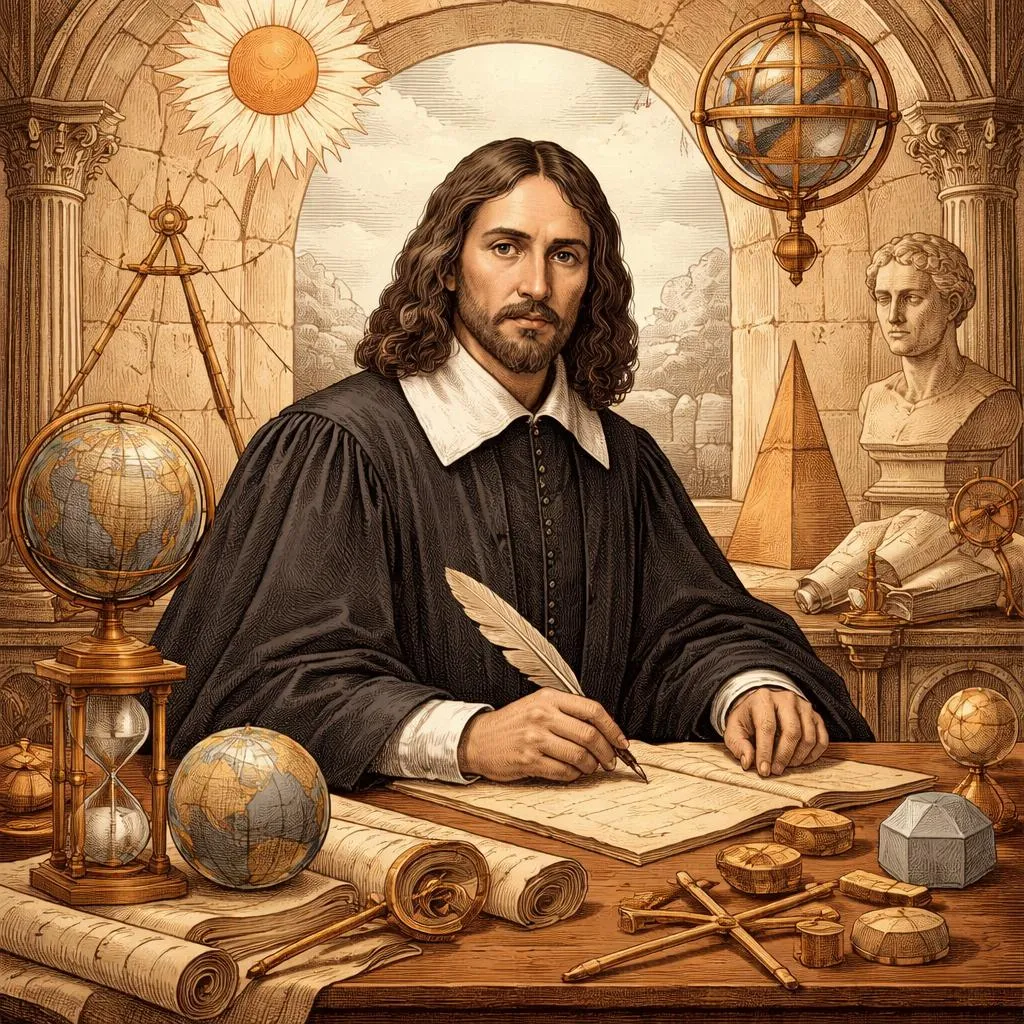

Isaac Barrow was born in London in 1630, and died at Cambridge in 1677. He went to school first at Charterhouse (where he was so troublesome that his father was heard to pray that if it pleased God to take any of his children he could best spare Isaac), and subsequently to Felstead. He completed his education at Trinity College, Cambridge; after taking his degree in 1648, he was elected to a fellowship in 1649; he then resided for a few years in college, but in 1655 he was driven out by the persecution of the Independents. He spent the next four years in the East of Europe, and after many adventures returned to England in 1659. He was ordained the next year, and appointed to the professorship of Greek at Cambridge. In 1662 he was made professor of geometry at Gresham College, and in 1663 was selected as the first occupier of the Lucasian chair at Cambridge. He resigned the latter to his pupil Newton in 1669, whose superior abilities he recognized and frankly acknowledged. For the remainder of his life he devoted himself to the study of divinity. He was appointed master of Trinity College in 1672, and held the post until his death.
He is described as "low in stature, lean, and of a pale complexion," slovenly in his dress, and an inveterate smoker. He was noted for his strength and courage, and once when travelling in the East he saved the ship by his own prowess from capture by pirates. A ready and caustic wit made him a favourite of Charles II., and induced the courtiers to respect even if they did not appreciate him. He wrote with a sustained and somewhat stately eloquence, and with his blameless life and scrupulous conscientiousness was an impressive personage of the time.
His earliest work was a complete edition of the Elements of Euclid, which he issued in Latin in 1655, and in English in 1660; in 1657 he published an edition of the Data. His lectures, delivered in 1664, 1665, and 1666, were published in 1683 under the title Lectiones Mathematicae; these are mostly on the metaphysical basis for mathematical truths. His lectures for 1667 were published in the same year, and suggest the analysis by which Archimedes was led to his chief results. In 1669 he issued his Lectiones Opticae et Geometricae. It is said in the preface that Newton revised and corrected these lectures, adding matter of his own, but it seems probable from Newton's remarks in the fluxional controversy that the additions were confined to the parts which dealt with optics. This, which is his most important work in mathematics, was republished with a few minor alterations in 1674. In 1675 he published an edition with numerous comments of the first four books of the Conics of Apollonius, and of the extant works of Archimedes and Theodosius.
In the optical lectures many problems connected with the reflexion and refraction of light are treated with ingenuity. The geometrical focus of a point seen by reflexion or refraction is defined; and it is explained that the image of an object is the locus of the geometrical foci of every point on it. Barrow also worked out a few of the easier properties of thin lenses, and considerably simplified the Cartesian explanation of the rainbow.
The geometrical lectures contain some new ways of determining the areas and tangents of curves. The most celebrated of these is the method given for the determination of tangents to curves, and this is sufficiently important to require a detailed notice, because it illustrates the way in which Barrow, Hudde and Sluze were working on the lines suggested by Fermat towards the methods of the differential calculus.
Fermat had observed that the tangent at a point P on a curve was determined if one other point besides P on it were known; hence, if the length of the subtangent MT could be found (thus determining the point T), then the line TP would be the required tangent. Now Barrow remarked that if the abscissa and ordinate at a point Q adjacent to P were drawn, he got a small triangle PQR (which he called the differential triangle, because its sides PR and PQ were the differences of the abscissae and ordinates of P and Q), so that
TM : MP = QR : RP.
To find QR : RP he supposed that x, y were the co-ordinates of P, and x - e, y - a those of Q (Barrow actually used p for x and m for y, but I alter these to agree with modern practice). Substituting the co-ordinates of Q in the equation of the curve, and neglecting the squares and higher powers of e and a as compared with their first powers, he obtained e : a. The ratio a/e was subsequently (in accordance with a suggestion made by Sluze) termed the angular coefficient of the tangent at the point. Barrow applied this method to the curves (i) x² (x² + y²) = r²y²;(ii) x³ + y³ = r³; (iii) x³ + y³ = rxy, called la galande; (iv) y = (r - x) tan πx/2r, the quadratrix; and (v) y = r tan πx/2r. It will be sufficient here if I take as an illustration the simpler case of the parabola y² = px. Using the notation given above, we have for the point P, y² = px; and for the point Q, (y - a)² = p(x - e). Subtracting we get 2ay - a² = pe. But, if a be an infinitesimal quantity, a² must be infinitely smaller and therefore may be neglected when compared with the quantities 2ay and pe. Hence 2ay = pe, that is, e : a = 2y : p. Therefore TP : y = e : a = 2y : p. Hence TM = 2y²/p = 2x. This is exactly the procedure of the differential calculus, except that there we have a rule by which we can get the ratio a/e or dy/dx directly without the labour of going through a calculation similar to the above for every separate case.
Latar Belakang dan Pengantar Penulis
Isaac Barrow adalah seorang matematikawan dan teolog luar biasa dari abad ke-17. Lahir di London pada tahun 1630, ia hidup pada masa penemuan ilmiah dan perubahan intelektual yang besar. Barrow bukan hanya seorang sarjana tetapi juga seorang petualang yang berani, dikenal karena kekuatan dan kecerdasannya. Terlepas dari masa mudanya yang agak sulit diatur, ia menjadi salah satu matematikawan terkemuka di eranya, memegang posisi akademik bergengsi di Universitas Cambridge. Karya Barrow meletakkan dasar-dasar penting untuk kalkulus, cabang matematika yang kemudian akan dikembangkan lebih lanjut oleh muridnya yang terkenal, Isaac Newton.
Kisah hidup Barrow mengajarkan kita tentang ketekunan, rasa ingin tahu intelektual, dan pentingnya mengenali serta mendorong bakat pada orang lain. Keputusannya untuk mengundurkan diri dari Kursi Lucasian yang bergengsi untuk Newton menunjukkan kerendahan hati dan komitmen terhadap kemajuan pengetahuan di luar ambisi pribadi.
Penjelasan Rinci dan Signifikansi
Tulisan di atas menjelaskan kontribusi Barrow terhadap matematika, terutama dalam geometri dan optik. Ia mengerjakan masalah yang melibatkan refleksi dan refraksi cahaya, menjelaskan bagaimana gambar terbentuk melalui lensa—topik yang masih mendasar dalam fisika dan optik saat ini. Kuliahnya tentang geometri memperkenalkan metode baru untuk menemukan garis singgung pada kurva, yang merupakan konsep kunci dalam kalkulus.
Pendekatan Barrow terhadap garis singgung melibatkan apa yang sekarang kita sebut "segitiga diferensial," alat geometris cerdas yang membantunya memperkirakan kemiringan kurva sebelum pengembangan formal kalkulus. Metode ini merupakan batu loncatan menuju teknik ampuh yang kemudian akan diformalkan oleh Newton dan Leibniz. Karya Barrow tentang irisan kerucut dan komentarnya tentang matematikawan kuno seperti Apollonius dan Archimedes juga membantu melestarikan dan memajukan pengetahuan matematika klasik.
Apa yang Dapat Dipelajari Siswa
-
Konteks Sejarah Matematika: Memahami karya Barrow membantu siswa menghargai bagaimana ide-ide matematika berkembang seiring waktu. Ini menunjukkan bahwa kalkulus, mata pelajaran yang sering dianggap sulit, dikembangkan selangkah demi selangkah oleh banyak pemikir yang membangun penemuan satu sama lain.
-
Pembelajaran Interdisipliner: Barrow menggabungkan minatnya pada matematika, teologi, dan filsafat, menunjukkan nilai pendidikan yang luas dan keterkaitan berbagai bidang.
-
Berpikir Kritis dan Pemecahan Masalah: Metode Barrow dalam menganalisis kurva dan cahaya mengajarkan siswa untuk mendekati masalah secara kreatif dan logis, memecah ide-ide kompleks menjadi bagian-bagian yang lebih sederhana.
-
Kerendahan Hati dan Bimbingan: Pengakuan Barrow terhadap bakat Newton yang lebih unggul dan kesediaannya untuk mengalah adalah pelajaran yang kuat tentang kerendahan hati dan pentingnya mendukung pertumbuhan orang lain.
Penerapan dalam Kehidupan dan Pembelajaran
-
Di Sekolah: Siswa dapat menerapkan contoh Barrow dengan bersikap ingin tahu dan tekun dalam studi mereka, terutama dalam mata pelajaran yang menantang seperti matematika dan sains. Mempelajari sejarah di balik konsep dapat membuatnya lebih menarik dan mudah dipahami.
-
Dalam Pengaturan Sosial: Kisah Barrow mendorong rasa hormat terhadap bakat orang lain dan pentingnya bimbingan. Membantu teman sekelas dan mengenali kekuatan mereka dapat membangun komunitas belajar yang positif.
-
Dalam Pertumbuhan Pribadi: Kehidupan Barrow menunjukkan bahwa kesalahan atau kesulitan awal tidak menentukan masa depan seseorang. Dengan usaha dan dedikasi, siapa pun dapat mencapai hal-hal besar.
Cara Mengembangkan Sifat Positif dari Kisah Barrow
-
Rasa Ingin Tahu: Selalu ajukan pertanyaan dan berupaya memahami cara kerja sesuatu, seperti Barrow menjelajahi sifat cahaya dan kurva.
-
Keberanian: Jangan takut menghadapi tantangan atau pengalaman baru, seperti yang dilakukan Barrow saat bepergian dan melawan bajak laut.
-
Kerendahan Hati: Akui ketika orang lain memiliki ide yang lebih baik dan bersedia belajar dari mereka.
-
Ketelitian: Berusaha untuk integritas dan pekerjaan yang cermat, seperti yang dilakukan Barrow dalam kehidupan ilmiah dan pribadinya.
Refleksi dan Apresiasi
Membaca tentang Isaac Barrow dapat menginspirasi siswa untuk menghargai pengetahuan dan karakter. Perpaduan antara kecemerlangan intelektual dan keberanian pribadi menjadikannya panutan tidak hanya bagi calon ilmuwan dan matematikawan tetapi juga bagi siapa saja yang ingin tumbuh sebagai individu yang bijaksana, penuh hormat, dan berani. Dengan mempelajari kehidupan dan karyanya, pelajar muda dapat melihat bagaimana dedikasi untuk belajar dan kebaikan kepada orang lain berjalan seiring dalam memberikan dampak yang berarti bagi dunia.