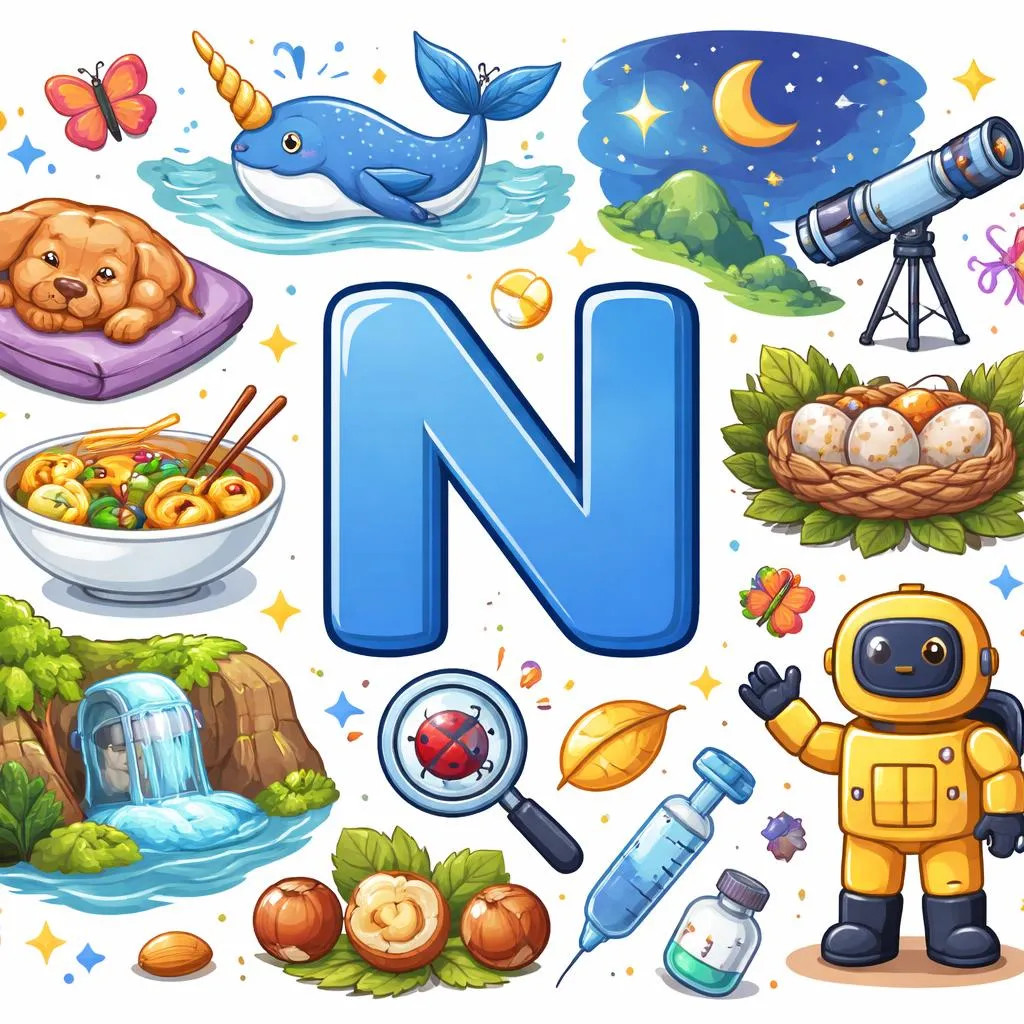

Did you notice the letter 'N' is everywhere? It is a very common sound. Many important words start with this letter. These words hide in your textbooks. They appear on your tests. You use them every day without knowing. Mastering them unlocks higher scores. It also makes your English sound natural. This article will guide you through these essential words. You will learn their key uses. You will see common test traps. You will gain confidence for exams and life.
Here is a core list of useful 'N' words. Study them well. name, near, neat, necessary, need, neighbor, never, new, next, nice, night, no, noise, normal, north, nose, note, notice, novel, number, nurse, nature, nation, national, native, natural, navigate, navy, near, nearly, neat, necessary, necessity, neck, need, needle, negative, neglect, negotiate, neighbor, neighborhood, neither, nerve, nervous, nest, net, network, neutral, never, nevertheless, new, news, newspaper, next, nice, nickel, night, nightmare, nine, ninety, ninth, no, noble, nobody, nod, noise, noisy, none, nonsense, noon, nor, normal, north, northern, nose, not, note, notebook, nothing, notice, notion, novel, novelty, now, nowhere, nuclear, number, numerous, nurse, nut, nutrition, nylon.
Let us explore one word in detail now. necessary ( /?nes.?.ser.i/ ) adj. (needed for a purpose or a reason) Exam Context: It is necessary for students to listen carefully. This helps them understand the lecture fully. Life Context: "Did you buy milk?" "Yes, it's necessary for the cake recipe." Key Learning Point: Watch for the fixed structure "It is necessary for someone to do something." Do not confuse it with 'essential'. They are very close in meaning. The adverb is 'necessarily'.
Now, we dive deeper into key 'N' words. These words are frequent in tests. They are also vital for daily talk.
necessary How is it tested? It appears in Single Choice questions. It tests vocabulary usage. Writing tasks also need this word. It shows a strong argument. Test Example: "It is ______ to wear a helmet when riding a bike. Safety must come first." A) natural B) necessary C) neutral D) noted. Answer: B. The context is about a requirement for safety. How is it used daily? Two friends plan a weekend trip. A: "What should I pack for the camping trip?" B: "A good sleeping bag is necessary. The nights get very cold." A: "Is a flashlight also necessary?" B: "Absolutely! It's necessary for finding your way at night." Common Errors: Spelling error: 'neccessary' is a common misspelling. Remember one 'c' and two 's's. Pronunciation: Stress the first syllable: /?nes/. Not /n??ses.?.ri/.
negotiate How is it tested? It appears in Cloze tests. It tests logical verb choice. Listening passages use it in business or school project talks. Test Example: "The two companies finally ______ a new contract after long discussions." The answer is 'negotiated'. It implies formal discussion to reach a deal. How is it used daily? A student talks to a teacher about homework. Student: "Mr. Lee, the history project is due Friday. But we have two big tests that day too. Can we discuss the deadline?" Teacher: "I see your point. What do you propose?" Student: "Could we negotiate? Maybe we submit the project on Monday instead?" Common Errors: Confusing with 'navigate'. You 'negotiate' a deal, but 'navigate' a road. The noun is 'negotiation'.
narrative How is it tested? It is common in Reading Comprehension. It describes the story structure. Writing prompts ask you to "write a narrative". Test Example: "The author uses a first-person narrative to make the story feel more personal and direct." It refers to the style of storytelling. How is it used daily? Friends discuss a movie. A: "I loved the movie's narrative! The way the story jumped between past and present was so cool." B: "Yes, a non-linear narrative makes you think more. A simple story is sometimes boring." Common Errors: Do not confuse with 'narrator'. The 'narrative' is the story. The 'narrator' is the person telling it.
notable How is it tested? It is an advanced word for Writing. It helps you highlight important points. Reading passages use it to describe significant features. Test Example: "One notable feature of the panda is its distinctive black-and-white fur." It means 'worthy of note' or 'remarkable'. How is it used daily? A student gives a class presentation. "Today, I will talk about Thomas Edison. His most notable invention is the practical light bulb. Another notable achievement was his work on sound recording." Common Errors: It is an adjective. The similar-sounding 'noticeable' means 'easy to see'. A stain is 'noticeable'. A great achievement is 'notable'.
nourish How is it tested? It appears in science or health-related readings. It is a precise verb for 'feed' or 'support growth'. Test Example: "Plants use sunlight to nourish themselves through photosynthesis." It is more specific than 'feed'. How is it used daily? A parent talks about food. "Eat your vegetables, dear. They nourish your body and help you grow strong. Junk food does not nourish you at all." Common Errors: The noun is 'nourishment'. Do not confuse with 'nurture'. You 'nourish' the body with food. You 'nurture' a child with care.
nurture How is it tested? It is common in passages about education or parenting. It means to care for and encourage growth. Test Example: "Good teachers nurture a love of learning in their students." It implies gentle, long-term encouragement. How is it used daily: A coach talks to the team. "Winning is good. But my job is to nurture your talent. I want to nurture your skills and your teamwork spirit." Common Errors: Often used for plants, children, or ideas. Do not use it for machines. You maintain a car, you do not nurture it.
naive How is it tested? It describes a character's personality in Reading. It means lacking experience or judgement. Test Example: "She was very naive to believe the stranger's promise. It was clearly a trick." It has a slightly negative meaning. How is it used daily? Friends talk about an online offer. A: "This website says I won a free phone! I just need to send my address." B: "Don't be naive! That's a classic scam. Never give personal info online." Common Errors: Spelling: it has an umlaut in French, but in English, it is often 'naive' or 'na?ve'. Pronunciation: /na??i?v/. It is not 'navy'.
notion How is it tested? It is a formal word for 'idea' or 'belief'. It appears in advanced vocabulary questions. Test Example: "The notion that the earth is flat has been proven false for centuries." It means a general concept or belief. How is it used daily? A discussion about studying. "I have a notion to start a study group. Do you like the notion? It would help us all prepare for the final exam." Common Errors: It is a countable noun. You can have a notion or several notions. It is more formal than 'idea'.
neutral How is it tested? It is common in science (pH), politics, and general descriptions. It means not supporting any side, or having no strong quality. Test Example: "Pure water has a neutral pH of 7. It is neither acidic nor basic." In debates: "Try to keep a neutral tone when reporting the news." How is it used daily? Two friends argue. A third friend tries to help. A: "I think the blue poster is best!" B: "No, the red one is better!" C: "Please, I'm neutral. Let's just vote on it. A neutral color like gray might be a good compromise." Common Errors: Means 'impartial', not 'uninterested'. A referee is neutral. A bored spectator is just uninterested.
numerous How is it tested? It is a high-level synonym for 'many'. Using it in writing improves your vocabulary score. Test Example: "The scientist conducted numerous experiments before reaching a conclusion." It sounds more academic than 'many'. How is it used daily? A student explains why homework is late. "I'm sorry. I had numerous interruptions at home. My dog needed a walk. My phone rang numerous times. Then the internet failed." Common Errors: It is an adjective. You cannot say "numerous of". Say "numerous reasons", not "numerous of reasons".
Now, let's practice with some interactive tasks.
Practice 1: Fill in the Blanks Read the story. Choose words from the 'Key Words' list. Fill in the blanks. Use each word once. Key Words: necessary, negotiate, narrative, notable, nourish, nurture, naive, notion, neutral, numerous.
Preparing for the big science fair was a challenge. Mia had a ______ to build a robot. She knew it was ______ to start early. She faced ______ problems. The motor was too weak. The wires were too short. She had to ______ with her brother for tools. Her project told a clear ______ about robotics helping people. Her teacher gave ______ encouragement. This helped ______ her confidence. Eating well was crucial to ______ her brain. She was not ______ about winning. She stayed ______ about other projects. On the day, her hard work led to a ______ success!
Practice 2: Create a Dialogue Imagine you are in a library. A new student cannot find the history section. Help them. Use these three words in your 4-sentence dialogue: notice, notable, numerous. Example: "Did you notice the signs on the shelves? The notable history section is in aisle 5. It has numerous books on ancient Rome. Let me show you the way."
Practice 3: Match the Word Draw a line to match the word on the left with its common usage or meaning on the right.
- necessary
- negotiate
- neutral
- nourish
- notion a. to discuss to reach an agreement b. a general idea or belief c. needed for a purpose d. to provide food for growth e. not supporting any side (Answers: 1-c, 2-a, 3-e, 4-d, 5-b)
Answers and Explanations Practice 1 Answers: notion, necessary, numerous, negotiate, narrative, neutral, nurture, nourish, naive, notable. Explanation: 'Notion' means idea, fitting the start. 'Necessary' fits the need to start early. 'Numerous' describes many problems. 'Negotiate' for tools. 'Narrative' is the story of her project. 'Neutral' encouragement is unbiased support. 'Nurture' confidence means to help it grow. 'Nourish' the brain. 'Naive' about winning means not foolishly expecting it. 'Notable' success means remarkable.
Practice 2: Sample dialogue provided. Ensure the three target words are used naturally in a library help context.
Practice 3 Answers: Listed above. This checks basic understanding of word meanings.
A good strategy helps you learn. Try the 'Word Family' method. Take a root word like 'nature'. Then learn 'natural' (from nature), 'naturally' (adverb), 'naturalist' (a scientist). This builds your vocabulary network. Another way is 'Scene Sorting'. Put your new 'N' words into groups. An 'Academic' group has 'narrative', 'notion', 'neutral'. A 'Daily Life' group has 'necessary', 'neighbor', 'noise'. An 'Action/Feeling' group has 'nurture', 'negotiate', 'nervous'. This makes recall easier.
You have explored a powerful set of tools today. These important words starting with 'N' are now your friends. See them in your next reading passage. Hear them in a movie. Try using one in your next English conversation. This active step turns study into real skill. Your language ability will grow stronger every day. Keep building your word power with confidence.