
Opening Introduction
Leo was looking at the new calendar on the wall. It had twelve big pictures. "January, February, March..." he read slowly. "There are so many!" he said. His mom pointed to a date in June. A little cake was drawn there. "That's the most important date for you〞your birthday! Your birthday is the special day you were born. It happens in one month every year. To find it, and all your friends' birthdays, you need to know the months. Let's learn the months of the year and birthdays. It's like having a map of the whole year, with a party marked just for you!" Leo's eyes lit up. A map with his party on it? He wanted to study this map right away. Let's explore the yearly calendar together.
Core Knowledge Explanation
A year is a long time. We break it into twelve parts called months. Each month has a name. Learning the months of the year and birthdays helps us plan, remember holidays, and of course, celebrate! The months, in order, are: January, February, March, April, May, June, July, August, September, October, November, December. That is twelve names. Saying them in order is the first big step. A good way to remember is that many months end with "-ber": September, October, November, December.
Now, what is a birthday? A birthday is the anniversary of the day you were born. You celebrate it once every year, in the same month. My birthday is in May. Your birthday might be in October. We say, "My birthday is in August." Or, "I was born in March." This is the happy connection in months of the year and birthdays. Each month holds the birthdays of many people. Your family members have birthdays in different months. Your friends too. When you know the months, you can write all these special days on a calendar. You will never forget a birthday card again!
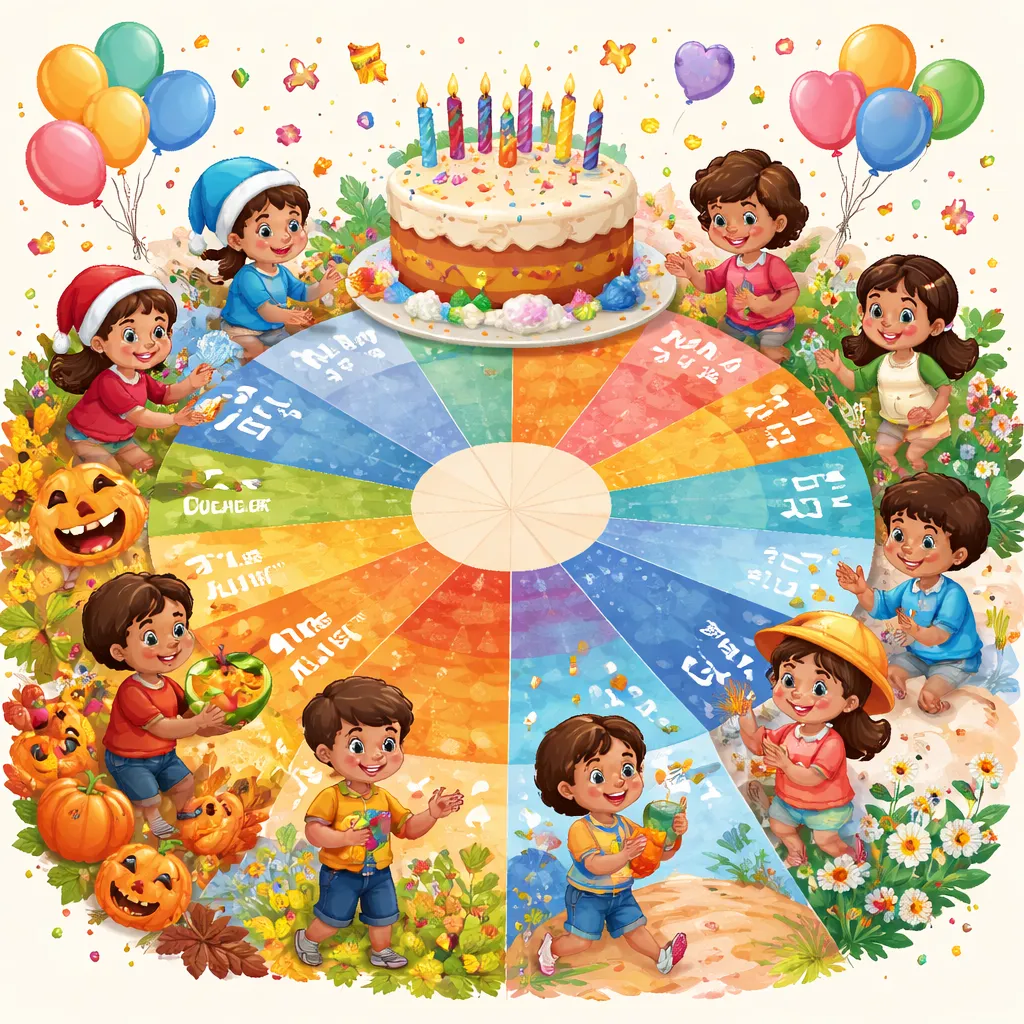
Some months have different numbers of days. January has 31 days. February is the shortest, with 28 or 29 days. March has 31. April has 30. The rhyme "Thirty days hath September, April, June, and November. All the rest have thirty-one, except February alone..." helps us remember. But for now, just knowing the twelve names and linking them to birthdays is perfect. Think of the year as a big circle. January starts the circle. December ends it. Then the circle begins again with a new January. And your birthday comes around every time the circle reaches your special month. This is the magic of the months of the year and birthdays.
Fun Interactive Learning
The best way to learn the months is with a song! Songs make the order stick. Let's sing to the tune of "Ten Little Indians." It's easy and repetitive.
January, February, March, and April! May, June, July, and August! September, October, November, December! These are the months of the year!
Sing it a few times. Clap your hands. Try to sing it faster. See if you can sing it without looking. This song is a super tool for months of the year and birthdays learning. Now, let's do a birthday activity. Make a "Family Birthday Chart." Take a big piece of paper. Write the twelve months at the top. Ask your family: "In which month is your birthday?" Write their name under the correct month. Draw a small cake next to it. Do the same for your friends. Hang your chart on the wall. Now you have a visual map of months of the year and birthdays. This is a fun and personal way to learn.
Another game is "Month Line-Up." Write each month name on a separate card. Mix them up. Now, try to put them in the correct order on the floor, from January to December. Time yourself. Can you do it faster each time? You can also play "Before and After." Someone says a month. You say the month that comes before it and the month that comes after. "June!" "Before is May. After is July." This cements the sequence in your mind.
Expanded Learning
The names of the months come from ancient Rome. Some are named after gods and emperors. January is for Janus, the god of doors. July is for Julius Caesar. August is for Emperor Augustus. Others are named for numbers. September comes from "septem," meaning seven, because it was the seventh month in the old Roman calendar. Our months of the year and birthdays have a long history! Different cultures have different calendars, but many use this same system today.
Birthdays are celebrated differently around the world. In Mexico, they have a pi?ata. In Vietnam, everyone's birthday is celebrated on Tet, the New Year. But the idea of marking the day you were born is common everywhere. When you learn the months of the year and birthdays, you are learning a global concept. Knowing the months also helps you understand seasons. December, January, February are winter months in the north. June, July, August are summer. Your birthday might be in a sunny month or a snowy one! Let's make a months chant. Chants are rhythmic and fun.
January, February, March, and April, flowers start to wake, you will feel! May and June and sunny July, with birthdays reaching to the sky! August, September, October, fall, we celebrate birthdays, one and all! November, December, the year is done, but birthday fun has just begun! Twelve months in a year, it's true, a special one for me and you!
What You Will Learn
You are learning about the calendar, time, and personal history. You are learning the twelve months of the year and birthdays vocabulary: January, February, March, April, May, June, July, August, September, October, November, December. You are also learning words like birthday, anniversary, celebrate, calendar, and season.
You are learning to talk about time and personal events. You can say, "My birthday is in November." You can ask, "In which month is your birthday?" You can state, "Christmas is in December." You are using English to share important personal information and to understand the yearly cycle. This builds conversational skills and time awareness.
You are building essential organizational skills. You are building sequential memory. You learn the fixed order of the months. You are building personal connection. You link abstract months to meaningful events. You are building planning skills. You can look forward to future birthdays and holidays. You are building cultural literacy. You understand the origins of month names. You are building a sense of time. You grasp the concept of a year.
You are forming an organized and celebratory habit. The habit of marking time and honoring special days. You see the year not as a blank space, but as a series of months, each with its own character and potential for joy. Mastering the months of the year and birthdays gives you a framework for your memories and your future plans.
Using What You Learned in Life
Use your knowledge every day. In the morning, look at a calendar. Say, "Today is April 10th." When you meet a new friend, ask, "When is your birthday?" Remember the month. Add it to your birthday chart. Help your family plan birthday parties. "Grandpa's birthday is in September. Let's think of a gift." Use a real calendar to mark all the birthdays with stickers. This is a practical use of months of the year and birthdays.
At school, you can be the one who knows what month it is. You can learn the birthdays of your classmates. You could even make a class birthday poster. When you read history, you will see months mentioned. "The Pilgrims landed in November." Understanding months helps in all subjects. The more you use the names of the months, the more they will be a natural part of your language. You are becoming the historian of your own life.
Closing Encouragement
You are a calendar reader. You are a birthday tracker. You are a joyful and timely learner. I am so proud of you. Learning the months of the year and linking them to birthdays shows you have a mind for order and a heart for celebration.
May your year be filled with the happy anticipation of birthdays and the steady rhythm of the passing months. Remember, every month holds the possibility of cake, candles, and joy〞especially in yours. You are learning the language of the year, and that is a language of cycles and celebrations.
You are knowledgeable, you are connected, and you are ready to celebrate every turn of the calendar. Great work, my wonderful time celebrant.