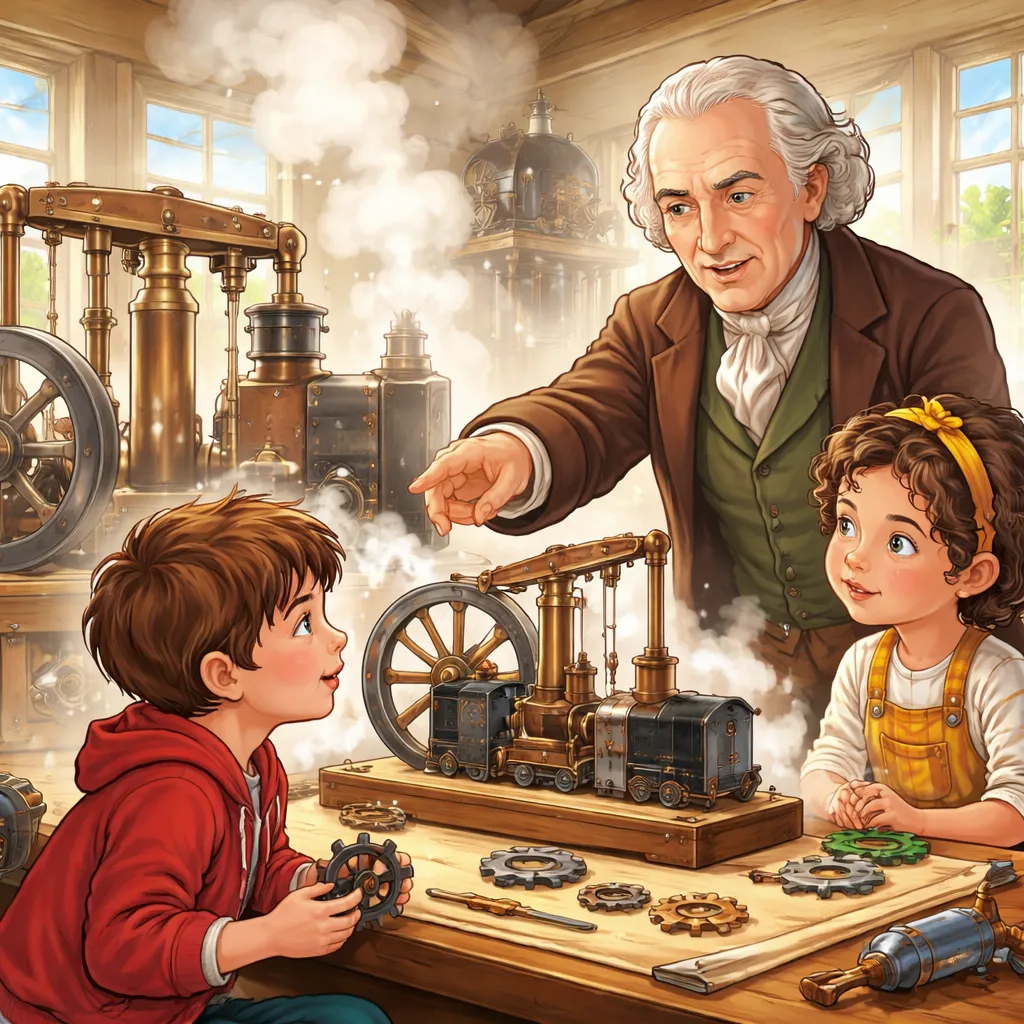

Introduction to James Watt
James Watt was a Scottish inventor, engineer, and chemist. He improved the steam engine more than anyone else. This celebrity story: James Watt shows how careful observation can spark a revolution. Watt did not invent the first steam engine. He made it work better, faster, and cheaper. Children can learn that small improvements sometimes matter more than big ideas. Parents can use his story to teach patience and precision. Watt's name lives on in the word "watt," the unit of electrical power. His engines powered factories, trains, and ships. They changed how people lived and worked. His life proves that a quiet mind that notices small problems can move the whole world.
Early Life and Background
James Watt was born on January 19, 1736, in Greenock, Scotland. His father, also named James Watt, was a shipwright and merchant. His mother, Agnes Muirhead, came from a well-educated family. Young James was often sick as a child. He could not attend school regularly. His mother taught him at home. He loved to take apart and fix things. He drew pictures of ships and machines. He also loved mathematics. At age 17, Watt moved to Glasgow to learn instrument making. He walked the 40 miles because he had little money. He found a job in London learning to make mathematical instruments. The work was hard. He stayed for one year. He returned to Scotland and opened a workshop at the University of Glasgow. He made and repaired rulers, scales, and telescopes. The university gave him a small room. Professors became his friends. One professor, Joseph Black, taught Watt about heat and steam. Watt listened carefully. He also read every book he could find about mechanics. His health remained weak, but his mind stayed sharp.
Career Highlights and Achievements
Watt's great breakthrough came from fixing a small problem. In 1763, he received a Newcomen steam engine to repair. The Newcomen engine was 50 years old. It pumped water out of coal mines. But it wasted huge amounts of fuel. Watt saw that the engine heated and cooled the same cylinder over and over. That wasted energy. In 1765, Watt had his flash of insight. He was walking through a Glasgow park on a Sunday afternoon. He realized that steam needed a separate place to cool. He added a separate condenser. This single change made the engine four times more efficient. Watt spent years testing and building. He partnered with Matthew Boulton, a factory owner from Birmingham. Boulton had money and skill. Together they built the Boulton & Watt steam engine. They sold engines for mines, mills, and factories. Watt also invented the double-acting engine, the centrifugal governor, and the pressure gauge. He retired a wealthy man in 1800. The University of Glasgow made him a doctor of laws. He became a member of the Royal Society of London.
Famous Works or Performances
James Watt's most famous work is the separate condenser steam engine. But he created many other inventions. The rotary engine, patented in 1781, turned back-and-forth motion into circular motion. This let steam engines power factory machines and wheels. The sun-and-planet gear system, invented in 1781, did the same job without a crankshaft. That design avoided an existing patent. The centrifugal governor, invented in 1788, controlled engine speed automatically. It used spinning balls to open or close a valve. This made engines safe and steady. The pressure gauge, or steam indicator, showed pressure inside the cylinder. This helped engineers measure and improve performance. Watt also invented a copying press for letters. He loved making precise drawings. His workshop still exists in Birmingham, England. Visitors can see his tools and models. The Science Museum in London holds his original steam engine designs. These works look simple today. But in the 1770s, they seemed like magic.
Personal Life and Fun Facts
James Watt had many interesting personal habits. He suffered from severe headaches and toothaches his whole life. He often worked in bed. He would draw plans on paper while lying down. A fun fact is that Watt hated public speaking. He preferred to write letters. He wrote thousands of letters to Boulton and others. Another fun fact is that Watt loved to experiment with chemistry. He once tried to make his own ink. He also tried to turn old rags into paper. He invented a machine to copy sculptures. Watt was very tidy. He kept his workshop spotless. He labeled every tool and part. He also loved to fish. He would sit by a river for hours, thinking about engine problems. Watt married his cousin, Margaret Miller, in 1764. She died in childbirth in 1772. He later married Ann MacGregor in 1776. She helped raise his two children from the first marriage. They had two more children together. Watt's son, also named James Watt, continued his father's engineering work. The family remained close. Watt also loved to read poetry and history. He spoke French and some German.
Legacy and Influence
James Watt changed the world more than most kings or generals. His efficient steam engine started the Industrial Revolution. Factories no longer needed to sit next to rivers for water power. They could build anywhere. Trains used Watt's engines to carry goods and people across continents. Ships used his engines to cross oceans in days instead of months. Coal mines became safer and more productive. Textile mills, iron forges, and flour mills all used Watt's designs. The word "watt" became the international unit of power. Light bulbs, computers, and toasters all use watts. The James Watt International Gold Medal rewards engineers who make great contributions. Statues of Watt stand in London, Manchester, and Birmingham. His old workshop is preserved as a museum. The University of Glasgow named a building after him. Many schools and streets bear his name. Watt's portrait appears on the British £50 banknote. His influence reaches every child who flips a light switch. Every engine that starts with a key. Every train that pulls into a station. Watt took a slow, wasteful machine and made it fast and useful. That is the power of paying attention to details.
Quotes or Famous Sayings
James Watt spoke few public words. But his private letters contain many wise thoughts. One famous line from his writing is, "I have no desire to make money from my inventions. My desire is to be useful to the world." Another quote is, "It is not enough to invent. You must also persuade people to use your invention." He also wrote, "Every great discovery is the result of many small observations." Children might like this one: "A good idea is nothing without hard work to back it up." Families can read these quotes together. Ask children, "What small observation have you made today?" Parents can help children see that Watt's genius came from looking closely. He did not just see a broken engine. He saw why it broke. That skill matters in school, sports, and art. Writing a good story requires small observations. Solving a math problem requires careful steps. Watt's words remind us that greatness grows from tiny details.
How to Learn from James Watt
Children can learn several lessons from James Watt. First, look for problems. Watt saw that the Newcomen engine wasted energy. He did not ignore it. Second, think about one small fix. A separate condenser seems simple. But it changed everything. Third, test your ideas patiently. Watt spent years improving his engine. He did not rush. Parents can encourage young children to find small problems at home. A drawer that sticks. A toy that breaks the same way each time. Ask, "What is one small change that could fix this?" Older children can build simple model engines. Many science kits have small steam or Stirling engines. They show Watt's principles in action. Families can also visit a train museum or old factory. Look for the steam engines. Count how many parts Watt invented. Another activity is to measure watts. Look at light bulbs at home. A 60-watt bulb uses 60 watts of power. A 100-watt bulb uses 100 watts. Ask children why some bulbs use more power. Watt's name is everywhere. In every light bulb, every engine, every power bill. His story teaches that you do not need to be loud or famous. You need to see what others miss. Then work quietly until you fix it. That is real power.