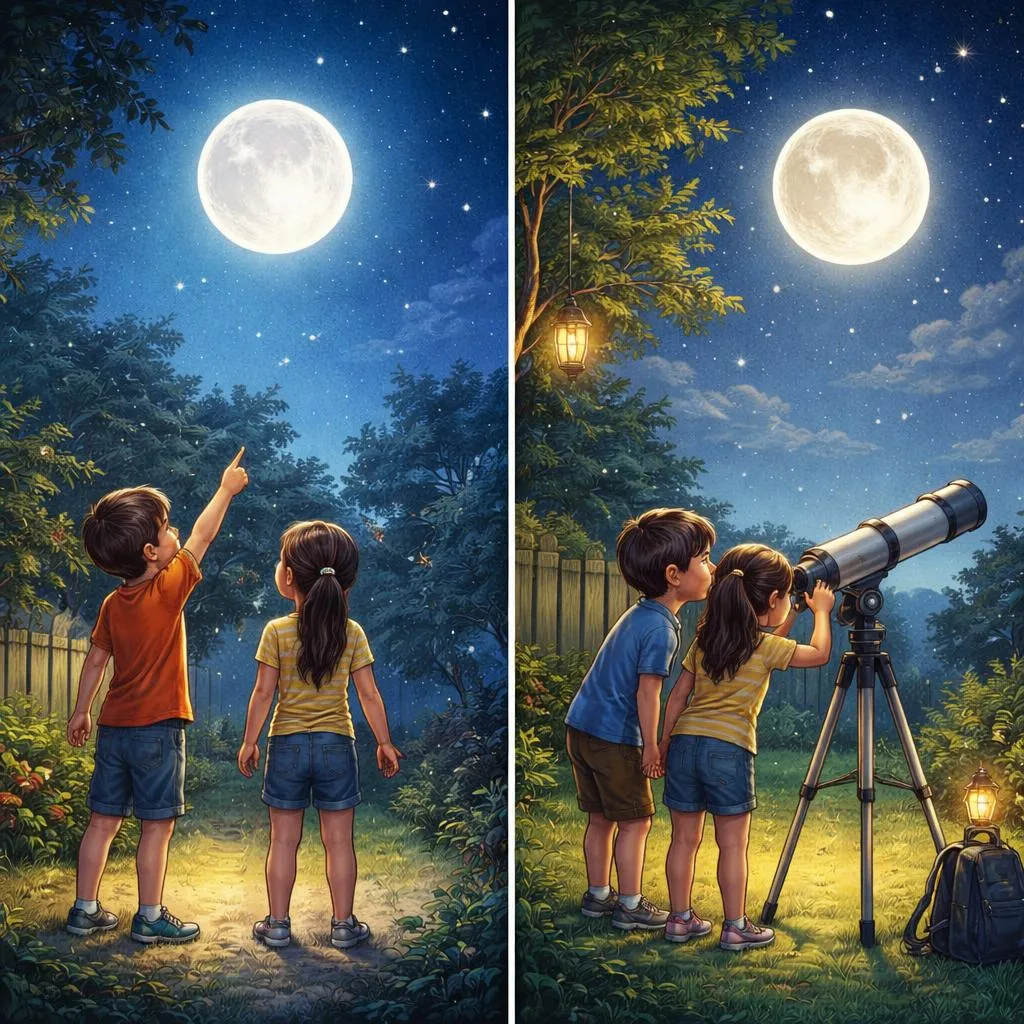

What Do These Expressions Mean? “See the moon” and “view the moon” both mean to look at Earth’s satellite in the night sky. They tell a child to observe the glowing circle in the heavens. Children hear these words on full moons, during camping, or in science class. Both inspire curiosity.
“See the moon” means to look up and notice the moon with your own eyes. It is simple and direct. A parent says it when the moon is bright. It is everyday language.
“View the moon” means to observe the moon, often with a telescope or binoculars. It sounds more deliberate and scientific. A parent might say it at an observatory. It feels more formal.
These expressions seem similar. Both mean “look at the moon.” Both inspire awe. But one is for naked-eye looking while one is for tool-aided observation.
What's the Difference? One is for casual, naked-eye looking. One is for deliberate, often tool-aided observation. “See the moon” is for looking out the window or walking at night. It is simple and accessible. Any child can do it.
“View the moon” is for when you use a telescope, binoculars, or a careful study. You view the craters. You view the seas. It is more specific and scientific. It is a stronger word.
Think of a child looking at a full moon. “See the moon” is right. A child looking through a telescope at the moon’s craters. “View the moon” fits better. One is for eyes alone. One is for tools.
One is for everyday. The other is for scientific observation. “See the moon” for a crescent. “View the moon” for an astronomy lesson. Use the first for casual. Use the second for deliberate.
Also, “view” can sound like a planned activity. “See” is spontaneous. Choose the word for the moment.
When Do We Use Each One? Use “see the moon” for casual, naked-eye moon watching. Use it from a window, car, or on a walk. Use it for quick looks. It fits everyday wonder.
Examples at home: “Let’s see the moon through the window.” “Can you see the moon? It’s almost full.” “I see the moon shining bright.”
Use “view the moon” for deliberate observation, often with tools. Use it for telescopes, binoculars, or science lessons. Use it for studying craters and phases. It fits scientific talk.
Examples for tools: “We can view the moon’s craters with this telescope.” “At the observatory, we will view the moon through a large lens.” “Let’s view the moon and look for the dark seas.”
Children can use both. “See the moon” for casual. “View the moon” for tool-aided. Both are beautiful.
Example Sentences for Kids See the moon: “See the moon? It’s shaped like a banana.” “Let’s see the moon before we go to bed.” “I see the moon in the sky.”
View the moon: “We will view the moon through the telescope.” “The astronomer helps us view the moon.” “Binoculars let you view the moon closer.”
Notice “see the moon” is for eyes alone. “View the moon” is for careful or tool-aided looking. Children learn both. One for wonder. One for science.
Parents can use both. A clear night: “let’s see the moon.” With a telescope: “let’s view the moon.” Children learn different moon watching words.
Common Mistakes to Avoid Some children say “view the moon” for a quick glance. That sounds too formal. A quick look is seeing, not viewing. Save “view” for when you take time or use tools.
Wrong: “Let’s view the moon for a second.” Better: “Let’s see the moon for a second.”
Another mistake: using “see” for a detailed observation. If you are using a telescope and studying craters, “view” is better. “See” is fine but less precise. Use “view” for detail.
Wrong: “I saw the craters.” (okay) Better: “I viewed the craters through the telescope.”
Some learners think “view” is only for adults. Children can view the moon too. But “see” is simpler and more common for kids. Teach both for vocabulary.
Also avoid saying “see the moon” when it is daytime. If the moon is not visible, say “the moon is not out yet.” Be honest.
Easy Memory Tips Think of “see the moon” as two eyes looking up. Eyes alone. Simple. For casual wonder.
Think of “view the moon” as a telescope tube. Lens. Focus. Detail. For scientific observation.
Another trick: remember the tools. “See” = naked eye. “View” = telescope or binoculars. Naked eye gets “see.” Tools get “view.”
Parents can say: “See with a glance. View for a science chance.”
Practice at home. Night sky: “see the moon.” With binoculars: “view the moon.”
Quick Practice Time Let us try a small exercise. Choose the better phrase for each situation.
A child looks out the window and notices the moon is full. a) “View the moon.” b) “See the moon.”
A child is at a science museum looking at the moon through a powerful telescope. a) “See the moon.” b) “View the moon.”
Answers: 1 – b. A casual glance from a window fits “see the moon.” 2 – b. A deliberate, tool-aided observation fits “view the moon.”
Fill in the blank: “When I walk home at night and the moon is out, I ______.” (“See the moon” is the casual, simple, everyday choice.)
One more: “When I use a telescope to look at the moon’s craters, I ______.” (“View the moon” fits the tool-aided, careful, scientific description.)
The moon is a constant friend. “See the moon” shares its light directly. “View the moon” explores its surface. Teach your child both. A child who learns both will love the moon for a lifetime.
Wrap-up “See the moon” is for casual, naked-eye moon watching, looking out a window or on a walk. “View the moon” is for deliberate, often tool-aided observation, like using a telescope or binoculars. Use “see the moon” for everyday wonder and quick glances. Use “view the moon” for astronomy lessons, observatories, and detailed study of craters. Both phrases celebrate Earth’s satellite. A child who learns both will see the moon with awe and view it with curiosity.