

Once there was a shepherd boy who lived in a quiet village at the foot of the hills. Every morning, he led his flock of sheep to the grassy meadows outside the village. The sun was warm, the sky was blue, and the sheep peacefully grazed.
At first, the boy enjoyed his work. He watched the lambs run and jump, and he whistled to keep himself busy. But as days passed, he grew restless. Guarding sheep felt boring, and there was nobody to play with.

One afternoon, a mischievous thought came to him. “What if I pretend a wolf is coming?” he said to himself. “The villagers will come running, and I’ll have some fun!”
The boy climbed on a rock and shouted as loudly as he could, “Wolf! Wolf! A wolf is attacking the sheep!”

The villagers dropped their tools and rushed up the hill. They carried sticks and shouted, “Where is the wolf?” But when they arrived, they found only calm, grazing sheep. The boy laughed loudly and said, “I tricked you! There was no wolf at all!” The villagers shook their heads and warned him not to lie.

A few days later, the boy grew bored again. Once more, he cupped his hands and shouted, “Wolf! Wolf!” The villagers, though tired from being fooled before, still came to help. And once again, there was no wolf. The boy rolled on the grass laughing, but the villagers frowned. “If you keep lying, no one will believe you next time,” they said.

Then, one evening as the sun was setting, a real wolf crept out from the forest. Its eyes were bright and hungry, and it began to chase the sheep. Terrified, the boy shouted, “Wolf! Wolf! Please help me! A wolf is here for real!”
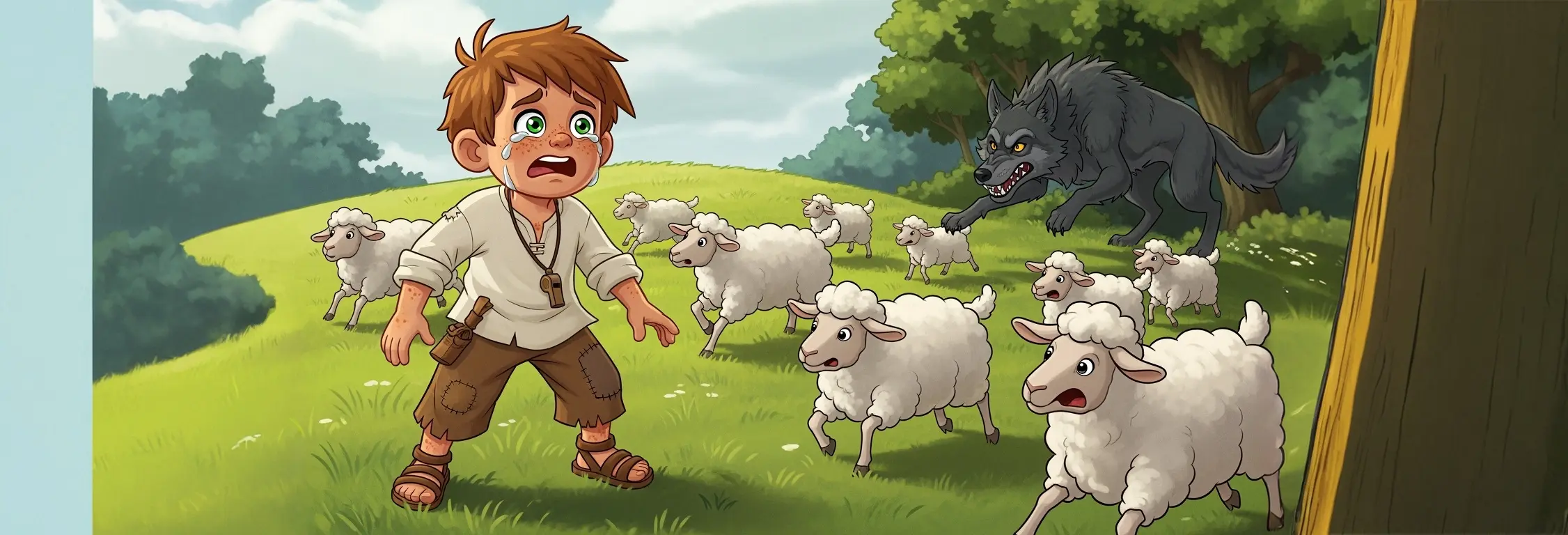
But this time, the villagers stayed in their homes. They thought, “It’s only another trick.” Nobody came. The wolf scattered the flock, and many sheep were lost.
The boy sat on the ground and cried. At last, he understood: if you lie too often, people will stop believing you, even when you tell the truth.
📖 Introduction
The Boy Who Cried Wolf is one of Aesop’s most famous fables.
It teaches children about honesty, trust, and the importance of telling the truth.
This timeless story has been passed down for centuries and is still told to kids all over the world.
🎯 Moral / Lesson
- Always tell the truth.
- If you lie too many times, people may not believe you when you are honest.
🏡 How to Use This Story
🎤 Activity 1: Read Aloud
- Read the story slowly and clearly, using different voices for the boy, the villagers, and the wolf.
- Pause at exciting moments (e.g., when the boy shouts “Wolf!”) to build suspense.
- Encourage children to repeat key lines, such as “Wolf! Wolf!”
❓ Activity 2: Ask Children
Guide children with open-ended questions to check understanding and spark discussion:
- “Why do you think the boy lied the first time?”
- “How did the villagers feel when they found out there was no wolf?”
- “What happened when the real wolf came?”
- “What lesson do you think the boy learned at the end?”
🎭 Activity 3: Role-Play
- Assign roles: shepherd boy, villagers, sheep, and wolf.
- Let children act out the scenes with simple props (sticks as shepherd’s staff, a blanket for sheep).
- Encourage them to change their voices and facial expressions to show fear, anger, or laughter.
🎨 Activity 4: Creative Expression
- Drawing: Ask children to draw the boy shouting from the hill or the wolf chasing the sheep.
- Writing: For older kids, let them write an ending where the boy regains the villagers’ trust.
- Craft: Create paper sheep or wolf masks to use in the role-play.
💡 Activity 5: Connect to Real Life
Help children apply the story to their daily experiences:
- “Have you ever told a lie? How did it feel?”
- “What happens if we don’t keep our promises?”
- “Why is it important that people can trust our words?”